1
RELATIONS AND FUNCTIONS
Click any topic to expand & view full definition / formula.
▶
Ordered Pair
A pair of elements listed in a specific order separated by comma and enclosing the pair in parenthesis is called an ordered pair.
For example, (a, b) is an ordered pair with a as the first element and b as the second element.
▶
Cartesian Product or Cross Product of sets A and B
The set of ordered pairs (a, b) such that a ∈ A, b ∈ B is called the cartesian product of A to B. The set of ordered pairs (b, a) such that a ∈ A, b ∈ B is called the cartesian product of B to A.
It is written as:
\[
\mathsf{A}\times \mathsf{B} = \{(a,b)\colon \mathsf{a}\in \mathsf{A}, b\in \mathsf{B}\}
\]
\[
\mathsf{B}\times \mathsf{A} = \{(b,a)\colon \mathsf{a}\in \mathsf{A}, b\in \mathsf{B}\}
\]
▶
Number of elements in A × B
▶
Relation from Set A to set B
▶
Relation on a Set
▶
Domain, Range and Codomain of Relation
▶
Empty Relation
▶
Universal Relation
▶
Trivial Relations
▶
Identity Relation
▶
Types of Relations
A relation on a non-empty set A is said to be
(i) Reflexive, if (a, a) ∈ R for all a ∈ A
(ii) Symmetric, if (a, b) ∈ R implies (b, a) ∈ R, for all a, b ∈ A
(iii) Transitive, if (a, b) ∈ R and (b, c) ∈ R implies (a, c) ∈ R, for all a, b, c ∈ A
▶
Equivalence Relation
▶
Equivalence Classes
Let R be an equivalence relation on a set A. The set of all those elements of A, which are related to a, where a ∈ A, is said equivalence class determined by a and is denoted by [a].
Given an arbitrary relation R on an arbitrary set A, R divides A into mutually disjoint subsets Ai, called partitions or subdivisions of A, satisfying the conditions:
(i) All elements of Ai are related to each other, for each i
(ii) No element of Aj is related to any element of Ai, for all i ≠ j
(iii) Ai ∩ Aj = ∅, for all i, j
▶
Function (Mapping)
▶
Domain, Codomain and Range of a Function
▶
Types of Functions
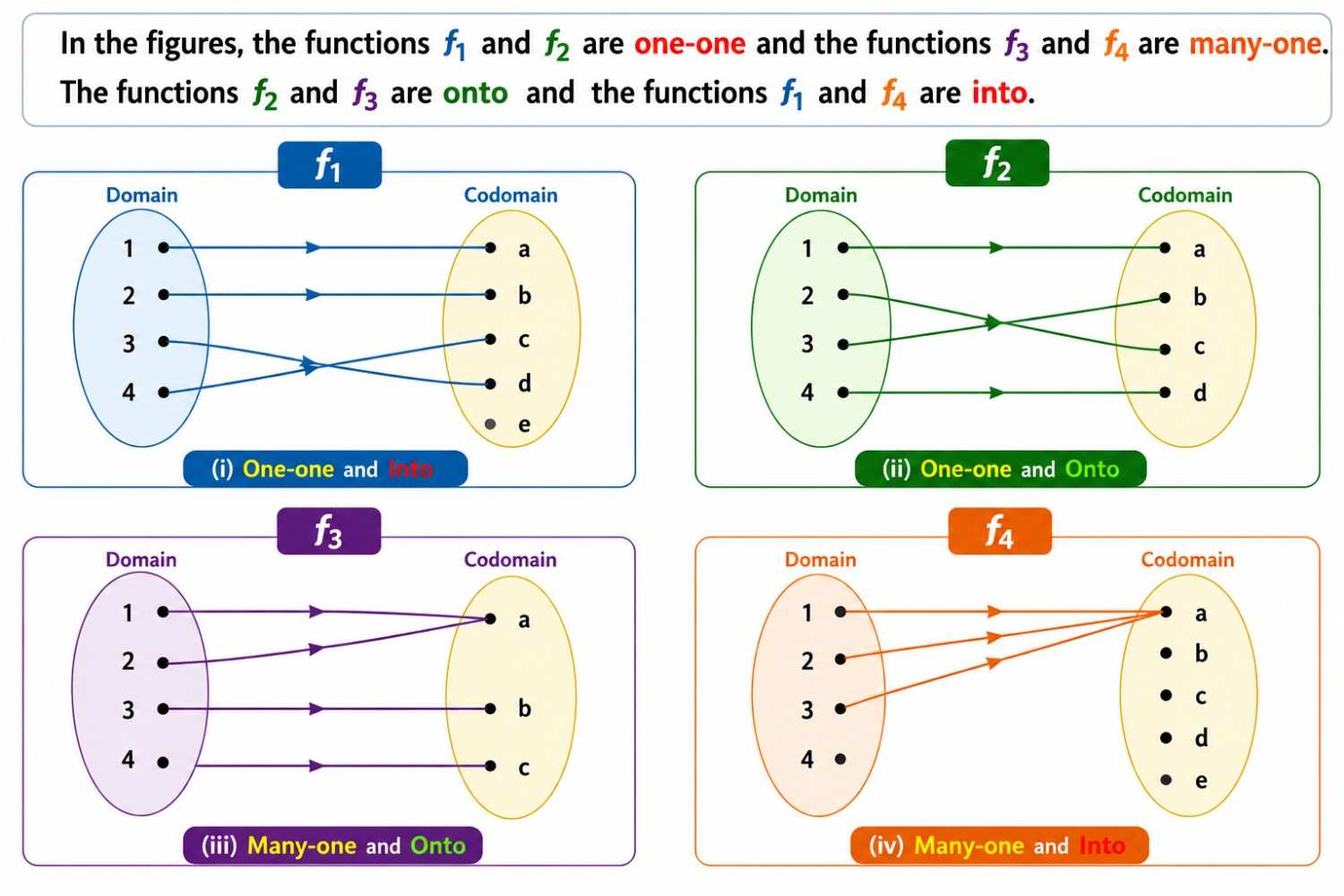
i.e., for every x1, x2 ∈ A, f(x1) = f(x2) implies x1 = x2Many-one function: A function f : A → B is called a many-one function, if there exist at least two distinct elements in A, whose images are same in B.Onto (or surjective function): A function f : A → B is said to be onto or surjective function, if every element of B is the image of some elements of A under f.
i.e., for every y ∈ B there exists an element x ∈ A such that f(x) = y
Into function: A function f : A → B is an into function, if there exists an element in B which have no preimage in A.
One-one and onto (or bijective function): A function f : A → B is said to be one-one and onto (or bijective function), if f is both one-one and onto.
In the figures, the functions f1 and f2 are one-one and the functions f3 and f4 are many-one. The functions f2 and f3 are onto and the functions f1 and f4 are into.
▶
Number of Relations from set A to set B
▶
Number of Reflexive Relations on a Set
▶
Number of Symmetric Relations on a Set
▶
Number of Functions
The total number of functions from A to B = nm
▶
Number of Surjective Functions (Onto Functions)
The number of onto functions from A to B = nm – nC1(n-1)m + nC2(n-2)m – nC3(n-3)m + … – nCn-1