
📝 SECTION D
4 × 5 = 20 marks
📐 Pair of Linear Equations
Aarush bought 2 pencils and 3 chocolates for ₹11 and Tanish bought 1 pencil and 2 chocolates for ₹7 from the same shop. Represent this situation in the form of a pair of linear equations. Find the price of 1 pencil and 1 chocolate, graphically.
🔍 VIEW SOLUTION
✅ STEP-BY-STEP SOLUTION:
Step 1: Formulate equations
Let price of 1 pencil = ₹x, price of 1 chocolate = ₹y
Aarush: 2 pencils + 3 chocolates = ₹11 ⇒ \(2x + 3y = 11\) …(1)
Tanish: 1 pencil + 2 chocolates = ₹7 ⇒ \(x + 2y = 7\) …(2)
Step 2: Find points for equation (1): 2x + 3y = 11
When x = 1: 2(1) + 3y = 11 ⇒ 3y = 9 ⇒ y = 3 → point (1, 3)
When x = 4: 2(4) + 3y = 11 ⇒ 8 + 3y = 11 ⇒ 3y = 3 ⇒ y = 1 → point (4, 1)
When x = 7: 2(7) + 3y = 11 ⇒ 14 + 3y = 11 ⇒ 3y = -3 ⇒ y = -1 → point (7, -1)
Step 3: Find points for equation (2): x + 2y = 7
When x = 1: 1 + 2y = 7 ⇒ 2y = 6 ⇒ y = 3 → point (1, 3)
When x = 3: 3 + 2y = 7 ⇒ 2y = 4 ⇒ y = 2 → point (3, 2)
When x = 5: 5 + 2y = 7 ⇒ 2y = 2 ⇒ y = 1 → point (5, 1)
Step 4: Graphical representation
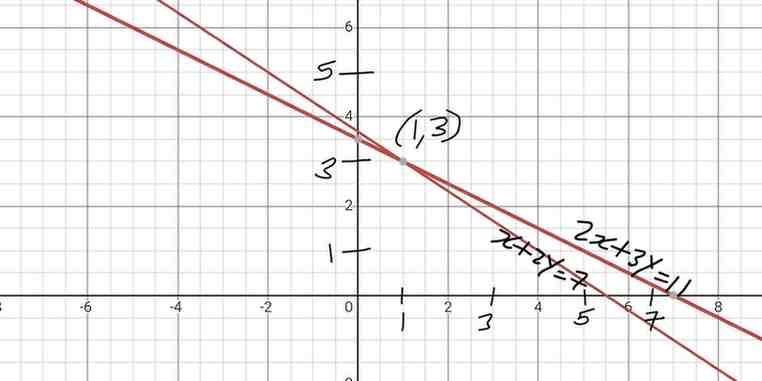
Graph of equations:
Plot points for equation (1): (1,3), (4,1), (7,-1) and draw line
Plot points for equation (2): (1,3), (3,2), (5,1) and draw line
Both lines intersect at point (1, 3)
Step 5: Find intersection point
From the graph, both lines intersect at (1, 3)
Therefore, x = 1, y = 3
Step 6: Verify
Equation (1): 2(1) + 3(3) = 2 + 9 = 11 ✓
Equation (2): 1 + 2(3) = 1 + 6 = 7 ✓
✅ Final Answer:
Price of 1 pencil = $${₹1}$$
Price of 1 chocolate = $${₹3}$$
💰 Quadratic Equations
(a) A person on a tour has ₹4,200 for expenses. If he extends his tour for 3 days, he has to cut down his daily expenses by ₹70. Find the original duration of the tour.
🔍 VIEW SOLUTION
✅ STEP-BY-STEP SOLUTION:
Step 1: Define variables
Let original duration of tour = x days
Original daily expense = $$\frac{4200}{x} rupees$$
Step 2: New conditions
New duration = (x + 3) days
New daily expense = $$\frac{4200}{x+3}$$ rupees
Given: New daily expense = Original daily expense – ₹70
Step 3: Form equation
$$\frac{4200}{x+3} = \frac{4200}{x} – 70$$
Step 4: Solve for x
Multiply throughout by x(x+3):
$$4200x = 4200(x+3) – 70x(x+3)$$
$$4200x $$
$$= 4200x + 12600 – 70x^2 – 210x$$
$$0 = 12600 – 70x^2 – 210x$$
$$70x^2 + 210x – 12600 = 0$$
Step 5: Simplify (divide by 70)
$$x^2 + 3x – 180 = 0$$
Step 6: Factorize
$$x^2 + 15x – 12x – 180 = 0$$
x(x + 15) – 12(x + 15) = 0
(x + 15)(x – 12) = 0
x = -15 or x = 12
Step 7: Select valid solution
x = -15 is not possible (days cannot be negative)
Therefore, x = 12 days
Step 8: Verify
Original: 12 days, daily expense = 4200/12 = ₹350
Extended: 15 days, daily expense = 4200/15 = ₹280
Reduction = 350 – 280 = ₹70 ✓
✅ Final Answer: Original duration of tour = $${12 \text{ days}}$$
📐 Quadratic Equations
(b) The area of a right-angled triangle is 600 cm². If the base of the triangle exceeds the altitude by 10 cm, find all the three dimensions of the triangle.
🔍 VIEW SOLUTION
✅ STEP-BY-STEP SOLUTION:
Step 1: Define variables
Let altitude = x cm
Base = (x + 10) cm (given: base exceeds altitude by 10 cm)
Step 2: Area formula for right triangle
Area $$= \frac{1}{2} \times \text{base} \times \text{height}$$
600 $$= \frac{1}{2} \times (x + 10) \times x$$
Step 3: Form equation
1200 = x(x + 10)
$$x^2 + 10x – 1200 = 0$$
Step 4: Solve quadratic
Using factorization: $$x^2 + 40x – 30x – 1200 = 0$$
x(x + 40) – 30(x + 40) = 0
(x + 40)(x – 30) = 0
x = -40 or x = 30
Step 5: Select valid solution
x = -40 not possible (length cannot be negative)
Therefore, altitude = 30 cm
Base = 30 + 10 = 40 cm
Step 6: Find hypotenuse (Pythagoras theorem)
Hypotenuse = $$\sqrt{(\text{base})^2 + (\text{altitude})^2}$$
= $$\sqrt{40^2 + 30^2} $$
=$$ \sqrt{1600 + 900} $$
=$$\sqrt{2500} = 50 cm$$
✅ Final Answer:
Altitude = $${30 \text{ cm}}$$
Base = $${40 \text{ cm}}$$
Hypotenuse = $${50 \text{ cm}}$$
🔺 Triangles (BPT)
(a) Prove that if a line is drawn parallel to one side of a triangle to intersect the other two sides in distinct points, then the other two sides are divided in the same ratio.
🔍 VIEW PROOF
✅ BASIC PROPORTIONALITY THEOREM (THALES THEOREM):
Statement: If a line is drawn parallel to one side of a triangle intersecting the other two sides, then it divides the two sides in the same ratio.
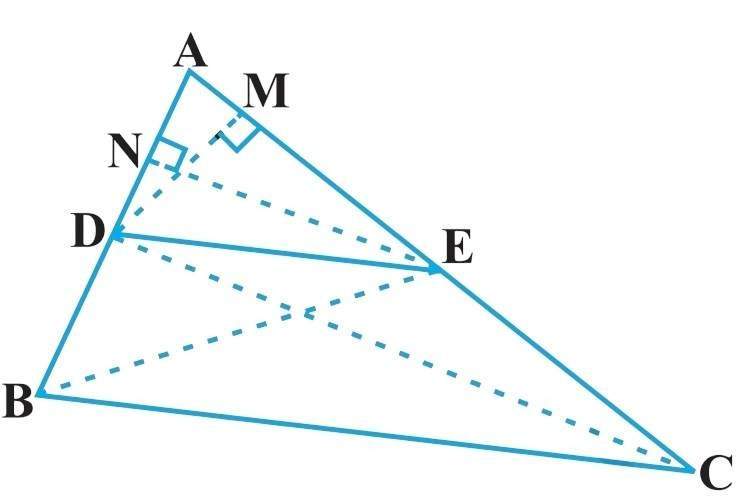
Given: In ΔABC, line DE ∥ BC, intersecting AB at D and AC at E.
To prove: $$\frac{AD}{DB} = \frac{AE}{EC}$$
Construction: Join BE and CD. Draw DM ⟂ AC and EN ⟂ AB.
Proof:
Step 1: Consider triangles ADE and BDE.
Area of ΔADE = \(\frac{1}{2} \times AD \times EN\)(taking AD as base, EN as height)
Area of ΔBDE = \(\frac{1}{2} \times DB \times EN\) (taking DB as base, EN as height)
\(\frac{ar(ADE)}{ar(BDE)}
= \frac{\frac{1}{2} \times AD \times EN}{\frac{1}{2} \times DB \times EN}
= \frac{AD}{DB}\) …(1)
Step 2: Consider triangles ADE and CDE.
Area of ΔADE = $$\frac{1}{2} \times AE \times DM$$ (taking AE as base, DM as height)
Area of ΔCDE = $$\frac{1}{2} \times EC \times DM$$ (taking EC as base, DM as height)
$$\frac{ar(ADE)}{ar(CDE)}$$
$$= \frac{\frac{1}{2} \times AE \times DM}{\frac{1}{2} \times EC \times DM} $$
$$= \frac{AE}{EC}$$ …(2)
Step 3: Observe that triangles BDE and CDE are on the same base DE and between the same parallels DE and BC.
Therefore, ar(BDE) = ar(CDE) …(3)
Step 4: From (1) and (2):
$$\frac{AD}{DB}$$
=$$ \frac{ar(ADE)}{ar(BDE)} and \frac{AE}{EC}$$
= $$\frac{ar(ADE)}{ar(CDE)}$$
Step 5: Using (3), since ar(BDE) = ar(CDE), we get:
$$\frac{AD}{DB} = \frac{AE}{EC}$$
✅ Hence proved: $${\frac{AD}{DB} = \frac{AE}{EC}}$$
📐 Similar Triangles
(b) As shown in the given figure, a girl of height 90 cm is walking away from the base of a lamp post at a speed of 1.2 m/s. If the lamp is 3.6 m above the ground, find the length of her shadow after 4 seconds.
🔍 VIEW SOLUTION
✅ STEP-BY-STEP SOLUTION:
Step 1: Convert units to same system
Girl’s height = 90 cm = 0.9 m
Lamp height = 3.6 m
Speed = 1.2 m/s
Time = 4 seconds
Step 2: Find distance walked in 4 seconds
Distance = Speed × Time = 1.2 × 4 = 4.8 m
After 4 seconds, girl is 4.8 m away from base of lamp post.
Step 3: Use similar triangles
Let length of shadow = x metres
In the figure, two similar triangles are formed:
· Large triangle: lamp post (height 3.6 m) and total distance from lamp to end of shadow (4.8 + x)
· Small triangle: girl (height 0.9 m) and her shadow length (x)
Step 4: Apply similarity property
$$\frac{\text{Lamp height}}{\text{Girl height}} $$
= $$\frac{\text{Total distance}}{\text{Shadow length}}$$
$$\frac{3.6}{0.9}$$
=$$ \frac{4.8 + x}{x}$$
Step 5: Solve for x
$$\frac{3.6}{0.9} = 4$$
4 = $$\frac{4.8 + x}{x}$$
4x = 4.8 + x
4x – x = 4.8
3x = 4.8
x = 1.6 m
✅ Final Answer: Length of shadow after 4 seconds = $${1.6 \text{ m}}$$ or $${160 \text{ cm}}$$
📊 Statistics
An SBI health insurance agent found the following data for distribution of ages of 100 policy holders. The health insurance policies are given to persons of age 15 years and onwards, but less than 60 years. Find the modal age and median age of the policy holders.
🔍 VIEW SOLUTION
✅ STEP-BY-STEP SOLUTION:
PART A: FINDING MODAL AGE
Step 1: Identify modal class
Modal class is the class with highest frequency.
Highest frequency = 33 in class 35 – 40
So modal class = 35 – 40
Step 2: Note the values
Lower limit of modal class (l) = 35
Class size (h) = 5
Frequency of modal class (f₁) = 33
Frequency of class preceding modal class (f₀) = 21 (class 30-35)
Frequency of class succeeding modal class (f₂) = 11 (class 40-45)
Step 3: Apply mode formula
$$Mode = l + \frac{f₁ – f₀}{2f₁ – f₀ – f₂} \times h$$
$$= 35 + \frac{33 – 21}{2(33) – 21 – 11} \times 5$$
$$= 35 + \frac{12}{66 – 32} \times 5$$
$$= 35 + \frac{12}{34} \times 5$$
$$= 35 + \frac{60}{34}$$
= 35 + 1.7647…
$$= 36.7647… \approx 36.76 years$$
Modal age ≈ 36.76 years
PART B: FINDING MEDIAN AGE
Step 1: Create cumulative frequency table
| Class | Frequency (f) | Cumulative Frequency (cf) |
|---|---|---|
| 15-20 | 2 | 2 |
| 20-25 | 4 | 6 |
| 25-30 | 18 | 24 |
| 30-35 | 21 | 45 |
| 35-40 | 33 | 78 |
| 40-45 | 11 | 89 |
| 45-50 | 3 | 92 |
| 50-55 | 6 | 98 |
| 55-60 | 2 | 100 |
Step 2: Find median class
Total frequency (N) = 100
\(\frac{N}{2} = 50\)
Cumulative frequency just greater than 50 is 78, corresponding to class 35-40.
So median class = 35 – 40
Step 3: Note values for median formula
Lower limit of median class (l) = 35
Class size (h) = 5
Cumulative frequency of class preceding median class (cf) = 45
Frequency of median class (f) = 33
$$\frac{N}{2} = 50$$
Step 4: Apply median formula
$$Median = l + \frac{\frac{N}{2} – cf}{f} \times h$$
$$= 35 + \frac{50 – 45}{33} \times 5$$
$$= 35 + \frac{5}{33} \times 5$$
$$= 35 + \frac{25}{33}$$
$$= 35 + 0.7575…$$
$$= 35.7575… \approx 35.76 years$$
✅ Final Answer:
Modal age = $${36.76 \text{ years}}$$
Median age = $${35.76 \text{ years}}$$
📌 SECTION D COMPLETE · 4/4 SOLVED
solvedpapers.net | CBSE Class 10 Mathematics Standard
🏆 CBSE CLASS 10 MATHEMATICS (STANDARD) SET 1
✅ Section D (Q32-Q35) complete solutions · Step-by-step explanations · Easy methods