
📝 SECTION B
5 × 2 = 10 marks
If \(\alpha , \beta\) are the zeroes of the quadratic polynomial \(px^2 + qx + r\), then find the value of \(\alpha^3 \beta + \beta^3 \alpha\).
🔍 VIEW SOLUTION
✅ STEP-BY-STEP SOLUTION:
Step 1: For quadratic polynomial \(px^2 + qx + r\), Sum of zeroes: \(\alpha + \beta = -\frac{q}{p}\) Product of zeroes: \(\alpha \beta = \frac{r}{p}\)
Step 2: We need $$\alpha^3 \beta + \beta^3 \alpha$$ $$= \alpha \beta (\alpha^2 + \beta^2)$$ $$= \alpha \beta [(\alpha + \beta)^2 – 2\alpha \beta]$$
Step 3: Substitute the values: $$\alpha^3 \beta + \beta^3 \alpha = \frac{r}{p} \left[ \left(-\frac{q}{p}\right)^2 – 2\left(\frac{r}{p}\right) \right]$$ $$= \frac{r}{p} \left[ \frac{q^2}{p^2} – \frac{2r}{p} \right]$$ $$= \frac{r}{p} \left[ \frac{q^2 – 2pr}{p^2} \right]$$ $$= \frac{r(q^2 – 2pr)}{p^3}$$
✅ Final Answer: $${\frac{r(q^2 – 2pr)}{p^3}}$$
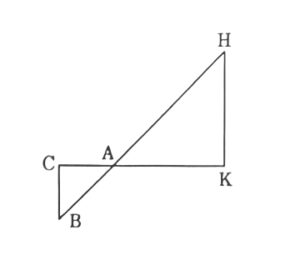
(a) In the given figure, \(\Delta \mathrm{AHK} \sim \Delta \mathrm{ABC}\). If \(\mathrm{AK} = 10 \mathrm{~cm}\), \(\mathrm{BC} = 3.5 \mathrm{~cm}\) and \(\mathrm{HK} = 7 \mathrm{~cm}\), find the length of \(\mathrm{AC}\).
🔍 VIEW SOLUTION
✅ STEP-BY-STEP SOLUTION:
Step 1: Given \(\Delta AHK \sim \Delta ABC\). When triangles are similar, corresponding sides are proportional. Since HK is parallel to BC, we have: \(\frac{AK}{AC} = \frac{HK}{BC}\)
Step 2: Substitute the given values: AK = 10 cm, HK = 7 cm, BC = 3.5 cm $$\frac{10}{AC} = \frac{7}{3.5}$$
Step 3: Simplify right side:$$ \frac{7}{3.5} = \frac{7}{7/2} = 7 \times \frac{2}{7} = 2$$ $$So, \frac{10}{AC} = 2$$
Step 4: Cross multiply:$$ 10 = 2 \times AC$$ $$AC = \frac{10}{2} = 5 cm$$ ✅ Final Answer: $${AC = 5 \text{ cm}}$$
(a) Prove that \(\frac{\tan \theta + \sin \theta}{\tan \theta – \sin \theta} = \frac{\sec \theta + 1}{\sec \theta – 1}\).
🔍 VIEW SOLUTION
✅ STEP-BY-STEP PROOF:
Step 1: Write \(\tan \theta = \frac{\sin \theta}{\cos \theta}\)
Step 2: $$LHS = \frac{\frac{\sin \theta}{\cos \theta} + \sin \theta}{\frac{\sin \theta}{\cos \theta} – \sin \theta}$$
Step 3: Take $$\sin \theta$$ common in numerator and denominator: $$= \frac{\sin \theta \left(\frac{1}{\cos \theta} + 1\right)}{\sin \theta \left(\frac{1}{\cos \theta} – 1\right)}$$
Step 4: Cancel $$\sin \theta (assuming \sin \theta \neq 0):$$ $$= \frac{\frac{1}{\cos \theta} + 1}{\frac{1}{\cos \theta} – 1}$$ Step 5: $$\frac{1}{\cos \theta} = \sec \theta$$ $$= \frac{\sec \theta + 1}{\sec \theta – 1} = RHS$$
✅ Hence proved: $${\frac{\tan \theta + \sin \theta}{\tan \theta – \sin \theta} = \frac{\sec \theta + 1}{\sec \theta – 1}}$$
(b) Simplify: \(\frac{\cos^2 45^\circ}{\sin^2 60^\circ} + \frac{\cos^2 60^\circ}{\sin^2 45^\circ} – \frac{\tan^2 30^\circ}{\cot^2 45^\circ} – \frac{\sin^2 30^\circ}{\cot^2 30^\circ}\)
🔍 VIEW SOLUTION
✅ STEP-BY-STEP SOLUTION:
Step 1: Recall standard values: \(\cos 45^\circ = \frac{1}{\sqrt{2}} \Rightarrow \cos^2 45^\circ = \frac{1}{2}\) \(\sin 60^\circ = \frac{\sqrt{3}}{2} \Rightarrow \sin^2 60^\circ = \frac{3}{4}\) \(\cos 60^\circ = \frac{1}{2} \Rightarrow \cos^2 60^\circ = \frac{1}{4}\) \(\sin 45^\circ = \frac{1}{\sqrt{2}} \Rightarrow \sin^2 45^\circ = \frac{1}{2}\) \(\tan 30^\circ = \frac{1}{\sqrt{3}} \Rightarrow \tan^2 30^\circ = \frac{1}{3}\) \(\cot 45^\circ = 1 \Rightarrow \cot^2 45^\circ = 1\) \(\sin 30^\circ = \frac{1}{2} \Rightarrow \sin^2 30^\circ = \frac{1}{4}\) \(\cot 30^\circ = \sqrt{3} \Rightarrow \cot^2 30^\circ = 3\)
Step 2: Substitute values: $$\frac{1/2}{3/4} + \frac{1/4}{1/2} – \frac{1/3}{1} – \frac{1/4}{3}$$
Step 3: Simplify each term: $$\frac{1}{2} \times \frac{4}{3} = \frac{4}{6} = \frac{2}{3}$$ $$\frac{1}{4} \times \frac{2}{1} = \frac{2}{4} = \frac{1}{2}$$ $$\frac{1/3}{1} = \frac{1}{3}$$ $$\frac{1/4}{3} = \frac{1}{4} \times \frac{1}{3} = \frac{1}{12}$$ Step 4: Combine: $$\frac{2}{3} + \frac{1}{2} – \frac{1}{3} – \frac{1}{12}$$ $$= \left(\frac{2}{3} – \frac{1}{3}\right) + \frac{1}{2} – \frac{1}{12}$$ $$= \frac{1}{3} + \frac{1}{2} – \frac{1}{12}$$ $$= \frac{4}{12} + \frac{6}{12} – \frac{1}{12} = \frac{9}{12} = \frac{3}{4}$$
✅ Final Answer: $${\frac{3}{4}}$$
A solid sphere of radius 6 cm is melted and recast into smaller solid spheres of radius 1 cm each. How many such spheres can be made?
🔍 VIEW SOLUTION
✅ STEP-BY-STEP SOLUTION:
Step 1: Volume of original sphere = \(\frac{4}{3}\pi R^3\) where \(R = 6\) cm \(V_{\text{large}} = \frac{4}{3}\pi (6)^3 \)\(= \frac{4}{3}\pi \times 216\)\( = 288\pi\) cm³
Step 2: Volume of each small sphere with radius r = 1 cm: $$V_{\text{small}} = \frac{4}{3}\pi (1)^3 = \frac{4}{3}\pi cm³$$ Step 3: Number of small spheres $$= \frac{V_{\text{large}}}{V_{\text{small}}}$$ $$= \frac{288\pi}{\frac{4}{3}\pi}$$ $$= 288 \times \frac{3}{4} = 72 \times 3 = 216$$
✅ Final Answer: $${216 \text{ spheres}}$$
Find the mean of the following frequency distribution:
| Class | Frequency |
|---|---|
| 0-10 | 5 |
| 10-20 | 8 |
| 20-30 | 12 |
| 30-40 | 10 |
| 40-50 | 5 |
🔍 VIEW SOLUTION
✅ STEP-BY-STEP SOLUTION:
Step 1: Find class marks (mid-points) for each class: Class mark \(x_i = \frac{\text{lower limit} + \text{upper limit}}{2}\)
Step 2: Create table with class marks and f_i x_i:
| Class | Frequency \(f_i\) | Class mark \(x_i\) | \(f_i x_i\) |
|---|---|---|---|
| 0-10 | 5 | 5 | 25 |
| 10-20 | 8 | 15 | 120 |
| 20-30 | 12 | 25 | 300 |
| 30-40 | 10 | 35 | 350 |
| 40-50 | 5 | 45 | 225 |
| Total | \(\sum f_i = 40\) | \(\sum f_i x_i\)\( = 1020\) |
Step 3: Mean = \(\frac{\sum f_i x_i}{\sum f_i} = \frac{1020}{40} = 25.5\)
✅ Final Answer: $${25.5}$$
📌 SECTION B COMPLETE · 5/5 SOLVED
solvedpapers.net | CBSE Class 10 Mathematics Standard
🏆 CBSE CLASS 10 MATHEMATICS (STANDARD) SET 1
✅ Section B (Q21-Q25) complete solutions · Step-by-step explanations · Easy methods