2
INVERSE TRIGONOMETRIC FUNCTIONS
Click any topic to expand & view full definition / formula.
▶
CBSE Syllabus
▶
Gist of topic Sine function and its inverse
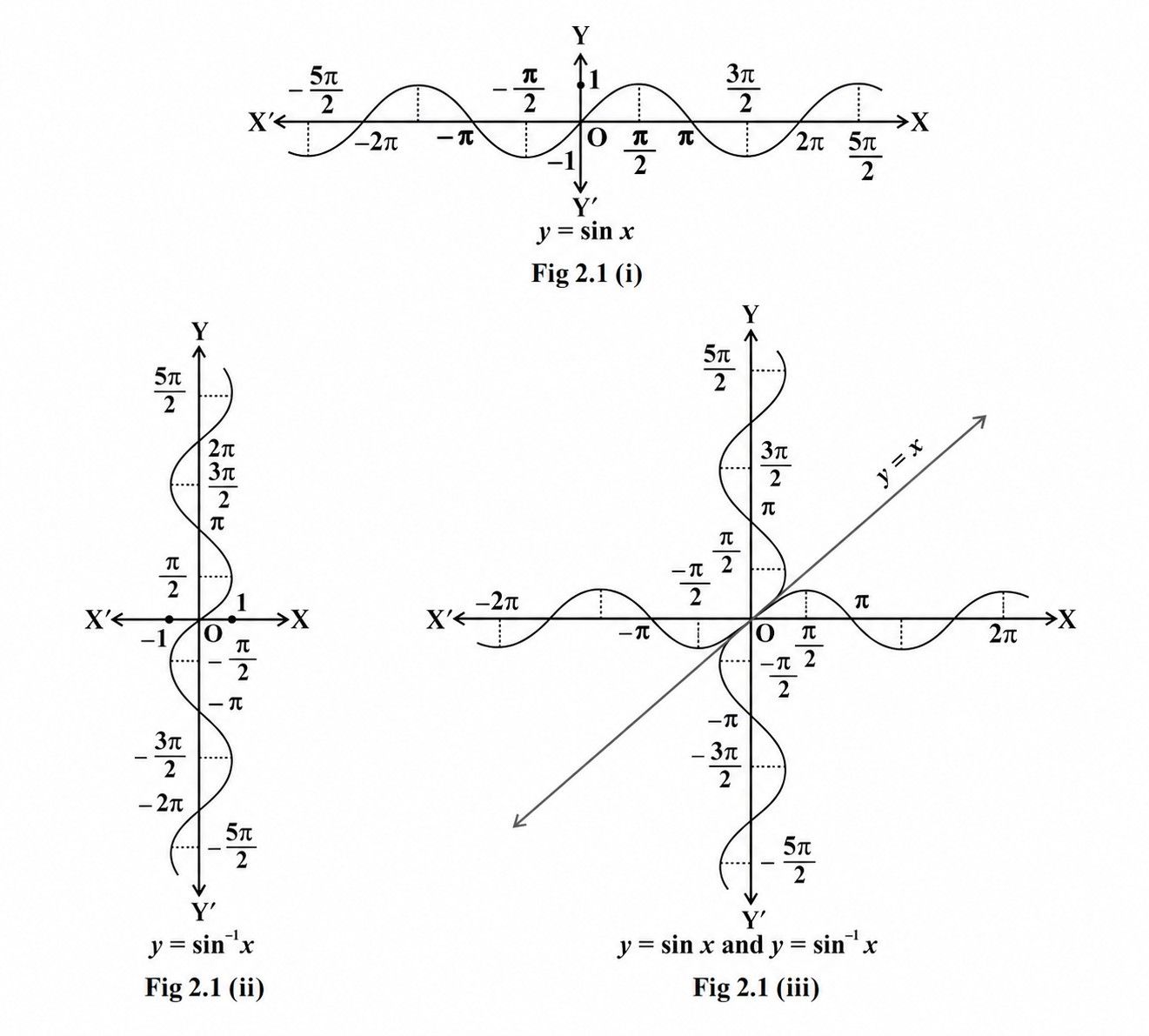
The domain of sine function is the set of all real numbers and range is the closed interval [-1, 1].
If we restrict its domain to \(\left[\frac{-\pi}{2},\frac{\pi}{2}\right]\), then it becomes one-one and onto with range [-1, 1].
Actually, sine function restricted to any of the intervals \(\left[\frac{-3\pi}{2},\frac{-\pi}{2}\right]\), \(\left[\frac{-\pi}{2},\frac{\pi}{2}\right]\), or \(\left[\frac{\pi}{2},\frac{3\pi}{2}\right]\), etc., is one-one and its range is [-1, 1].
Therefore, define the inverse of sine function in each of these intervals.
We denote the inverse of sine function by sin-1 (arc sine function).
Thus, sin-1 is a function whose domain is [-1, 1] and range could be any of the intervals \(\left[\frac{-3\pi}{2},\frac{-\pi}{2}\right]\), \(\left[\frac{-\pi}{2},\frac{\pi}{2}\right]\), or \(\left[\frac{\pi}{2},\frac{3\pi}{2}\right]\), … and so on. Corresponding to each such interval, we get a branch of the function sin-1. The branch with range \(\left[\frac{-\pi}{2},\frac{\pi}{2}\right]\) is called the principal value branch, whereas other intervals as range give different branches of sin-1. When we refer to the function sin-1, we take it as the function whose domain is [-1, 1] and range is \(\left[\frac{-\pi}{2},\frac{\pi}{2}\right]\).
▶
Cosine function & its inverse
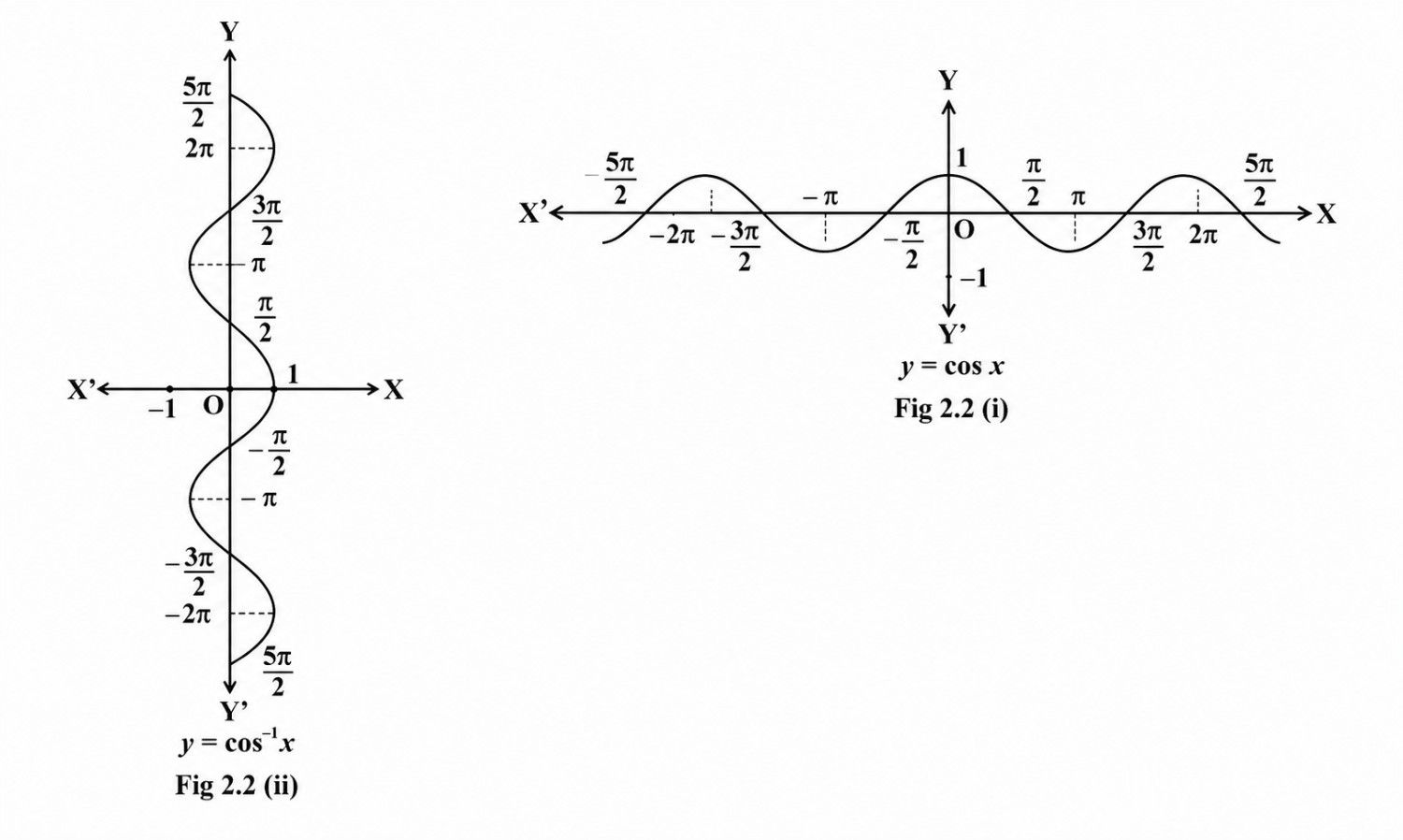
The cosine function is a function whose domain is the set of all real numbers and range is the set [-1, 1].
If we restrict the domain of cosine function to [0, π], then it becomes one-one and onto with range [-1, 1]. Actually, cosine function restricted to any of the intervals [-π, 0], [0, π], [π, 2π] etc., is bijective with range as [-1, 1].
We can, therefore, define the inverse of cosine function in each of these intervals. We denote the inverse of the cosine function by cos-1 (arc cosine function).
Thus, cos-1 is a function whose domain is [-1, 1] and range could be any of the intervals [-π, 0], [0, π], [π, 2π] etc. Corresponding to each such interval, we get a branch of the function cos-1. The branch with range [0, π] is called the principal value branch of the function cos-1.
▶
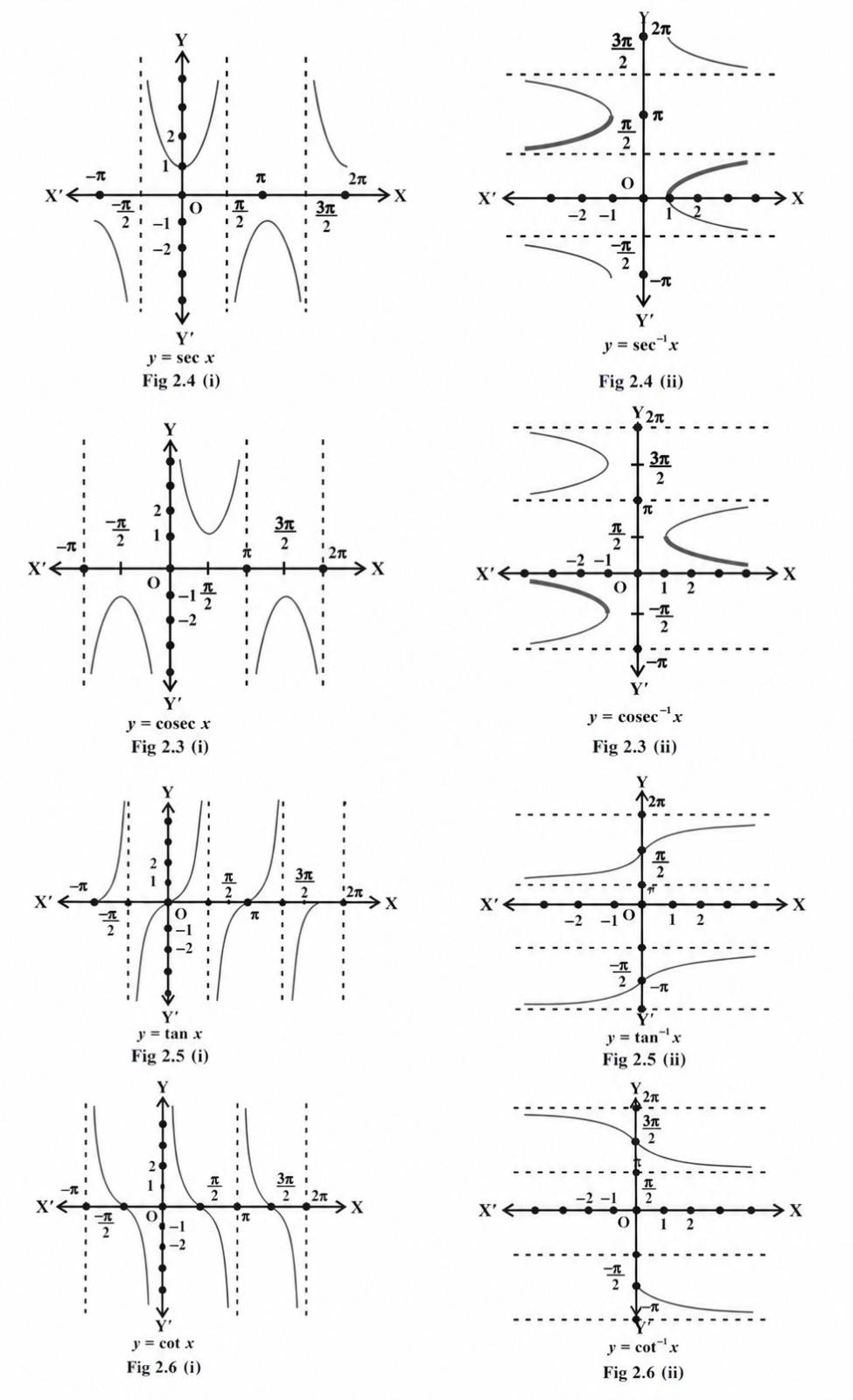
Tan, Cosec, Sec, Cot Functions and its inverse
▶
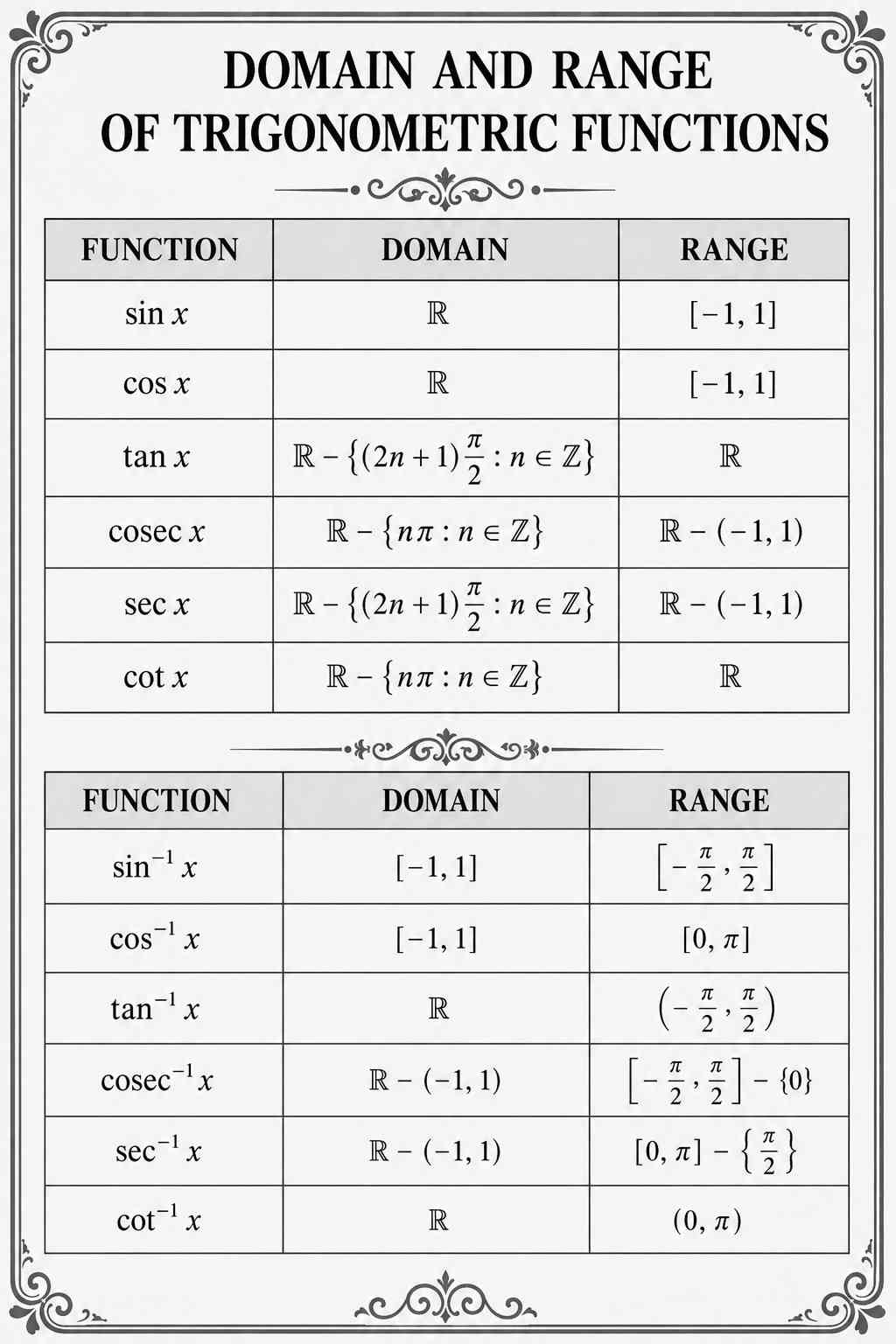
Table: Trigonometric Functions & Inverse Trigonometric Functions
▶
Sum and Difference formulae
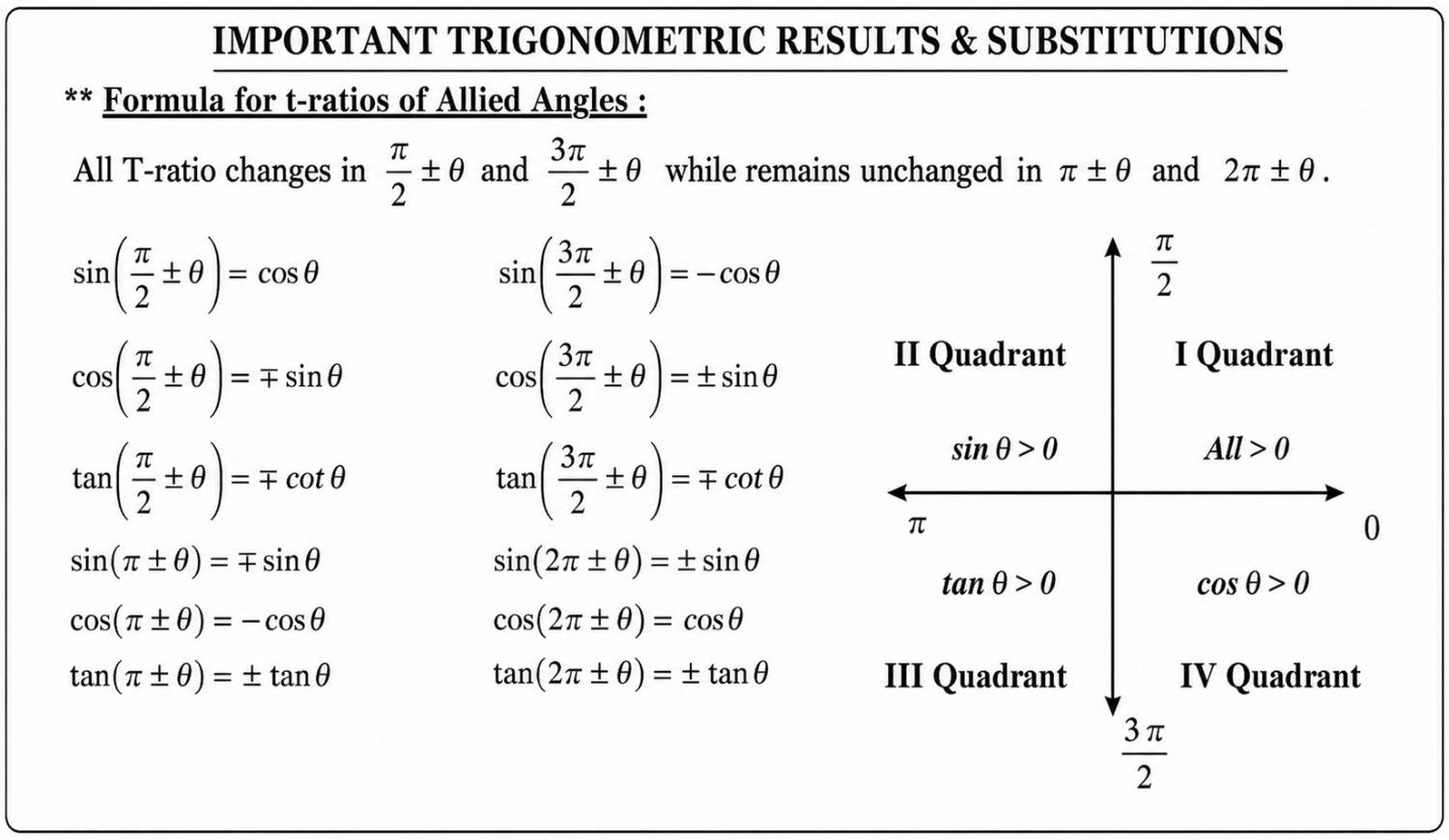
Sum and Difference formulae:
\[
\sin(A+B) = \sin A \cos B + \cos A \sin B
\]
\[
\sin(A-B) = \sin A \cos B – \cos A \sin B
\]
\[
\cos(A+B) = \cos A \cos B – \sin A \sin B
\]
\[
\cos(A-B) = \cos A \cos B + \sin A \sin B
\]
\[
\tan (A + B) = \frac{\tan A + \tan B}{1 – \tan A \tan B},\]
\[\quad
\tan (A – B) = \frac{\tan A – \tan B}{1 + \tan A \tan B}
\]
\[
\tan \left(\frac{\pi}{4} + A\right) = \frac{1 + \tan A}{1 – \tan A},\]
\[\quad
\tan \left(\frac{\pi}{4} – A\right) = \frac{1 – \tan A}{1 + \tan A}
\]
\[
\cot (A + B) = \frac{\cot A \cdot \cot B – 1}{\cot B + \cot A}, \]
\[\quad
\cot (A – B) = \frac{\cot A \cdot \cot B + 1}{\cot B – \cot A}
\]
Product Identities
1. \(\sin(A+B)\sin(A-B)\)
$$\sin(A+B)\sin(A-B)$$
$$=\sin^2A-\sin^2B$$
$$=\cos^2B-\cos^2A$$
2. \(\cos(A+B)\cos(A-B)\)
$$\cos(A+B)\cos(A-B)$$
$$=\cos^2A-\sin^2B$$
$$=\cos^2B-\sin^2A$$
▶
Formulae for t-ratios of multiple and sub-multiple angles
\sin 2A = 2\sin A \cos A\] \[= \frac{2\tan A}{1 + \tan^2 A}
\]
\[
\cos 2A = \cos^2 A – \sin^2 A \]\[= 1 – 2\sin^2 A \]\[= 2\cos^2 A – 1\] \[= \frac{1 – \tan^2 A}{1 + \tan^2 A}\]
Double Angle Formula
1. Tan 2A
$$\tan 2A=\frac{2\tan A}{1-\tan^2 A}$$
Triple Angle Formulas
2. Sin 3A
$$\sin 3A=3\sin A-4\sin^3 A$$
3. Cos 3A
$$\cos 3A=4\cos^3 A-3\cos A$$
4. Tan 3A
$$\tan 3A=\frac{3\tan A-\tan^3 A}{1-3\tan^2 A}$$
▶
Properties of Inverse trigonometric functions
Important Inverse Trigonometric Identities
1.
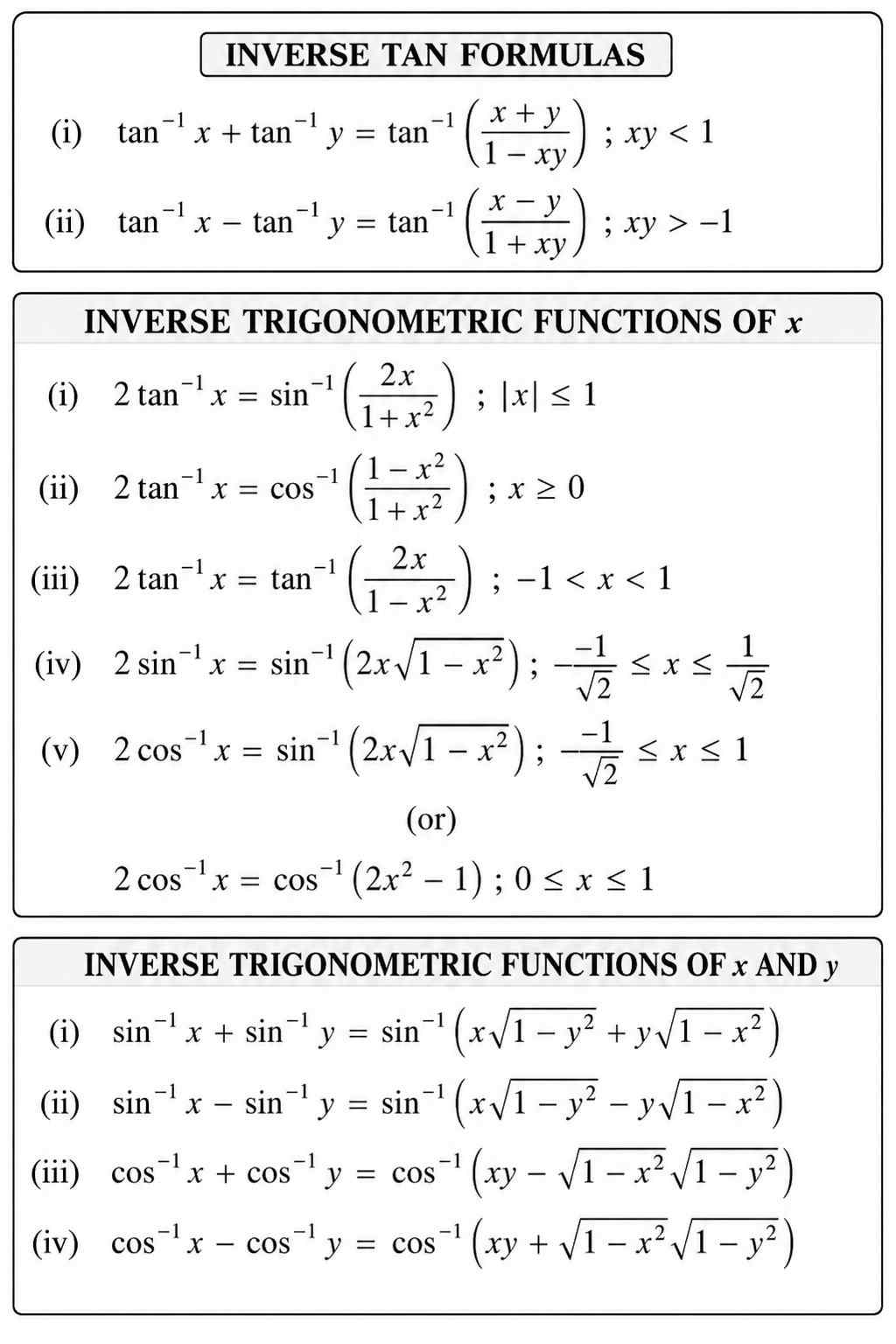
$$\sin(\sin^{-1}x)=x,\qquad x\in[-1,1]$$
$$\sin^{-1}(\sin x)=x,\qquad x\in\left[-\frac{\pi}{2},\frac{\pi}{2}\right]$$
2.
(i)
$$\sin^{-1}\!\left(\frac1x\right)=\csc^{-1}x,$$
$$\qquad x\ge1\ \text{or}\ x\le-1$$
(ii)
$$\cos^{-1}\!\left(\frac1x\right)=\sec^{-1}x,$$
$$\qquad x\ge1\ \text{or}\ x\le-1$$
(iii)
$$\tan^{-1}\!\left(\frac1x\right)=\cot^{-1}x,\qquad x>0$$
3.
(i)
$$\sin^{-1}(-x)=-\sin^{-1}x,$$
$$\qquad x\in[-1,1]$$
(ii)
$$\tan^{-1}(-x)=-\tan^{-1}x,$$
$$\qquad x\in\mathbb{R}$$
(iii)
$$\csc^{-1}(-x)=-\csc^{-1}x,$$
$$\qquad |x|\ge1$$
4.
(i)
$$\cos^{-1}(-x)=\pi-\cos^{-1}x,$$
$$\qquad x\in[-1,1]$$
(ii)
$$\sec^{-1}(-x)=\pi-\sec^{-1}x,$$
$$\qquad |x|\ge1$$
(iii)
$$\cot^{-1}(-x)=\pi-\cot^{-1}x,$$
$$\qquad x\in\mathbb{R}$$
5.
(i)
$$\sin^{-1}x+\cos^{-1}x=\frac{\pi}{2},$$
$$\qquad x\in[-1,1]$$
(ii)
$$\csc^{-1}x+\sec^{-1}x=\frac{\pi}{2}$$
(iii)
$$\tan^{-1}x+\cot^{-1}x=\frac{\pi}{2},\qquad x>0$$
▶
Inverse Trignometry Functions Formulas