
📝 SECTION E
3 × 4 = 12 marks
🏦 Case Study 1: Loan Repayment
Your elder brother wants to buy a car and plans to take a loan from a bank for his car. He repays his total loan of ₹1,18,000 by paying every month, starting with the first instalment of ₹1,000 and he increases the instalment by ₹100 every month.
Based on the information given above, answer the following questions:
(i) Find the amount paid by him in the 30th instalment. [1 mark]
(ii) If the total number of instalments is 40, what is the amount paid in the last instalment? [1 mark]
(iii) (a) What amount does he still have to pay after the 30th instalment? [2 marks]
OR
(iii) (b) Find the ratio of the tenth instalment to the last instalment. [2 marks]
🔍 VIEW SOLUTION
✅ STEP-BY-STEP SOLUTION:
Step 1: Identify the pattern
The instalments form an Arithmetic Progression (AP) with:
First term (a) = ₹1000
Common difference (d) = ₹100
Total loan amount = ₹1,18,000
Step 2 (i): Amount in 30th instalment
Using formula:$$ a_n = a + (n-1)d$$
$$a_{30} = 1000 + (30-1) \times 100$$
$$a_{30} = 1000 + 29 \times 100$$
$$a_{30} = 1000 + 2900 = ₹3900$$
✅ Answer (i): $${₹3900}$$
Step 3 (ii): Amount in last instalment (40th)
$$a_{40} = 1000 + (40-1) \times 100$$
$$a_{40} = 1000 + 39 \times 100$$
$$a_{40} = 1000 + 3900 = ₹4900$$
✅ Answer (ii): $${₹4900}$$
Step 4 (iii)(a): Amount paid after 30th instalment
First find total amount paid in 30 instalments using sum formula:
$$S_n = \frac{n}{2}[2a + (n-1)d]$$
$$S_{30} = \frac{30}{2}[2 \times 1000 + (30-1) \times 100]$$
$$S_{30} = 15[2000 + 2900]$$
$$S_{30} = 15 \times 4900 = ₹73,500$$
Amount still to be paid = Total loan – Amount paid in 30 instalments
= ₹1,18,000 – ₹73,500 = ₹44,500
✅ Answer (iii)(a): $${₹44,500}$$
Step 5 (iii)(b): Ratio of 10th instalment to last instalment (OR)
10th instalment: $$a_{10} = 1000 + (10-1) \times 100 $$
$$= 1000 + 900 $$
$$= ₹1900$$
Last instalment (40th): $$a_{40} = ₹4900$$ (from above)
Ratio = 1900 : 4900 = 19 : 49
✅ Answer (iii)(b): $${19 : 49}$$
🏢 Case Study 2: Angle of Depression
Tejas is standing at the top of a building and observes a car at an angle of depression of \(30^\circ\) as it approaches the base of the building at a uniform speed. 6 seconds later, the angle of depression increases to \(60^\circ\), and at that moment, the car is 25 m away from the building.
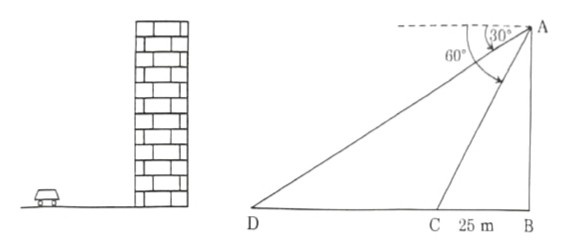
Based on the information given above, answer the following questions:
(i) What is the height of the building? [1 mark]
(ii) What is the distance between the two positions of the car? [1 mark]
(iii) (a) What would be the total time taken by the car to reach the foot of the building from the starting point? [2 marks]
OR
(iii) (b) What is the distance of the observer from the car when it makes an angle of \(60^\circ\)? [2 marks]
🔍 VIEW SOLUTION
✅ STEP-BY-STEP SOLUTION:
Step 1: Understand the situation
Let height of building = h meters.
At second position (angle 60°), car is 25 m away from building.
So, distance from building at second position = 25 m.
Step 2 (i): Find height of building using second position
In right triangle at second position:
$$\tan 60^\circ = \frac{h}{25}$$
$$\sqrt{3} = \frac{h}{25}$$
$$h = 25\sqrt{3} meters$$
✅ Answer (i): $${25\sqrt{3} \text{ m}}$$
Step 3: Find distance of first position from building
At first position (angle 30°):
$$\tan 30^\circ$$
$$= \frac{h}{d} $$where d
= distance of first position from building$$\frac{1}{\sqrt{3}}$$
$$= \frac{25\sqrt{3}}{d}$$
$$d = 25\sqrt{3} \times \sqrt{3}$$
$$= 25 \times 3 = 75 m$$
Step 4 (ii): Distance between two positions
Distance = First position distance – Second position distance
= 75 m – 25 m = 50 m
✅ Answer (ii): $${50 \text{ m}}$$
Step 5 (iii)(a): Total time to reach foot of building
Speed of car = Distance covered / Time taken
Car covers 50 m in 6 seconds, so speed = $$\frac{50}{6}$$
$$= \frac{25}{3} m/s$$
Total distance from first position to building = 75 m
$$Time = \frac{\text{Distance}}{\text{Speed}}$$
$$= \frac{75}{\frac{25}{3}}$$
$$= 75 \times \frac{3}{25} $$
$$= 3 \times 3 = 9 seconds$$
✅ Answer (iii)(a): $${9 \text{ seconds}}$$
Step 6 (iii)(b): Distance of observer from car at 60° (OR)
At 60° angle, we have a right triangle with:
Height = $$25\sqrt{3} m$$, base = 25 m
Distance from observer to car = hypotenuse
Using Pythagoras theorem:
$$d = \sqrt{(25\sqrt{3})^2 + 25^2}$$
$$= \sqrt{1875 + 625}$$
$$= \sqrt{2500} = 50 m$$
✅ Answer (iii)(b): $${50 \text{ m}}$$
🧊 Case Study 3: Rubik’s Cube & Ice-cream
On a Sunday your parents took you to a fair. You could see lot of toys displayed and you wanted them to buy a Rubik’s cube and a strawberry ice-cream for you.
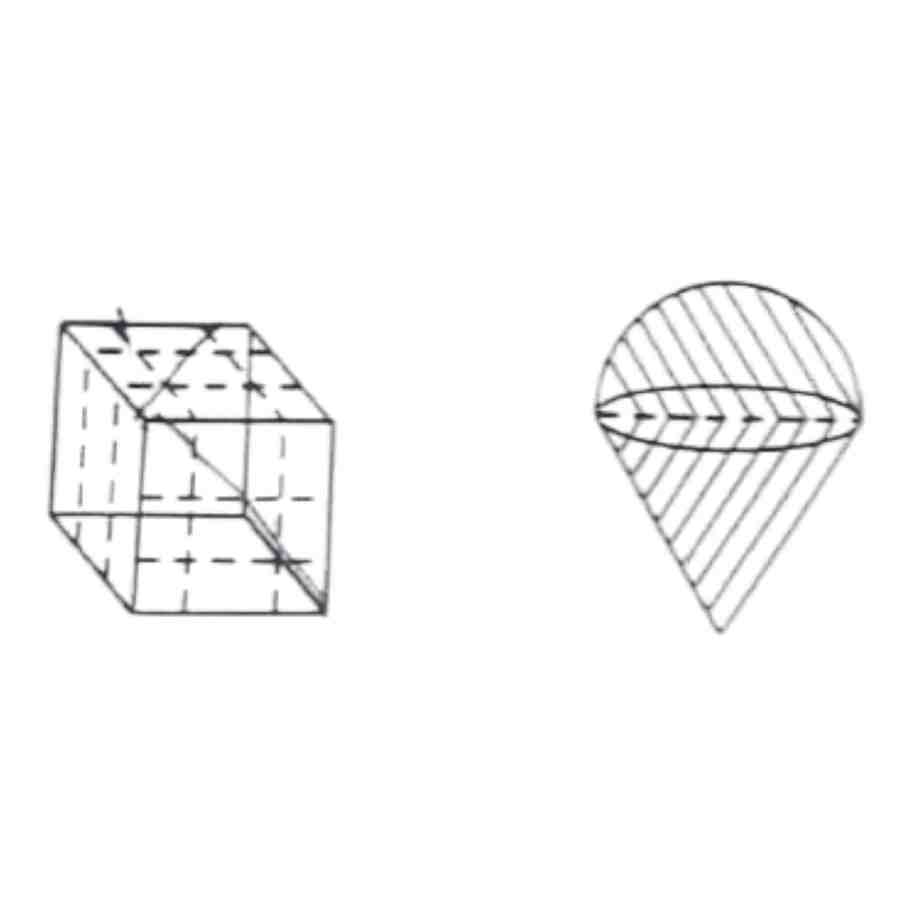
Based on the information given above, answer the following questions:
(i) Find the length of the diagonal of Rubik’s cube if each edge measures 6 cm. [1 mark]
(ii) Find the volume of Rubik’s cube if the length of the edge is 7 cm. [1 mark]
(iii) (a) What is the curved surface area of hemisphere (ice-cream) if the base radius is 7 cm? [2 marks]
OR
(iii) (b) If two cubes of edges 4 cm are joined end-to-end, then find the surface area of the resulting cuboid. [2 marks]
🔍 VIEW SOLUTION
✅ STEP-BY-STEP SOLUTION:
Step 1 (i): Diagonal of cube with edge 6 cm
Formula for diagonal of cube = \(a\sqrt{3}\) where a = edge length
Diagonal = \(6\sqrt{3}\) cm
✅ Answer (i): $${6\sqrt{3} \text{ cm}}$$
Step 2 (ii): Volume of cube with edge 7 cm
Volume of cube = $$a^3$$
Volume = $$7^3 = 343 cm³$$
✅ Answer (ii): $${343 \text{ cm}^3}$$
Step 3 (iii)(a): Curved surface area of hemisphere (ice-cream)
Radius r = 7 cm
Curved surface area of hemisphere = $$2\pi r^2$$
Using $$\pi = \frac{22}{7}$$:
$$CSA = 2 \times \frac{22}{7} \times 7^2$$
$$= 2 \times \frac{22}{7} \times 49$$
$$= 2 \times 22 \times 7$$
$$= 44 \times 7 = 308 cm²$$
✅ Answer (iii)(a): $${308 \text{ cm}^2}$$
Step 4 (iii)(b): Surface area of cuboid formed by joining two cubes (OR)
Two cubes of edge 4 cm joined end-to-end form a cuboid of dimensions:
Length = 4 + 4 = 8 cm
Breadth = 4 cm
Height = 4 cm
Surface area of cuboid = 2(lb + bh + hl)
$$= 2(8 \times 4 + 4 \times 4 + 4 \times 8)$$
= 2(32 + 16 + 32)
$$= 2 \times 80 = 160 cm²$$
✅ Answer (iii)(b): $${160 \text{ cm}^2}$$
📌 SECTION E COMPLETE · 3/3 CASE STUDIES SOLVED
solvedpapers.net | CBSE Class 10 Mathematics Standard
🎯 COMPLETE PAPER SOLVED
Section A: 20/20 MCQ & Assertion-Reason
Section B: 5/5 Very Short Answer
Section C: 6/6 Short Answer
Section D: 4/4 Long Answer
Section E: 3/3 Case Study Based
Total: 38/38 Questions Solved ✅
🏆 CBSE CLASS 10 MATHEMATICS (STANDARD) SET 1
✅ Complete solutions for all sections (A, B, C, D, E) · Step-by-step explanations · Easy methods
solvedpapers.net · Your Ultimate CBSE Solution Partner