📝 SECTION C
6 × 3 = 18 marks
🔢 Real Numbers
Prove that \(\sqrt{5}\) is an irrational number.
🔍 VIEW SOLUTION
✅ STEP-BY-STEP PROOF (By contradiction method):
Step 1: Assume, to the contrary, that \(\sqrt{5}\) is rational.
Then \(\sqrt{5} = \frac{p}{q}\) where \(p\) and \(q\) are co-prime integers (no common factor other than 1) and \(q \neq 0\).
Step 2: Squaring both sides:
$$5 = \frac{p^2}{q^2}$$
$$p^2 = 5q^2 …(1)$$
Step 3: This implies that $$p^2$$ is divisible by 5.
If a prime number (5) divides $$p^2$$, then it also divides p.
So, p = 5k for some integer k.
Step 4: Substitute p = 5k in equation (1):
$$(5k)^2 = 5q^2$$
$$25k^2 = 5q^2$$
$$5k^2 = q^2$$
This implies $$q^2$$ is divisible by 5, so q is also divisible by 5.
Step 5: Thus, p and q both have common factor 5.
This contradicts our assumption that p and q are co-prime.
Step 6: Therefore, our assumption is false.
Hence, $$\sqrt{5}$$ is irrational.
✅ Hence proved:
$${\sqrt{5} \text{ is irrational}}$$
📍 Coordinate Geometry
Find the coordinates of the points of trisection of the line segment joining the points A(-1, 4) and B(-3, -2).
🔍 VIEW SOLUTION
✅ STEP-BY-STEP SOLUTION:
Step 1: Points of trisection divide the line segment in the ratio 1:2 and 2:1.
Let P and Q be the points of trisection with P closer to A and Q closer to B.
Step 2: For point P dividing AB in ratio 1:2 (AP:PB = 1:2)
Using section formula: P(x,y) $$= \left(\frac{mx_2 + nx_1}{m+n}, \frac{my_2 + ny_1}{m+n}\right)$$
Here m:n = 1:2, $$A(x_1,y_1) = (-1,4),$$
$$B(x_2,y_2) = (-3,-2)$$
$$x_P = \frac{1(-3) + 2(-1)}{1+2}$$
$$= \frac{-3 – 2}{3} = \frac{-5}{3}$$
$$y_P = \frac{1(-2) + 2(4)}{3}$$
$$= \frac{-2 + 8}{3} = \frac{6}{3} = 2$$
So, $$P = \left(-\frac{5}{3}, 2\right)$$
Step 3: For point Q dividing AB in ratio 2:1 (AQ:QB = 2:1)
$$x_Q = \frac{2(-3) + 1(-1)}{2+1}$$
$$= \frac{-6 – 1}{3} = \frac{-7}{3}$$
$$y_Q = \frac{2(-2) + 1(4)}{3}$$
$$= \frac{-4 + 4}{3} = \frac{0}{3} = 0$$
$$So, Q = \left(-\frac{7}{3}, 0\right)$$
✅ Final Answer: Points of trisection are $${\left(-\frac{5}{3}, 2\right)}$$ and $${\left(-\frac{7}{3}, 0\right)}$$
📐 Trigonometry
(a) Prove that:
\(\frac{\sec^{3}\theta}{\sec^{2}\theta – 1} + \frac{\cos^{3}\theta}{\cos^{2}\theta – 1} = \sec\theta + \cos\theta\)
🔍 VIEW SOLUTION
✅ STEP-BY-STEP PROOF:
Step 1: Note that \(\sec^2\theta – 1 = \tan^2\theta\) and \(\cos^2\theta – 1 = -\sin^2\theta\)
Step 2: First term: $$\frac{\sec^3\theta}{\sec^2\theta – 1}$$
$$= \frac{\sec^3\theta}{\tan^2\theta}$$
$$= \frac{\sec^3\theta}{\frac{\sin^2\theta}{\cos^2\theta}}$$
$$= \frac{\sec^3\theta \cdot \cos^2\theta}{\sin^2\theta}$$
$$= \frac{\frac{1}{\cos^3\theta} \cdot \cos^2\theta}{\sin^2\theta}$$
$$= \frac{1}{\cos\theta \cdot \sin^2\theta}$$
$$= \frac{\sec\theta}{\sin^2\theta}$$
Step 3: Second term: $$\frac{\cos^3\theta}{\cos^2\theta – 1}$$
$$= \frac{\cos^3\theta}{-\sin^2\theta} $$
$$= -\frac{\cos^3\theta}{\sin^2\theta}$$
Step 4: LHS
$$= \frac{\sec\theta}{\sin^2\theta} – \frac{\cos^3\theta}{\sin^2\theta}$$
$$= \frac{\sec\theta – \cos^3\theta}{\sin^2\theta}$$
Step 5: simplifying numerator from result of step 4
Write $$\sec\theta = \frac{1}{\cos\theta}$$
$$=\sec\theta – \cos^3\theta$$
$$= \frac{1}{\cos\theta} – \cos^3\theta = \frac{1 – \cos^4\theta}{\cos\theta} $$
$$= \frac{(1 – \cos^2\theta)(1 + \cos^2\theta)}{\cos\theta}$$
$$= \frac{\sin^2\theta(1 + \cos^2\theta)}{\cos\theta}$$
Step 6: Therefore, LHS$$ = \frac{\frac{\sin^2\theta(1 + \cos^2\theta)}{\cos\theta}}{\sin^2\theta}$$
$$= \frac{1 + \cos^2\theta}{\cos\theta}$$
$$= \frac{1}{\cos\theta} + \cos\theta = \sec\theta + \cos\theta$$
= RHS
✅ Hence proved
📐 Trigonometry
(b) If \(\frac{\sec \alpha}{\cos \beta} = p\) and \(\frac{\tan \alpha}{\cos \beta} = q\), then prove that \((p^{2} – q^{2})\sec^{2}\alpha = p^{2}\).
🔍 VIEW SOLUTION
✅ STEP-BY-STEP PROOF:
Step 1: Given: \(p = \frac{\sec\alpha}{\cos\beta}\) and \(q = \frac{\tan\alpha}{\cos\beta}\)
Step 2: Find $$p^2 – q^2:$$
$$p^2 – q^2 $$
$$= \frac{\sec^2\alpha}{\cos^2\beta} – \frac{\tan^2\alpha}{\cos^2\beta} $$
$$= \frac{\sec^2\alpha – \tan^2\alpha}{\cos^2\beta}$$
Step 3: Using identity $$\sec^2\alpha – \tan^2\alpha = 1:$$
$$p^2 – q^2 = \frac{1}{\cos^2\beta}$$
Step 4: Multiply both sides by $$\sec^2\alpha = \frac{1}{\cos^2\alpha}$$
Step 3 become
$$=>(p^2 – q^2)\sec^2\alpha$$
$$= \frac{1}{\cos^2\beta} \cdot \frac{1}{\cos^2\alpha}$$
$$= \frac{1}{\cos^2\alpha \cos^2\beta}$$
Step 5: From given p $$= \frac{\sec\alpha}{\cos\beta} $$
Step 3 become
$$=> \frac{1}{\cos\alpha \cos\beta}$$
So,$$ p^2 $$
$$= \frac{1}{\cos^2\alpha \cos^2\beta}$$
Step 6: Therefore, $$(p^2 – q^2)\sec^2\alpha = p^2$$
✅ Hence proved
⭕ Circles
(a) Prove that the lengths of tangents drawn from an external point to a circle are equal.
🔍 VIEW SOLUTION
✅ STEP-BY-STEP PROOF:
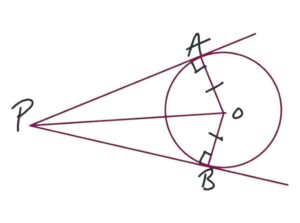
Given: Circle with centre O. P is an external point. PA and PB are two tangents from P to the circle touching at A and B respectively.
To prove: PA = PB
Construction: Join OA, OB, and OP.
Proof:
Step 1: OA ⟂ PA and OB ⟂ PB (Radius is perpendicular to tangent at point of contact)
∴ ∠OAP = ∠OBP = 90°
Step 2: In right triangles OAP and OBP:
OA = OB (radii of same circle)
OP = OP (common side)
Step 3: By RHS (Right angle-Hypotenuse-Side) congruence criterion:
ΔOAP ≅ ΔOBP
Step 4: Corresponding parts of congruent triangles are equal:
PA = PB
✅ Hence proved: Lengths of tangents from an external point are equal.
✂️━━━━━━━━━━━━━━━━━━━
⭕ Circles
(b) Two tangents TP and TQ are drawn to a circle with centre O from an external point T. Prove that \(\angle \mathrm{PTQ} = 2\angle \mathrm{OPQ}\).
🔍 VIEW SOLUTION
✅ STEP-BY-STEP PROOF:
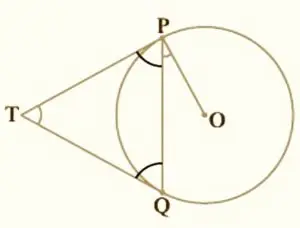
Given: Circle with centre O. TP and TQ are tangents from external point T touching the circle at P and Q respectively.
To prove: ∠PTQ = 2∠OPQ
Construction: Join OP, OQ, and PQ.
Proof:
Step 1: OP ⟂ TP and OQ ⟂ TQ (Radius ⟂ tangent)
∴ ∠OPT = ∠OQT = 90°
Step 2: In quadrilateral OPTQ:
∠OPT + ∠OQT + ∠PTQ + ∠POQ = 360° (sum of angles of quadrilateral)
90° + 90° + ∠PTQ + ∠POQ = 360°
∠PTQ + ∠POQ = 180° …(1)
Step 3: In ΔOPQ, OP = OQ (radii)
∴ ∠OPQ = ∠OQP (angles opposite equal sides)
∠OPQ + ∠OQP + ∠POQ = 180°
2∠OPQ + ∠POQ = 180° …(2)
Step 4: From (1) and (2):
∠PTQ + ∠POQ = 2∠OPQ + ∠POQ
∠PTQ = 2∠OPQ
✅ Hence proved: \angle PTQ = 2\angle OPQ
📐 Areas Related to Circles
Find the area of the sector of a circle of radius 42 cm and of central angle \(30^{\circ}\). Also, find the area of the corresponding major sector. [Use \(\pi = \frac{22}{7}\)]
🔍 VIEW SOLUTION
✅ STEP-BY-STEP SOLUTION:
Step 1: Given: Radius \(r = 42\) cm, Central angle \(\theta = 30^\circ\), \(\pi = \frac{22}{7}\)
Step 2: Area of sector
$$= \frac{\theta}{360^\circ} \times \pi r^2$$
$$= \frac{30}{360} \times \frac{22}{7} \times (42)^2$$
$$= \frac{1}{12} \times \frac{22}{7} \times 1764$$
$$= \frac{1}{12} \times \frac{22}{7} \times 1764$$
Step 3: Simplify:
$$1764 \div 7 = 252$$
$$= \frac{1}{12} \times 22 \times 252$$
$$= \frac{1}{12} \times 5544$$
$$= 462 cm²$$
Step 4: Area of major sector = Area of circle – Area of minor sector
Area of circle
$$= \pi r^2 = \frac{22}{7} \times 1764 $$
$$= 22 \times 252 = 5544 cm²$$
Area of major sector = 5544 – 462 = 5082 cm²
✅ Final Answer:
Area of minor sector =$${462 \text{ cm}^2}$$
Area of major sector = $${5082 \text{ cm}^2}$$
🎲 Probability
Two dice are thrown at the same time. Determine the probability that the (i) sum of the numbers on the two dice is 5, and (ii) difference of the numbers on the two dice is 3.
🔍 VIEW SOLUTION
✅ STEP-BY-STEP SOLUTION:
Step 1: Total outcomes when two dice are thrown = \(6 \times 6 = 36\)
Step 2 (i): Sum of numbers is 5
Favorable outcomes: (1,4), (2,3), (3,2), (4,1)
Number of favorable outcomes = 4
$$P(sum = 5) = \frac{4}{36} = \frac{1}{9}$$
Step 3 (ii): Difference of numbers is 3
Favorable outcomes: (1,4), (2,5), (3,6), (4,1), (5,2), (6,3)
Number of favorable outcomes = 6
$$P(difference = 3) = \frac{6}{36} = \frac{1}{6}$$
✅ Final Answer:
(i) P(sum = 5) = $${\frac{1}{9}}$$
(ii) P(difference = 3) =$$boxed{\frac{1}{6}}$$
📌 SECTION C COMPLETE · 6/6 SOLVED
solvedpapers.net | CBSE Class 10 Mathematics Standard
🏆 CBSE CLASS 10 MATHEMATICS (STANDARD) SET 1
✅ Section C (Q26-Q31) complete solutions · Step-by-step explanations · Easy methods