
🏫 CBSE FINAL PAPER
Class 10 Mathematics (Standard)
SET 1 · 2026
📘 Mathematics (041) · Solved Section A
⏱️ 3 Hours · Max Marks: 80 · 5 Sections (A-E)
📋
Section A: Q1-18 MCQs + Q19-20 Assertion-Reason (1 mark each)
Section B: Q21-25 VSA (2 marks each)
Section C: Q26-31 SA (3 marks each)
Section D: Q32-35 LA (5 marks each)
Section E: Q36-38 Case-based (4 marks each)
Internal choices in Sections B, C, D, E. Draw neat diagrams. Use \(\pi = \frac{22}{7}\) if not stated. No calculators.
📝 SECTION A
20 × 1 = 20 marks
The LCM of 960 and 240 is:
(A) 960
(B) 240
(C) 60
(D) 15
🔍 VIEW ANSWER
✅ ANSWER: A (960)
📐 EXPLANATION:
LCM Calculation: Prime Factorization
First, find the prime factors of each number:
\[ 240 = 2^4 \times 3 \times 5 \]
\[ 960 = 2^6 \times 3 \times 5 \]
To find the LCM, take the highest power of each prime factor:
- Highest power of \( 2 \): \( 2^6 \)
- Highest power of \( 3 \): \( 3^1 \)
- Highest power of \( 5 \): \( 5^1 \)
Multiply them together: \[ \text{LCM} = 2^6 \times 3 \times 5 \]
\[ \text{LCM} = 64 \times 15 = 960 \]
The natural number 1 is :
(A) a prime number.
(B) a composite number.
(C) prime as well as composite.
(D) neither prime nor composite.
🔍 VIEW ANSWER
✅ ANSWER: D (neither prime nor composite)
📐 EXPLANATION: A prime number has exactly two factors: 1 and itself. A composite number has more than two factors. The number 1 has only one factor (itself), so it is neither prime nor composite.
For any natural number \(n\), \(5^{n}\) ends with the digit :
(A) 0
(B) 5
(C) 3
(D) 2
🔍 VIEW ANSWER
✅ ANSWER: B (5)
📐 EXPLANATION: Any power of 5 ends with digit 5.
Check: \(5^1=5\),
\(5^2=25\),
\(5^3=125\), etc.
All end with 5.
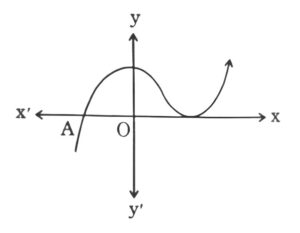
The graph of \(y = f(x)\) is given. The number of distinct zeroes of \(y = f(x)\) is :
(A) 0
(B) 1
(C) 2
(D) 3
🔍 VIEW ANSWER
✅ ANSWER: C (2)
📐 EXPLANATION: The zeroes of a function are the x-coordinates where the graph intersects the x-axis. From the given graph (parabola), it crosses the x-axis at two distinct points, so there are 2 distinct zeroes.
If \(\alpha\) and \(\beta\) are two zeroes of a polynomial \(f(x) = px^2 – 2x + 3p\) and \(\alpha + \beta = \alpha \beta\), then value of \(p\) is :
(A) \(-\frac{2}{3}\)
(B) \(\frac{2}{3}\)
(C) \(\frac{1}{3}\)
(D) \(-\frac{1}{3}\)
🔍 VIEW ANSWER
✅ ANSWER: B (\(\frac{2}{3}\))
📐 EXPLANATION: For quadratic \(px^2 – 2x + 3p\):
Sum of zeroes \(\alpha + \beta = \frac{-(-2)}{p} = \frac{2}{p}\)
Product of zeroes \(\alpha \beta = \frac{3p}{p} = 3\)
Given \(\alpha + \beta = \alpha \beta\) ⇒ \(\frac{2}{p} = 3\) ⇒ \(p = \frac{2}{3}\)
If the pair of linear equations : \(a_{1}x + b_{1}y + c_{1} = 0\) and \(a_{2}x + b_{2}y + c_{2} = 0\) is consistent and dependent, then
(A) \(\frac{a_{1}}{a_{2}}\neq \frac{b_{1}}{b_{2}}\)
(B) \(\frac{a_{1}}{a_{2}}\neq \frac{b_{1}}{b_{2}} = \frac{c_{1}}{c_{2}}\)
(C) \(\frac{a_{1}}{a_{2}} = \frac{b_{1}}{b_{2}}\neq \frac{c_{1}}{c_{2}}\)
(D) \(\frac{a_{1}}{a_{2}} = \frac{b_{1}}{b_{2}} = \frac{c_{1}}{c_{2}}\)
🔍 VIEW ANSWER
✅ ANSWER: D (\(\frac{a_{1}}{a_{2}} = \frac{b_{1}}{b_{2}} = \frac{c_{1}}{c_{2}}\))
📐 EXPLANATION: For a pair of linear equations to be consistent and dependent (coincident lines), the ratios of coefficients must be equal: \(\frac{a_1}{a_2} = \frac{b_1}{b_2} = \frac{c_1}{c_2}\).
Which of the following sequence is not an A.P.?
(A) \(2,\frac{5}{2},3,\frac{7}{2},\dots\)
(B) \(-1.2, -3.2, -5.2, -7.2,\dots\)
(C) \(\sqrt{2},\sqrt{8},\sqrt{18},\dots\)
(D) \(1^{2},3^{2},5^{2},7^{2},\dots\)
🔍 VIEW ANSWER
✅ ANSWER: D (\(1^{2},3^{2},5^{2},7^{2},\dots\))
📐 EXPLANATION: Check common difference:
(A) \(d = \frac{5}{2}-2 = \frac{1}{2}\) constant → AP
(B) \(d = -3.2-(-1.2) = -2\) constant → AP
(C) \(\sqrt{8}-\sqrt{2}\)\( = 2\sqrt{2}-\sqrt{2} \)\(= \sqrt{2}\), \(\sqrt{18}-\sqrt{8} \)\(= 3\sqrt{2}-2\sqrt{2}\)\( = \sqrt{2}\) constant → AP
(D) \(1,9,25,49\) differences: 8,16,24 → not constant → not AP
In triangles ABC and PQR, \(\angle A = \angle Q\) and \(\angle B = \angle R\), then AB : AC is equal to:
(A) PQ:PR
(B) PQ:QR
(C) QR:QP
(D) PR:QR
🔍 VIEW ANSWER
✅ ANSWER: ANSWER: C (QR:QP)
📐 EXPLANATION:
Triangle Similarity Problem
Step 1: Establish Similarity
In \(\triangle ABC\) and \(\triangle QRP\), we are given:
- \(\angle A = \angle Q\)
- \(\angle B = \angle R\)
According to the AA (Angle-Angle) similarity criterion, if two angles of one triangle are equal to two angles of another triangle, the triangles are similar. Therefore:
$$\triangle ABC \sim \triangle QRP$$
Step 2: Determine Corresponding Sides
When two triangles are similar, the ratios of their corresponding sides are equal. Based on the similarity \(\triangle ABC \sim \triangle QRP\), the corresponding sides are:
- \(AB\) corresponds to \(QR\)
- \(BC\) corresponds to \(RP\)
- \(AC\) corresponds to \(QP\)
Setting up the ratio for the sides mentioned in the question:
$$\frac{AB}{QR} = \frac{AC}{QP}$$
Step 3: Solve for the Required Ratio
To find what \(AB : AC\) is equal to, we rearrange the proportion:
$$\frac{AB}{AC} = \frac{QR}{QP}$$
In ratio form, this is \(AB : AC = QR : QP\).
Answer:
(C) QR:Qp
✅ CORRECT ANSWER: C (QR:QP)
The distance of the point A(4a, 3a) from x-axis is:
(A) 3a
(B) -3a
(C) 4a
(D) -4a
🔍 VIEW ANSWER
✅ ANSWER: A (3a)
📐 EXPLANATION: Distance from x-axis = |y-coordinate| = |3a| = 3a (distance is always positive).
If cos A = \(\frac{4}{5}\), then the value of tan A is :
(A) \(\frac{3}{5}\)
(B) \(\frac{3}{4}\)
(C) \(\frac{4}{3}\)
(D) \(\frac{5}{3}\)
🔍 VIEW ANSWER
✅ ANSWER: B (\(\frac{3}{4}\))
📐 EXPLANATION: Using identity \(\sin^2 A + \cos^2 A = 1\): \(\sin^2 A = 1 – \left(\frac{4}{5}\right)^2\)\( = 1 – \frac{16}{25}\)\( = \frac{9}{25}\) \(\sin A = \frac{3}{5}\) (positive, assuming acute angle) \(\tan A = \frac{\sin A}{\cos A} = \frac{3/5}{4/5} = \frac{3}{4}\)
If 2 sin A = 1, then the value of tan A + cot A is :
(A) \(\sqrt{3}\)
(B) \(\frac{4}{\sqrt{3}}\)
(C) \(\frac{\sqrt{3}}{2}\)
(D) 1
🔍 VIEW ANSWER
✅ ANSWER: B (\(\frac{4}{\sqrt{3}}\))
📐 EXPLANATION:
2 sin A = 1 ⇒ sin A = \(\frac{1}{2}\) ⇒ A = 30° (or 150°, but take acute) cos 30° = \(\frac{\sqrt{3}}{2}\)
tan 30° = \(\frac{1}{\sqrt{3}}\),
cot 30° = \(\sqrt{3}\)
tan A + cot A
= \(\frac{1}{\sqrt{3}} + \sqrt{3}
= \frac{1 + 3}{\sqrt{3}}
= \frac{4}{\sqrt{3}}\)
From a point on the ground, which is 60 m away from the foot of a vertical tower, the angle of elevation of the top of the tower is found to be 45°. The height (in metres) of the tower is :
(A) \(10\sqrt{3}\)
(B) \(30\sqrt{3}\)
(C) 60
(D) 30
🔍 VIEW ANSWER
✅ ANSWER: C (60)
📐 EXPLANATION:
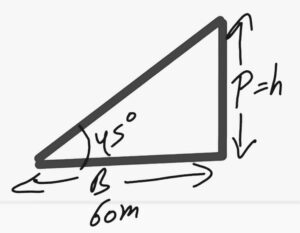
Height of a Vertical Tower
Step 1: Identify Given Information
The problem describes a right-angled triangle formed by:
- The vertical tower (the opposite side, $$h$$).
- The distance from the foot of the tower (the adjacent side), which is $$60 \text{ m}$$.
- The angle of elevation to the top of the tower, which is $$45^\circ$$.
Step 2: Use Trigonometric Ratios
We use the tangent ratio, which relates the opposite side to the adjacent side:
$$\tan(\theta) = \frac{\text{Opposite}}{\text{Adjacent}}$$
Substitute the given values:
$$\tan(45^\circ) = \frac{h}{60}$$
Step 3: Solve for Height
Since $$\tan(45^\circ) = 1$$, the equation becomes:
$$1 = \frac{h}{60}$$
$$h = 60 \text{ m}$$
Answer:
The height of the tower is $$60 \text{ m}$$.
In the given figure, PA and PB are tangents to a circle centred at O. If \(\angle OAB = 15^\circ\), then \(\angle APB\) equals :
(A) \(30^\circ\)
(B) \(15^\circ\)
(C) \(45^\circ\)
(D) \(10^\circ\)
🔍 VIEW ANSWER
✅ ANSWER: A (30°)
📐 EXPLANATION: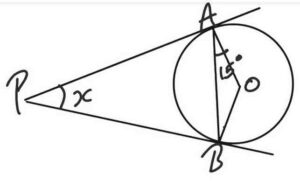
In triangle OAB,
OA = OB (radii),
so it’s isosceles. ∠OAB = 15°
⇒ ∠OBA = 15°
∠AOB = 180° – 15° – 15° = 150°
In quadrilateral OAPB, ∠OAP = ∠OBP = 90° (radius ⊥ tangent)
∠APB = 360° – 90° – 90° – 150° = 30°
In the given figure, PA and PB are tangents to a circle centred at O. If \(\angle AOB = 130^\circ\), then \(\angle APB\) is equal to :
(A) 130°
(B) 50°
(C) 120°
(D) 90°
🔍 VIEW ANSWER
✅ ANSWER: B (50°)
📐 EXPLANATION: In quadrilateral OAPB, ∠OAP = ∠OBP = 90° (radius ⊥ tangent) ∠AOB = 130° ∠APB = 360° – 90° – 90° – 130° = 50°
Area of a segment of a circle of radius ‘r’ and central angle 60° is :
(A) \(\frac{\pi r^2}{2} – \frac{1}{2}r^2\)
(B) \(\frac{2\pi r}{4} – \frac{\sqrt{3}}{4}r^2\)
(C) \(\frac{\pi r^2}{6} – \frac{\sqrt{3}}{4}r^2\)
(D) \(\frac{2\pi r}{4} – r^2 \sin 60^\circ\)
🔍 VIEW ANSWER
✅ ANSWER: C (\(\frac{\pi r^2}{6} – \frac{\sqrt{3}}{4}r^2\))
📐 EXPLANATION: Area of sector with angle θ = \(\frac{\theta}{360°} \times \pi r^2\) For θ = 60°, sector area = \(\frac{60}{360} \pi r^2 = \frac{\pi r^2}{6}\) Area of equilateral triangle formed by radii and chord = \(\frac{\sqrt{3}}{4}r^2\) Area of segment = sector area – triangle area = \(\frac{\pi r^2}{6} – \frac{\sqrt{3}}{4}r^2\)
A hemispherical bowl is made of steel of thickness 1 cm. The outer radius of the bowl is 6 cm. The volume of steel used (in cm³) is :
(A) 182 π
(B) \(\frac{182}{3} \pi\)
(C) \(\frac{682}{3} \pi\)
(D) \(\frac{364}{3} \pi\)
🔍 VIEW ANSWER
✅ ANSWER: D (\(\frac{364}{3} \pi\))
📐 EXPLANATION: Outer radius R = 6 cm, inner radius r = 6 – 1 = 5 cm (thickness 1 cm) Volume of hemisphere = \(\frac{2}{3}\pi r^3\) Volume of steel = outer volume – inner volume \( = \frac{2}{3}\pi (6^3) – \frac{2}{3}\pi (5^3)\) \(= \frac{2}{3}\pi (216 – 125)\) \(= \frac{2}{3}\pi \times 91 = \frac{182}{3}\pi\) cm³ Wait, 2/3 × 91 = 182/3, so answer is \(\frac{182}{3}\pi\) → option B.
✅ CORRECT ANSWER: B (\(\frac{182}{3} \pi\))
The mean and median of a frequency distribution are 43 and 43.4 respectively. The mode of the distribution is:
(A) 43.4
(B) 42.4
(C) 44.2
(D) 49.3
🔍 VIEW ANSWER
✅ ANSWER: C (44.2)
📐 EXPLANATION: Using empirical formula: Mode = 3(Median) – 2(Mean) Mode = 3(43.4) – 2(43) = 130.2 – 86 = 44.2
The probability for a randomly selected number out of 1, 2, 3, 4, …, 25 to be a composite number is:
(A) \(\frac{15}{25}\)
(B) \(\frac{10}{25}\)
(C) \(\frac{11}{25}\)
(D) \(\frac{9}{25}\)
🔍 VIEW ANSWER
✅ ANSWER: A (\(\frac{15}{25}\))
📐 EXPLANATION: Numbers from 1 to 25: total 25 numbers. Composite numbers (not prime and not 1): 4,6,8,9,10,12,14,15,16,18,20,21,22,24,25 → 15 numbers. Probability = \(\frac{15}{25}\)
Assertion (A): The surface area of the cuboid formed by joining two cubes of sides 4 cm each, end-to-end, is 160 cm². Reason (R): The surface area of a cuboid of dimensions \(l \times b \times h\) is \((lb + bh + hl)\).
Choices: (a) Both A and R are true and R is the correct explanation of A. (b) Both A and R are true but R is not the correct explanation of A. (c) A is true but R is false. (d) A is false but R is true.
🔍 VIEW ANSWER
✅ ANSWER: (d) A is false but R is true.
📐 EXPLANATION: Reason (R) is the correct formula for surface area of cuboid: \(2(lb + bh + hl)\) (missing factor 2 in given statement). The given R says \((lb + bh + hl)\) without the factor 2, which is incorrect. So R is false. Assertion (A): Two cubes of side 4 cm joined end-to-end form a cuboid of dimensions 8 cm × 4 cm × 4 cm. Surface area = \(2(8×4 + 4×4 + 4×8) \)\(= 2(32 + 16 + 32) \)\(= 2×80 = 160\) cm². So A is true. But since R is false, correct option is (c) A true, R false.
✅ CORRECT ANSWER: (c) A is true but R is false.
Assertion (A): The mean of first ‘n’ natural numbers is \(\frac{n – 1}{2}\). Reason (R): The sum of first ‘n’ natural numbers is \(\frac{n(n + 1)}{2}\).
Choices: (a) Both A and R are true and R is the correct explanation of A. (b) Both A and R are true but R is not the correct explanation of A. (c) A is true but R is false. (d) A is false but R is true.
🔍 VIEW ANSWER
✅ ANSWER: (d) A is false but R is true.
📐 EXPLANATION: Reason (R) is correct: sum of first n natural numbers = \(\frac{n(n+1)}{2}\). Assertion (A): Mean = sum/n = \(\frac{n(n+1)}{2n} = \frac{n+1}{2}\), not \(\frac{n-1}{2}\). So A is false. Thus, A false, R true → option (d).
📌 SECTION A COMPLETE · 20/20 SOLVED
solvedpapers.net | CBSE Class 10 Mathematics Standard
🏆 CBSE CLASS 10 MATHEMATICS (STANDARD) SET 1
✅ Section A (Q1-Q20) complete solutions · Step-by-step explanations · Easy methods