
Indian Education System 2026
Structure, Board Exams, NEP 2020 & Future Reforms Explained in Simple Language
Introduction
India has one of the largest education systems in the world. Every year, millions of students appear in school and board examinations.
The education system in India is changing fast, especially after the launch of the National Education Policy (NEP) 2020.
This policy focuses on skill-based learning, understanding concepts clearly, and reducing exam pressure.
Board exams for Class 10 and Class 12 are very important in India. These exams are conducted mainly between February and April.
Major boards like CBSE, CISCE (ICSE/ISC), NIOS, and various State Boards manage these exams.
Quick Facts About Indian Education
| Feature | Details |
|---|---|
| Free Education | Free and compulsory education for ages 6–14 (RTE Act) |
| Major Boards | CBSE, ICSE, ISC, NIOS, State Boards |
| Important Exams | Class 10 & Class 12 Board Exams |
| Entrance Exams | JEE, NEET, CUET and others |
| New Policy | National Education Policy 2020 |
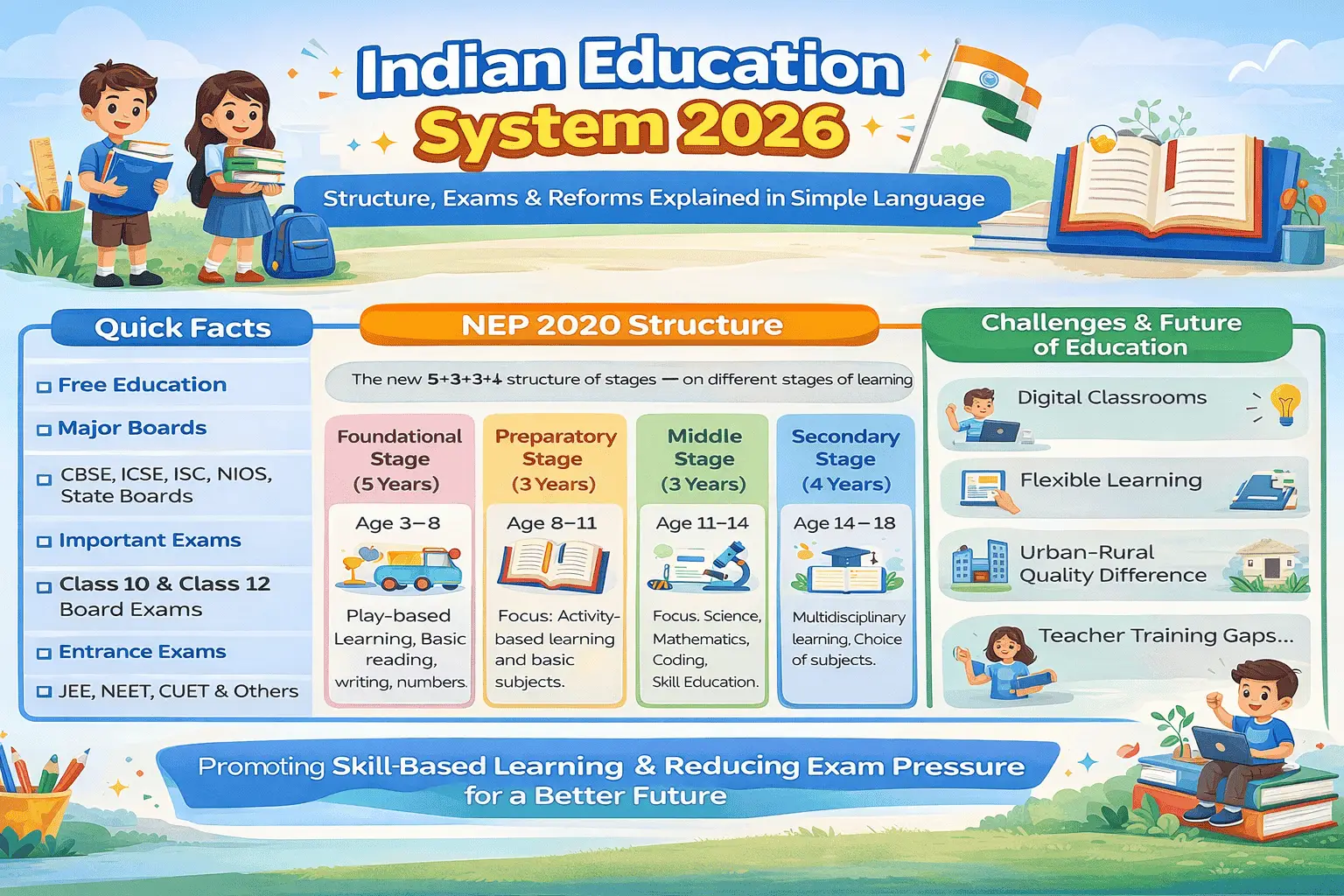
New Structure Under NEP 2020
The old 10+2 system has been replaced with a new 5+3+3+4 structure.
This structure focuses on learning according to child development stages.
Foundational Stage (5 Years)
Age: 3–8 Years
Includes 3 years of preschool + Class 1 and 2.
Focus: Play-based learning, basic reading, writing, numbers.
Preparatory Stage (3 Years)
Classes 3–5
Focus: Activity-based learning and basic subjects.
Middle Stage (3 Years)
Classes 6–8
Focus: Science, Mathematics, Coding, Skill Education.
Secondary Stage (4 Years)
Classes 9–12
Multidisciplinary learning, choice of subjects.
Board Exams in India (2026 Update)
Board exams are considered high-stakes exams. They play a major role in college admissions and career decisions.
CBSE has introduced important reforms from 2026.
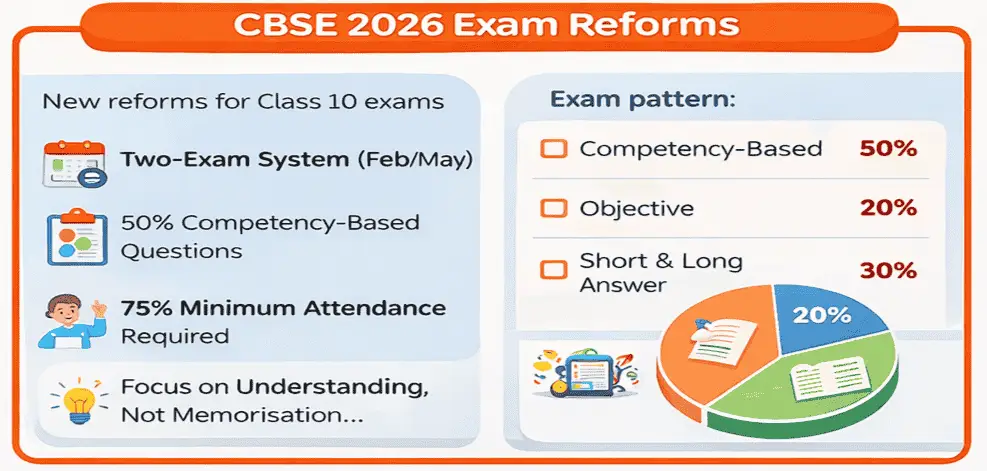
CBSE 2026 Reforms
- Two-Exam System for Class 10
- 50% Competency-Based Questions
- Focus on Understanding, Not Memorization
- 75% Minimum Attendance Required
| Exam Pattern | Weightage |
|---|---|
| Competency / Case Study Questions | 50% |
| Objective Questions | 20% |
| Short & Long Answers | 30% |
Higher Education in India
India has the third-largest higher education system in the world.
There are Central Universities, State Universities, Private Universities, IITs, IIMs, Medical Colleges and Skill Universities.
Popular Entrance Exams
- JEE – For Engineering
- NEET – For Medical
- CUET – For Central Universities
Challenges in Indian Education
- Exam pressure on students
- Difference in quality between urban and rural schools
- Rote learning culture
- Teacher training gaps
However, NEP 2020 aims to reduce these challenges by promoting skill-based education and critical thinking.
Future of Education in India
The future of Indian education looks positive. Digital classrooms, online learning, smart boards, and skill-based courses are becoming common.
Students now get more subject choices and flexible learning options.
The main goal is to make students confident, creative, and capable of solving real-life problems.
Conclusion
The Indian education system is changing rapidly. With the implementation of NEP 2020 and CBSE reforms in 2026,
students will experience less pressure and more meaningful learning.
The focus is shifting from memorization to understanding and skill development.
If these reforms are implemented properly, India can become a global education leader in the coming years.
Article Written for Educational purpose Only| parent Friendly | Student Friendly |Awareness purpose
Frequently Asked Questions (FAQs)
1. What is the structure of the Indian education system under NEP 2020?
The new structure is 5+3+3+4. It includes Foundational (5 years), Preparatory (3 years), Middle (3 years), and Secondary (4 years) stages.
2. What are the major education boards in India?
The major boards are CBSE, CISCE (ICSE/ISC), NIOS, and different State Boards like Maharashtra, UP, Tamil Nadu, and others.
3. What changes are introduced in CBSE 2026 board exams?
CBSE has introduced a two-exam system for Class 10 and increased competency-based questions to 50%. The focus is now on understanding concepts instead of memorization.
4. Are board exams important for higher education?
Yes. Class 10 and Class 12 board exam results are important for college admissions and eligibility for entrance exams like JEE, NEET, and CUET.
5. What is the minimum attendance required for CBSE students?
Students must have at least 75% attendance to appear in CBSE board examinations.
6. What is the main goal of NEP 2020?
The main goal of NEP 2020 is to promote skill-based learning, critical thinking, flexibility in subject choice, and reduce exam pressure.