
CHAPTER 7
COORDINATE GEOMETRY
| 1. | The distance of a point from the y-axis is called the x-coordinate (Abscissa). |
| 2. | The distance of a point from the x-axis is called the y-coordinate (Ordinate). |
| 3. | Any point on the x-axis is of the form ( x , 0 ). |
| 4. | Any point on the y-axis is of the form ( 0 , y ). |
| 5. | If point A is ( x₁ , y₁ ) and point B is ( x₂ , y₂ ). |
Distance $$\mathrm{AB}=\sqrt{\left(x_{2}-x_{1}\right)^{2}+\left(y_{2}-y_{1}\right)^{2}}$$
6. Distance of a point $$\mathrm{A}(\mathrm{x}, \mathrm{y})$$ from the origin $$\mathrm{O}=\mathrm{OA}=\sqrt{(x)^{2}+(y)^{2}}$$
7. Distance of a point $$\boldsymbol{P}(\boldsymbol{x}, \boldsymbol{y})$$ from the $$\boldsymbol{x}$$-axix is $$|\boldsymbol{y}|$$ units.
8. Distance of a point $$\boldsymbol{P}(\boldsymbol{x}, \boldsymbol{y})$$ from the $$\boldsymbol{y}$$-axix is $$|\boldsymbol{x}|$$ units
9.Three points $$\mathrm{A}, \mathrm{B}, \mathrm{C}$$ are collinear if the sum of the distances between two pairs of points = the distance between the third pair.
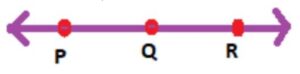
$$P Q+Q R=P R . P, Q, R$$ are collinear points.
$$A C+C B \neq A B$$. A, B. C are non collinear points.
10. SECTION FORMULA :
INTERNAL DIVISION :
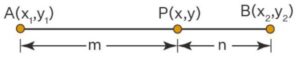
$$P(x, y)$$ divides the line joining $$A\left(x_{1}, y_{1}\right)$$ and $$B\left(x_{2}, y_{2}\right)$$
in the ratio $$m: n$$ internally.
$$\mathrm{P}(\mathrm{x}, \mathrm{y})=\frac{m x_{2}+n x_{1}}{m+n}, \frac{m y_{2}+m y_{1}}{m+n}$$
EXTERNAL DIVISION :
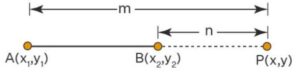
$$P(x, y)$$ divides the line joining $$A\left(x_{1}, y_{1}\right)$$ and $$B\left(x_{2}, y_{2}\right)$$ in the ratio $$m: n$$ externally.
$$\mathrm{P}(\mathrm{x}, \mathrm{y})=\frac{m x_{2}-n x_{1}}{m-n}, \frac{m y_{2}-m y_{1}}{m-n}$$
11. MID – POINT FORMULA :
If $$P(x, y)$$ is the midpoint of the line joining $$A\left(x_{1}, y_{1}\right)$$ and $$B\left(x_{2}, y_{2}\right)$$
$$\boldsymbol{P}(\boldsymbol{x}, \boldsymbol{y})=\frac{x_{2}+x_{1}}{2}, \frac{y_{2}+y_{1}}{2}$$
| 12. | Points of Trisection: The points which divide the line joining A and B in the ratio 2 : 1 and 1 : 2 are called the points of trisection. |
| 13. | To prove that a quadrilateral is a Parallelogram, (given the vertices), prove that the midpoints of both the diagonals are the same. Use the same concept to find the fourth vertex of the parallelogram if three vertices in order are given. |
| 14. | To prove that the quadrilateral is a Rectangle, (given the vertices), prove that the opposite sides are equal and the two diagonals are equal. |
| 15. | To prove that the quadrilateral is a Rhombus, (given the vertices), prove that all four sides are equal. Diagonals are not equal. The diagonals of a rhombus bisect each other at right angles. (Important property of a Rhombus) |
| 16. | To prove that the quadrilateral is a Square, (given the vertices), prove that all four sides are equal and the two diagonals are equal. |