
Pair Of Linear Equations In Two Variables
Previous Year Solved Questions 2025
Q1.Solve the system of Equation for x and y :
\( \frac{x}{2} + \frac{2y}{3} = -1 \) and \( x – \frac{y}{3} = 3 \)( 2 Marks) [CBSE 2025]
Solution:
Multiply first equation by 6 to eliminate denominators:
\( 3x + 4y = -6 \) …(1)
Multiply second equation by 3:
\( 3x – y = 9 \) …(2)
Subtract (2) from (1):
\( (3x + 4y) – (3x – y) = -6 – 9 \)
\( 5y = -15 \Rightarrow y = -3 \)
Substitute \( y = -3 \) into (2):
\( 3x – (-3) = 9 \Rightarrow 3x + 3\)
\(= 9 \Rightarrow 3x = 6 \Rightarrow x = 2 \)
Answer: \( x = 2, y = -3 \)
Q2. Solve graphically:
\( x + 3y = 6 \) and \( 2x – 3y = 12 \) ( 3 Marks)[CBSE 2025]
Solution:
Find two points for each line:
For \( x + 3y = 6 \):
If \( x = 0, y = 2 \) → (0, 2)
If \( y = 0, x = 6 \) → (6, 0)
For \( 2x – 3y = 12 \):
If \( x = 0, y = -4 \) → (0, -4)
If \( y = 0, x = 6 \) → (6, 0)
The lines intersect at (6, 0).
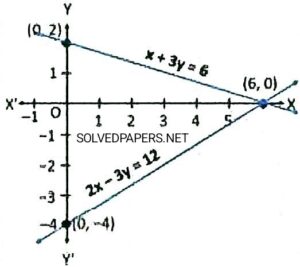
Answer: \( x = 6, y = 0 \)
Q3. Complementary angles:
x and y are complementary such that \( x : y = 1 : 2 \) Express the given information as a system of linear equations in two variables and hence solve it.( 3 Marks) [CBSE 2025]
Solution:
Since complementary angles sum to 90°:
\( x + y = 90 \) …(1)
Given \( \frac{x}{y} = \frac{1}{2} \Rightarrow 2x = y \) …(2)
Substitute (2) into (1):
\( x + 2x = 90 \Rightarrow 3x = 90 \Rightarrow x = 30 \)
Then \( y = 2 \times 30 = 60 \)
Answer: \( x = 30^\circ, y = 60^\circ \)
Q4. Solution of equations:
If \( x = 1, y = 2 \) is a solution of \( 2x – 3y + a = 0 \) and \( 2x + 3y = b \), then
(A) a = 2b
(B) 2a = b
(C) a + 2b = 0
(D) 2a + b = 0:( 1 Marks)CBSE 2025]
Solution:
Substitute into first equation:
\( 2(1) – 3(2) + a = 0 \Rightarrow 2 – 6 + a = 0 \Rightarrow a = 4 \)
Substitute into second equation:
\( 2(1) + 3(2) = b \Rightarrow 2 + 6 = b \Rightarrow b = 8 \)
Now, \( 2a = 2 \times 4 = 8 = b \)
Answer: (B) \( 2a = b \)
Q5. Investment problem:
Vijay invested certain amounts of money in two schemes A and B, which offer interest at the rate of 8% per annum and 9% per annum, respectively. He received ₹1,860 as the total annual interest. However, had he interchanged the amounts of investments in the two schemes, he would have received ₹20 more as annual interest. How much money did he invest in each scheme?(5 Marks)[CBSE 2025]
Solution:
Let investment in scheme A = ₹x at 8%
Investment in scheme B = ₹y at 9%
\( \frac{8x}{100} + \frac{9y}{100} = 1860 \Rightarrow 8x + 9y = 186000 \) …(1)
If interchanged:
\( \frac{9x}{100} + \frac{8y}{100} = 1880 \Rightarrow 9x + 8y = 188000 \) …(2)
Multiply (1) by 9 and (2) by 8:
\( 72x + 81y = 1674000 \)
\( 72x + 64y = 1504000 \)
Subtract: \( 17y = 170000 \Rightarrow y = 10000 \)
From (1): \( 8x + 9(10000) = 186000\)
\(\Rightarrow 8x = 96000\)
\(\Rightarrow x = 12000 \)
Answer: ₹12000 in scheme A, ₹10000 in scheme B
Q6. Train speed problem.
A train travels a distance of 480 km at a uniform speed. If the speed had been 8 km/h less, then it would have taken 3 hours more to cover the same distance. Find the speed of the train.(5 Marks)[CBSE 2025]
Solution:
Let speed = x km/h
Usual time \( = \frac{480}{x} \) hours
Reduced speed = (x – 8) km/h
New time \( = \frac{480}{x – 8} \)
\( \frac{480}{x – 8} – \frac{480}{x} = 3 \)
\( 480 \left( \frac{1}{x – 8} – \frac{1}{x} \right) = 3 \)
\( 480 \left( \frac{x – (x – 8)}{x(x – 8)} \right) = 3 \)
\( \frac{480 \times 8}{x(x – 8)} = 3 \)
\( 3840 = 3x(x – 8) \)
\( x^2 – 8x – 1280 = 0 \)
\( (x – 40)(x + 32) = 0 \)
\( x = 40 \) (since speed can’t be negative)
Answer: Speed = 40 km/h
Q9. Assertion and Reason. ( 1 Marks)[CBSE 2025]
Assertion (A): The value of p for which the system of equations \( 4x + py + 8 = 0 \) and \( 2x + 2y + 2 = 0 \) is consistent is 4.
Reason (R): The system of equations \( a_1x + b_1y = c_1 \) and \( a_2x + b_2y = c_2 \) is consistent with infinitely many solutions, if \( \frac{a_1}{a_2} = \frac{b_1}{b_2} = \frac{c_1}{c_2} \).
Two statements are given, one labelled as Assertion (A) and the other is labelled as Reason (R). Select the correct answer to these questions from the codes (A), (B), (C) and (D) as given below.
(A) Both Assertion (A) and Reason (R) are true and Reason (R) is the correct explanation of Assertion (A).
(B) Both Assertion (A) and Reason (R) are true, but Reason (R) is not the correct explanation of Assertion (A).
(C) Assertion (A) is true, but Reason (R) is false.
(D) Assertion (A) is false, but Reason (R) is true.
Answer: (D) Assertion (A) is false, but Reason (R) is true.
Explanation: For consistency with infinitely many solutions, the ratios must be equal. For the given equations:
\( \frac{4}{2} = \frac{p}{2} = \frac{8}{2} \Rightarrow 2 = \frac{p}{2} = 4 \)
This gives \( \frac{p}{2} = 2 \Rightarrow p = 4 \) and \( \frac{p}{2} = 4 \Rightarrow p = 8 \), which is a contradiction. So, no such p exists. Hence, Assertion is false. Reason is a standard true statement.