
Polynomials
Previous Year Solved Questions 2025
1. Find a quadratic polynomial whose sum and product of zeroes are 0 and -9, respectively. Also, find the zeroes of the polynomial so obtained. [CBSE 2025] (3 Marks)
View Answer
Ans:
Quadratic polynomial: x² – (sum)x + (product)
= x² – 0·x + (-9)
= x² – 9
Quadratic polynomial: x² – (sum)x + (product)
= x² – 0·x + (-9)
= x² – 9
Finding zeroes: x² – 9 = 0
(x+3)(x-3) = 0
x = -3, 3
Polynomial: x² – 9
Zeroes: -3 and 3
2. If α and β are the zeroes of polynomial 3x² + 6x + k such that α + β = αβ, then the value of k is [CBSE 2025] (1 Mark)
(A) 8 (B) -8 (C) 4 (D) -6
(A) 8 (B) -8 (C) 4 (D) -6
View Answer
Ans: (D) -6
For 3x² + 6x + k:
Sum of zeroes α+β = -6/3 = -2
Product αβ = k/3
Given: α+β = αβ
-2 = k/3
k = -6
For 3x² + 6x + k:
Sum of zeroes α+β = -6/3 = -2
Product αβ = k/3
Given: α+β = αβ
-2 = k/3
k = -6
3. Two polynomials are shown in the graph below. The number of distinct zeroes of both the polynomials is: [CBSE 2025] (1 Mark)

(A) 3 (B) 5 (C) 2 (D) 4
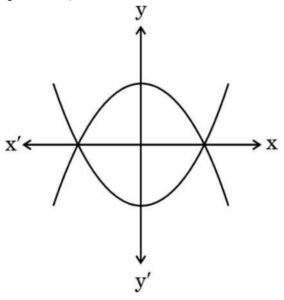
(A) 3 (B) 5 (C) 2 (D) 4
View Answer
Ans: (C) 2
The number of distinct zeroes is equal to the number of times the graph intersects the x-axis. From the graph, there are 2 intersection points.
The number of distinct zeroes is equal to the number of times the graph intersects the x-axis. From the graph, there are 2 intersection points.
4. Find the zeroes of the polynomial p(x) = x² + (4/3)x – (4/3). [CBSE 2025] (2 Marks)
View Answer
Ans: 2/3 and -2
p(x) = x² + (4/3)x – (4/3)
Multiply by 3: 3x² + 4x – 4
Factorize: 3x² + 6x – 2x – 4
= 3x(x+2) – 2(x+2)
= (3x-2)(x+2)
Zeroes: 3x-2=0 → x=2/3
x+2=0 → x=-2