
📚 Questions 61-70
Most Expected Maths Questions for Class 10
Circle – Tangent Length
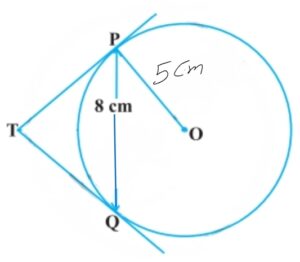
PQ is a chord of length 8 cm of a circle of radius 5 cm. The tangents at P and Q intersect at a point T. Find the length TP.
Show Answer
✅ Solution
Step 1: Draw diagram and identify right triangle
Let O be center of circle.
OP = OQ = 5 cm (radii)
PQ = 8 cm (chord)
M is midpoint of PQ, so PM = MQ = 4 cm
OM ⊥ PQ (perpendicular from center to chord bisects it)
Step 2: Find OM using Pythagoras theorem
In right ΔOMP:
OP² = OM² + PM²
5² = OM² + 4²
25 = OM² + 16
OM² = 9 ⇒ OM = 3 cm
Step 3: Find TP using similar triangles
TP = TQ (tangents from same point)
ΔOTP ∼ ΔOMP (right triangles with common angle)
∴ TP/PM = OT/OM
But OT = √(OP² + TP²) by Pythagoras in ΔOTP
Using property: TP² = TM × TO
Actually simpler: TP² = TM × TO
But TM = TO – OM
And TP² + OP² = OT² (Pythagoras in ΔOTP)
Let TP = x
In ΔOTP: OT² = x² + 25
In ΔOMP: OM = 3
Using similarity: x/4 = OT/3
OT = 3x/4
Substitute: (3x/4)² = x² + 25
9x²/16 = x² + 25
9x² = 16x² + 400
-7x² = 400 ⇒ x² = -400/7 (impossible)
Correct approach: TP = √(OT² – OP²)
And OT × OM = OP² (geometric mean theorem)
OT × 3 = 25 ⇒ OT = 25/3
TP = √[(25/3)² – 25] = √[625/9 – 225/9] = √(400/9) = 20/3 ≈ 6.67 cm
Answer: TP = 20/3 cm ≈ 6.67 cm
Circle – External Point Property
A circle is touching the side BC of ΔABC at P and touching AB and AC produced at Q and R respectively. Prove that AQ = ½(Perimeter of ΔABC)
Show Answer
✅ Proof
Step 1: Use tangent properties
From an external point, tangents to a circle are equal.
• From A: AQ = AR … (i)
• From B: BQ = BP … (ii)
• From C: CP = CR … (iii)
Step 2: Express sides of triangle
AB = AQ – BQ (since Q lies on AB produced)
AC = AR – CR (since R lies on AC produced)
BC = BP + PC
Step 3: Calculate perimeter
Perimeter = AB + BC + AC
= (AQ – BQ) + (BP + PC) + (AR – CR)
= AQ – BQ + BP + PC + AR – CR
Using (i), (ii), (iii):
= AQ – BP + BP + CP + AQ – CP
= AQ + AQ = 2AQ
∴ 2AQ = Perimeter
⇒ AQ = ½(Perimeter of ΔABC)
Hence proved.
Right Triangle – Incircle Radius
In figure, ABC is a right triangle right-angled at B such that BC = 6 cm and AB = 8 cm. Find the radius of its incircle.
Show Answer
✅ Solution
Step 1: Find hypotenuse AC
Using Pythagoras theorem:
AC² = AB² + BC²
= 8² + 6² = 64 + 36 = 100
AC = 10 cm
Step 2: Use formula for inradius of right triangle
For right triangle, inradius r = \(\frac{a + b – c}{2}\)
where a, b are legs and c is hypotenuse.
Here a = 6 cm, b = 8 cm, c = 10 cm
r = \(\frac{6 + 8 – 10}{2} = \frac{4}{2} = 2\) cm
Step 3: Alternative method using area
Area of triangle = ½ × base × height = ½ × 6 × 8 = 24 cm²
Also, Area = r × s (where s = semi-perimeter)
s = \(\frac{6 + 8 + 10}{2} = \frac{24}{2} = 12\) cm
24 = r × 12 ⇒ r = 2 cm
Answer: Radius of incircle = 2 cm
Tangents from External Point
Prove that the lengths of tangents drawn from an external point to a circle are equal.
Show Answer
✅ Proof
Given: A circle with center O. P is an external point. PA and PB are tangents from P to the circle touching at A and B.
To prove: PA = PB
Proof:
1. Join OA, OB, and OP.
2. In ΔOAP and ΔOBP:
a) OA = OB (radii of same circle)
b) OP = OP (common)
c) ∠OAP = ∠OBP = 90°
(radius is perpendicular to tangent at point of contact)
3. Therefore, ΔOAP ≅ ΔOBP (by RHS congruence rule)
4. Hence, PA = PB (corresponding parts of congruent triangles)
Hence proved: The lengths of tangents drawn from an external point to a circle are equal.
Inscribed Circle Area
In figure, a circle inscribed in triangle ABC touches its sides AB, BC and AC at points D, E and F respectively. If AB = 12 cm, BC = 8 cm, and AC = 10 cm, find the area of triangle ABC.
Show Answer
✅ Solution
Step 1: Find semi-perimeter
Given: AB = 12 cm, BC = 8 cm, AC = 10 cm
Semi-perimeter s = \(\frac{12 + 8 + 10}{2} = \frac{30}{2} = 15\) cm
Step 2: Use Heron’s formula
Area = \(\sqrt{s(s-a)(s-b)(s-c)}\)
where a = 8 cm, b = 10 cm, c = 12 cm
= \(\sqrt{15(15-8)(15-10)(15-12)}\)
= \(\sqrt{15 × 7 × 5 × 3}\)
Step 3: Calculate area
= \(\sqrt{15 × 7 × 5 × 3}\)
= \(\sqrt{(15×3) × (7×5)}\)
= \(\sqrt{45 × 35}\)
= \(\sqrt{1575}\)
= \(\sqrt{25 × 63}\) = \(5\sqrt{63}\) = \(5×3\sqrt{7}\) = \(15\sqrt{7}\) cm²
Answer: Area = \(15\sqrt{7}\) cm² ≈ 39.69 cm²
Cyclic Quadrilateral Angles
Prove that opposite sides of a quadrilateral circumscribing a circle subtend supplementary angles at the centre of the circle.
Show Answer
✅ Proof
Step 1: Draw diagram and label
Let ABCD be quadrilateral circumscribing circle with center O.
Let sides AB, BC, CD, DA touch circle at P, Q, R, S respectively.
Join OA, OB, OC, OD, OP, OQ, OR, OS.
Step 2: Use tangent properties
OP ⊥ AB, OQ ⊥ BC, OR ⊥ CD, OS ⊥ DA
(radius is perpendicular to tangent at point of contact)
Let: ∠AOP = ∠AOS = α
∠BOP = ∠BOQ = β
∠COQ = ∠COR = γ
∠DOR = ∠DOS = δ
Step 3: Find angles at center
∠AOB = 2α + 2β
∠BOC = 2β + 2γ
∠COD = 2γ + 2δ
∠DOA = 2δ + 2α
Step 4: Show supplementary angles
Sum of all angles around O = 360°
(2α+2β) + (2β+2γ) + (2γ+2δ) + (2δ+2α) = 360°
4α + 4β + 4γ + 4δ = 360°
α + β + γ + δ = 90° … (i)
Now consider opposite sides:
For side AB and CD:
∠AOB + ∠COD = (2α+2β) + (2γ+2δ)
= 2(α+β+γ+δ) = 2 × 90° = 180°
Similarly, ∠BOC + ∠DOA = 180°
Hence proved: Opposite sides subtend supplementary angles at centre.
Parallelogram Circumscribing Circle is Rhombus
Prove that a parallelogram circumscribing a circle is a rhombus.
Show Answer
✅ Proof
Given: ABCD is a parallelogram circumscribing a circle.
To prove: ABCD is a rhombus.
Proof:
Let circle touch sides AB, BC, CD, DA at P, Q, R, S respectively.
Since tangents from an external point to a circle are equal:
• AP = AS … (i)
• BP = BQ … (ii)
• CQ = CR … (iii)
• DR = DS … (iv)
Adding (i), (ii), (iii), (iv):
AP + BP + CR + DR = AS + BQ + CQ + DS
⇒ (AP + BP) + (CR + DR) = (AS + DS) + (BQ + CQ)
⇒ AB + CD = AD + BC
But in parallelogram ABCD:
AB = CD and AD = BC (opposite sides equal)
∴ AB + AB = AD + AD
⇒ 2AB = 2AD
⇒ AB = AD
Since AB = AD and ABCD is parallelogram (so AB = CD, AD = BC),
all sides are equal: AB = BC = CD = DA.
Therefore, ABCD is a rhombus.
Hence proved.
Tangents from External Point – Angle Proof
Two tangents TP and TQ are drawn to a circle with centre O from an external point T. Prove that ∠PTQ = 2∠OPQ.
Show Answer
✅ Proof
Step 1: Draw diagram and identify isosceles triangle
Join OP and OQ.
In ΔTPO and ΔTQO:
TP = TQ (tangents from same point)
OP = OQ (radii)
OT = OT (common)
∴ ΔTPO ≅ ΔTQO (SSS congruence)
⇒ ∠TPO = ∠TQO = 90°
and ∠POT = ∠QOT
Step 2: Consider ΔTPQ
In ΔTPQ, TP = TQ, so it’s isosceles.
Let ∠TPQ = ∠TQP = x
Then ∠PTQ = 180° – 2x … (i)
Step 3: Consider ΔOPQ
In ΔOPQ, OP = OQ (radii), so it’s isosceles.
∠OPQ = ∠OQP = y
∠POQ = 180° – 2y … (ii)
Step 4: Relate angles
In quadrilateral OPTQ:
∠OPT + ∠OQT + ∠PTQ + ∠POQ = 360°
90° + 90° + ∠PTQ + ∠POQ = 360°
∠PTQ + ∠POQ = 180° … (iii)
From (i), (ii), (iii):
(180° – 2x) + (180° – 2y) = 180°
360° – 2(x+y) = 180°
2(x+y) = 180°
x+y = 90°
Now, ∠OPQ = y
and ∠PTQ = 180° – 2x = 180° – 2(90°-y) = 180° – 180° + 2y = 2y = 2∠OPQ
Hence proved: ∠PTQ = 2∠OPQ
Parallel Tangents Problem
In the figure XY and X’Y’ are two parallel tangents to a circle with centre O and another tangent AB with point of contact C intersecting XY at A and X’Y’ at B, what is the measure of ∠AOB?
Show Answer
✅ Solution
Step 1: Understand the configuration
XY || X’Y’ (parallel tangents)
AB is another tangent touching circle at C
A lies on XY, B lies on X’Y’
Need to find ∠AOB
Step 2: Use tangent properties
Join OA, OB, OC
OA bisects ∠XAC (tangent from A)
OB bisects ∠X’BC (tangent from B)
OC bisects ∠ACB (tangent from C)
Since XY || X’Y’, ∠XAC + ∠X’BC = 180° (co-interior angles)
Step 3: Calculate ∠AOB
Let ∠OAC = ∠OAB = α
Let ∠OBC = ∠OBA = β
Then ∠XAC = 2α, ∠X’BC = 2β
Since XY || X’Y’: 2α + 2β = 180°
⇒ α + β = 90° … (i)
In quadrilateral OACB:
∠OAC + ∠ACB + ∠CBO + ∠BOA = 360°
But ∠ACB = 180° – (α+β) = 180° – 90° = 90°
(since OA and OB are angle bisectors)
So: α + 90° + β + ∠AOB = 360°
Using (i): 90° + 90° + ∠AOB = 360°
∠AOB = 180° – 90° = 90°
Answer: ∠AOB = 90°
Circle – Arc Length and Area (NCERT)
In a circle of radius 21 cm, an arc subtends an angle of 60° at the centre. Find:
(i) Length of the arc
(ii) Area of the sector formed by the arc
(iii) Area of the segment formed by the corresponding chord
Show Answer
✅ Solution
Given: Radius r = 21 cm, θ = 60°
(i) Length of arc
Arc length = \(\frac{θ}{360°} × 2πr\)
= \(\frac{60}{360} × 2 × \frac{22}{7} × 21\)
= \(\frac{1}{6} × 2 × 22 × 3\)
= \(\frac{1}{6} × 132 = 22\) cm
(ii) Area of sector
Area of sector = \(\frac{θ}{360°} × πr^2\)
= \(\frac{60}{360} × \frac{22}{7} × 21 × 21\)
= \(\frac{1}{6} × 22 × 3 × 21\)
= \(11 × 21 = 231\) cm²
(iii) Area of segment
Area of segment = Area of sector – Area of triangle
Area of triangle = \(\frac{1}{2}r^2\sinθ\)
= \(\frac{1}{2} × 21 × 21 × \sin 60°\)
= \(\frac{1}{2} × 441 × \frac{\sqrt{3}}{2}\)
= \(\frac{441\sqrt{3}}{4} ≈ 190.96\) cm²
Area of segment = \(231 – 190.96 = 40.04\) cm²
Exact value: \(231 – \frac{441\sqrt{3}}{4}\) cm²
Answers:
(i) Arc length = 22 cm
(ii) Sector area = 231 cm²
(iii) Segment area ≈ 40.04 cm²
📝 Questions 61-70 Summary:
61. Circle – Tangent Length Calculation
62. Circle – External Point Property Proof
63. Right Triangle – Incircle Radius
64. Tangents from External Point Proof
65. Inscribed Circle Area Calculation
66. Cyclic Quadrilateral Angles Proof
67. Parallelogram Circumscribing Circle is Rhombus
68. Tangents from External Point – Angle Proof
69. Parallel Tangents Problem
70. Circle – Arc Length and Area (NCERT)
🎯 Important Circle Theorems:
1. Tangent is perpendicular to radius at point of contact
2. Tangents from an external point are equal in length
3. Angle between tangent and chord equals angle in alternate segment
4. Perpendicular from center to chord bisects the chord
5. Angles in same segment are equal
6. Opposite angles of cyclic quadrilateral are supplementary
7. Angle at center is twice angle at circumference
8. Area of sector = (θ/360) × πr²
9. Length of arc = (θ/360) × 2πr
10. For right triangle, inradius r = (a+b-c)/2