
📚 Questions 51-60
Most Expected Maths Questions for Class 10
Trigonometric Identity Proof
Prove that: \(\frac{\sin A – 2\sin^3 A}{2\cos^3 A – \cos A} = \tan A\)
Show Answer
✅ Proof
Step 1: Factor numerator and denominator
LHS = \(\frac{\sin A – 2\sin^3 A}{2\cos^3 A – \cos A}\)
= \(\frac{\sin A(1 – 2\sin^2 A)}{\cos A(2\cos^2 A – 1)}\)
Step 2: Use trigonometric identities
Using identities:
>>1 – 2sin²A =sin²A+cos²A- 2sin²A=cos²A-sin²A
>>2cos²A – 1 = 2cos²A – [ sin²A+cos²A ] = 2cos²A – sin²A – cos²A =cos²A-sin²A
∴ LHS = \(\frac{\sin A \cdot \cos²A-sin²A}{\cos A \cdot \cos²A-sin²A}\)
Step 3: Simplify
Cancel cos²A-sin²A (provided cos²A-sin²A ≠ 0):
LHS = \(\frac{\sin A}{\cos A} = \tan A\)
∴ LHS = RHS
Hence proved.
Trigonometric Identity Proof
Prove that: \(\sec A (1 – \sin A)(\sec A + \tan A) = 1\)
Show Answer
✅ Proof
Step 1: Expand LHS
LHS = \(\sec A (1 – \sin A)(\sec A + \tan A)\)
= \(\frac{1}{\cos A} (1 – \sin A)\left(\frac{1}{\cos A} + \frac{\sin A}{\cos A}\right)\)
= \(\frac{1 – \sin A}{\cos A} \cdot \frac{1 + \sin A}{\cos A}\)
Step 2: Simplify
LHS = \(\frac{(1 – \sin A)(1 + \sin A)}{\cos^2 A}\)
= \(\frac{1 – \sin^2 A}{\cos^2 A}\)
Step 3: Use identity
Using \(\sin^2 A + \cos^2 A = 1\) ⇒ \(1 – \sin^2 A = \cos^2 A\)
LHS = \(\frac{\cos^2 A}{\cos^2 A} = 1\)
∴ LHS = RHS
Hence proved.
Trigonometric Evaluation
Evaluate: \(\frac{5\cos^2 60^\circ + 4\sec^2 30^\circ – \tan^2 45^\circ}{\sin^2 30^\circ + \cos^2 30^\circ}\)
Show Answer
✅ Solution
Step 1: Find trigonometric values
\(\cos 60^\circ = \frac{1}{2}\)
\(\sec 30^\circ = \frac{2}{\sqrt{3}}\)
\(\tan 45^\circ = 1\)
\(\sin 30^\circ = \frac{1}{2}\)
\(\cos 30^\circ = \frac{\sqrt{3}}{2}\)
Step 2: Calculate numerator
Numerator = \(5\left(\frac{1}{2}\right)^2 + 4\left(\frac{2}{\sqrt{3}}\right)^2 – (1)^2\)
= \(5 \times \frac{1}{4} + 4 \times \frac{4}{3} – 1\)
= \(\frac{5}{4} + \frac{16}{3} – 1\)
Step 3: Calculate denominator
Denominator = \(\left(\frac{1}{2}\right)^2 + \left(\frac{\sqrt{3}}{2}\right)^2\)
= \(\frac{1}{4} + \frac{3}{4} = 1\)
Step 4: Simplify numerator
Numerator = \(\frac{5}{4} + \frac{16}{3} – 1\)
= \(\frac{5}{4} + \frac{16}{3} – \frac{4}{4}\)
= \(\frac{1}{4} + \frac{16}{3}\)
= \(\frac{3}{12} + \frac{64}{12} = \frac{67}{12}\)
Final value = \(\frac{67/12}{1} = \frac{67}{12}\)
Answer: \(\frac{67}{12}\)
Find Angles from Trigonometric Equations
If A and B are acute angles such that \(\sin(A – B) = 0\) and \(2\cos(A + B) – 1 = 0\), then find angles A and B.
Show Answer
✅ Solution
Step 1: Solve first equation
\(\sin(A – B) = 0\)
Since A and B are acute (0° to 90°), A-B is between -90° and 90°
\(\sin θ = 0\) when θ = 0°, 180°, etc.
In given range, only θ = 0° works
∴ A – B = 0 ⇒ A = B … (i)
Step 2: Solve second equation
\(2\cos(A + B) – 1 = 0\)
\(2\cos(A + B) = 1\)
\(\cos(A + B) = \frac{1}{2}\)
Step 3: Find A+B
\(\cos 60^\circ = \frac{1}{2}\)
Since A and B are acute, A+B is between 0° and 180°
∴ A + B = 60° … (ii)
Step 4: Solve equations
From (i): A = B
From (ii): A + B = 60°
∴ A + A = 60° ⇒ 2A = 60° ⇒ A = 30°
B = A = 30°
Answer: A = 30°, B = 30°
Trigonometric Identity Proof
If \(\sin θ + \cos θ = \sqrt{3}\) then prove that \(\tan θ + \cot θ = 1\)
Show Answer
✅ Proof
Step 1: Square the given equation
Given: \(\sin θ + \cos θ = \sqrt{3}\)
Squaring both sides:
\((\sin θ + \cos θ)^2 = (\sqrt{3})^2\)
\(\sin^2 θ + \cos^2 θ + 2\sin θ \cos θ = 3\)
Step 2: Use identity
Using \(\sin^2 θ + \cos^2 θ = 1\):
\(1 + 2\sin θ \cos θ = 3\)
\(2\sin θ \cos θ = 2\)
\(\sin θ \cos θ = 1\)
Step 3: Prove required identity
\(\tan θ + \cot θ = \frac{\sin θ}{\cos θ} + \frac{\cos θ}{\sin θ}\)
= \(\frac{\sin^2 θ + \cos^2 θ}{\sin θ \cos θ}\)
= \(\frac{1}{\sin θ \cos θ}\)
= \(\frac{1}{1} = 1\) (from step 2)
Hence proved.
Trigonometric Expression Evaluation
If \(4 \tan θ = 3\), evaluate \(\frac{4\sin θ – \cos θ + 1}{4\sin θ + \cos θ – 1}\)
Show Answer
✅ Solution
Step 1: Find trigonometric ratios
Given: \(4\tan θ = 3\) ⇒ \(\tan θ = \frac{3}{4}\)
Draw right triangle: Opposite = 3, Adjacent = 4
Hypotenuse = \(\sqrt{3^2 + 4^2} = \sqrt{9+16} = \sqrt{25} = 5\)
∴ \(\sin θ = \frac{3}{5}\), \(\cos θ = \frac{4}{5}\)
Step 2: Substitute in expression
\(\frac{4\sin θ – \cos θ + 1}{4\sin θ + \cos θ – 1}\)
= \(\frac{4\left(\frac{3}{5}\right) – \frac{4}{5} + 1}{4\left(\frac{3}{5}\right) + \frac{4}{5} – 1}\)
Step 3: Simplify
Numerator: \(\frac{12}{5} – \frac{4}{5} + 1 = \frac{8}{5} + 1 = \frac{8}{5} + \frac{5}{5} = \frac{13}{5}\)
Denominator: \(\frac{12}{5} + \frac{4}{5} – 1 = \frac{16}{5} – 1 = \frac{16}{5} – \frac{5}{5} = \frac{11}{5}\)
Expression = \(\frac{13/5}{11/5} = \frac{13}{11}\)
Answer: \(\frac{13}{11}\)
Height and Distance Problem
The angle of elevation of the top of a building from the foot of the tower is 30° and the angle of elevation of the top of the tower from the foot of the building is 60°. If the tower is 50 m high, then find the height of the building.
Show Answer
✅ Solution
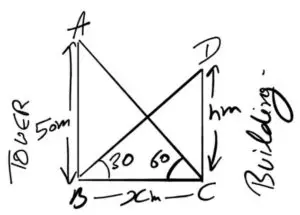
Step 1: Draw diagram
Let: Tower height = AB = 50 m
Building height = CD = h m
Distance between them = BC = x m
Step 2: From tower to building
In ΔABC: \(\tan 60^\circ = \frac{AB}{BC}\)
\(\sqrt{3} = \frac{50}{x}\)
\(x = \frac{50}{\sqrt{3}}\) … (i)
Step 3: From building to tower
In ΔBCD: \(\tan 30^\circ = \frac{CD}{BC}\)
\(\frac{1}{\sqrt{3}} = \frac{h}{x}\)
\(h = \frac{x}{\sqrt{3}}\)
Substitute x from (i):
\(h = \frac{50/\sqrt{3}}{\sqrt{3}} = \frac{50}{3} \approx 16.67 \text{ m}\)
Answer: Height of building = 50/3 m ≈ 16.67 m
Height and Distance – Ship Problem
A man standing on the deck of a ship, which is 10 m above water level, observes the angle of elevation of the top of a hill as 60° and the angle of depression of the base of hill as 30°. Find the distance of the hill from the ship and the height of the hill.
Show Answer
✅ Solution
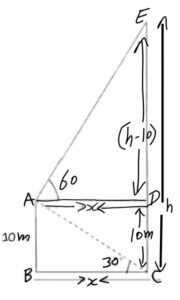
Step 1: Draw diagram
Let: Ship’s height above water = AB = 10 m
Distance from ship to hill = BC = x m
Height of hill above water = CE = h m
Height of hill above ship’s deck = DE = (h – 10) m
Step 2: Find distance to hill
In ΔABC: \(\tan 30^\circ = \frac{AB}{BC}\)
\(\frac{1}{\sqrt{3}} = \frac{10}{x}\)
\(x = 10\sqrt{3} \approx 17.32 \text{ m}\)
Distance of hill from ship = \(10\sqrt{3}\) m
Step 3: Find height of hill
In ΔBDE: \(\tan 60^\circ = \frac{DE}{BD} = \frac{h-10}{x}\)
\(\sqrt{3} = \frac{h-10}{10\sqrt{3}}\)
\(h-10 = \sqrt{3} \times 10\sqrt{3} = 10 \times 3 = 30\)
\(h = 40 \text{ m}\)
Answer: Distance = \(10\sqrt{3}\) m ≈ 17.32 m, Height = 40 m
Height and Distance – Tower Problem
The angle of elevation of the top Q of a vertical tower PQ from a point X on the ground is 60°. From a point Y, 40 m vertically above X, the angle of elevation of the top Q of tower is 45°. Find the height of the tower PQ and the distance PX. (Use √3 = 1.73)
Show Answer
✅ Solution
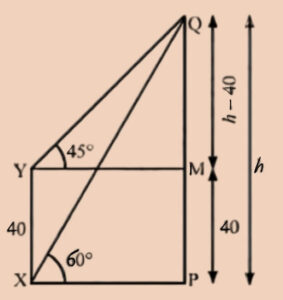
Step 1: Draw diagram
Let: Tower height = PQ = h m
Distance PX = x m
Y is 40 m above X, so YX = 40 m
In triangles, we have two right triangles.
Step 2: From point X (ground)
In ΔPQX: \(\tan 60^\circ = \frac{PQ}{PX}\)
\(\sqrt{3} = \frac{h}{x}\)
\(h = x\sqrt{3}\) … (i)
Step 3: From point Y (40 m above X)
Height from Y to Q = h – 40
In ΔQYR (where R is vertically below Y):
\(\tan 45^\circ = \frac{h-40}{x}\)
\(1 = \frac{h-40}{x}\)
\(x = h – 40\) … (ii)
Step 4: Solve equations
From (i) and (ii):
\(h = (h-40)\sqrt{3}\)
\(h = h\sqrt{3} – 40\sqrt{3}\)
\(h\sqrt{3} – h = 40\sqrt{3}\)
\(h(\sqrt{3} – 1) = 40\sqrt{3}\)
\(h = \frac{40\sqrt{3}}{\sqrt{3}-1} \times \frac{\sqrt{3}+1}{\sqrt{3}+1}\)
\(h = \frac{40\sqrt{3}(\sqrt{3}+1)}{3-1} = \frac{40(3+\sqrt{3})}{2} = 20(3+\sqrt{3})\)
Using √3 = 1.73: h = 20(3+1.73) = 20×4.73 = 94.6 m
x = h – 40 = 94.6 – 40 = 54.6 m
Answer: Height = 94.6 m, Distance = 54.6 m
Cloud Height Problem
At a point A, 20 metres above the level of water in a lake, the angle of elevation of a cloud is 30°. The angle of depression of the reflection of the cloud in the lake, at A is 60°. Find the distance of the cloud from A.
Show Answer
✅ Solution
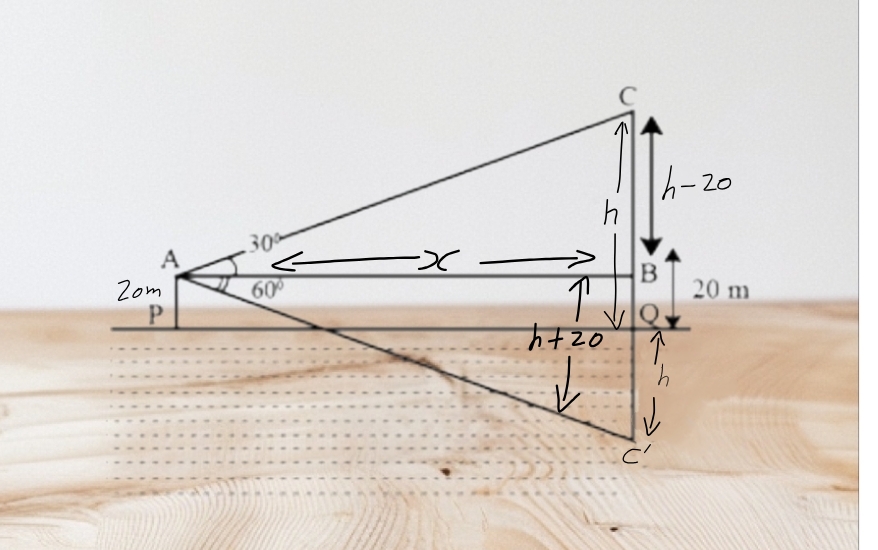
Step 1: Understand the problem
Let: A is 20 m above water level
Cloud is at C, height h above water
Reflection of cloud is at C’ (h below water)
Distance AB = x (to find)
Step 2: For cloud elevation
Height of cloud above B = (h – 20) m
Horizontal distance from A to B= x m
\(\tan 30^\circ = \frac{h-20}{x}\)
\(\frac{1}{\sqrt{3}} = \frac{h-20}{x}\)
\(x = \sqrt{3}(h-20)\) … (i)
Step 3: For reflection depression
Depth of reflection below water = h
Depth below B = (h + 20) m
\(\tan 60^\circ = \frac{h+20}{x}\)
\(\sqrt{3} = \frac{h+20}{x}\)
\(x = \frac{h+20}{\sqrt{3}}\) … (ii)
Step 4: Solve equations
From (i) and (ii):
\(\sqrt{3}(h-20) = \frac{h+20}{\sqrt{3}}\)
\(3(h-20) = h+20\)
\(3h – 60 = h + 20\)
\(2h = 80\)
\(h = 40 \text{ m}\)
Now find x (distance AB):
Vertical distance = h-20 = 20 m
Horizontal distance x = \(\sqrt{3}(20) = 20\sqrt{3}\) m \(d = \sqrt{(20)^2 + (20\sqrt{3})^2}\) \(= \sqrt{400 + 1200}\) \(= \sqrt{1600}\) \(= 40 \text{ m}\)
Answer: Distance of cloud from A = 20 m