
Similar Triangles with Angle Bisectors
If CD and GH (D and H lie on AB and FE) are respectively bisectors of ∠ACB and ∠EGF and ΔABC ∼ ΔFEG, prove that ΔDCA ∼ ΔHGF.
Show Answer
✅ Proof
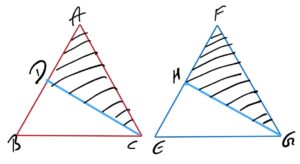
Step 1: Given information
Given: ΔABC ∼ ΔFEG
∴ ∠A = ∠F, ∠B = ∠E, ∠C = ∠G
Also: CD bisects ∠ACB ⇒ ∠ACD = ∠DCB = ½∠C
GH bisects ∠EGF ⇒ ∠EGH = ∠HGF = ½∠G
Step 2: Show corresponding angles are equal
In ΔDCA and ΔHGF:
1. ∠A = ∠F (from ΔABC ∼ ΔFEG)
2. ∠ACD = ½∠C = ½∠G = ∠HGF
(Since ∠C = ∠G and both are bisected)
Step 3: Apply AA similarity criterion
In ΔDCA and ΔHGF:
∠A = ∠F
∠ACD = ∠HGF
∴ By AA similarity criterion:
ΔDCA ∼ ΔHGF
Similar Triangles Proof
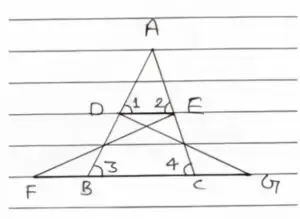
In figure, ΔFEC ≅ ΔGDB and ∠1 = ∠2. Prove that ΔADE ∼ ΔABC.
Show Answer
✅ Proof
Given:
- ΔFEC ≅ ΔGDB
- ∠1 = ∠2
To Prove:
ΔADE ~ ΔABC
Proof:
Given ∠1 = ∠2
AD = AE ( side opposite to equal angle are equal ) —-l
Since ΔFEC ≅ ΔGDB, their corresponding parts are equal.
Therefore:
EC = DB —-ll
From l and ll
AD / DB = AE / EC
By converse of B.P.T
Hence, DE ∥ BC
Using Parallel Lines Property:
∠1 = ∠3. [ By corresponding angles are equal ]
∠2 = ∠4 [ By corresponding angles are equal ]
In ΔADE and ΔABC
- ∠1 = ∠3 [ proved above ]
- ∠2 = ∠4 [ proved above ]
Therefore, by AA Similarity Rule:
ΔADE ~ ΔABC
Hence Proved ✔
Intersecting Chords Theorem
Two right triangles ABC and DBC are drawn on the same hypotenuse BC and on the same side of BC. If AC and BD intersect at P, prove that AP × PC = BP × DP.
Show Answer
✅ Proof
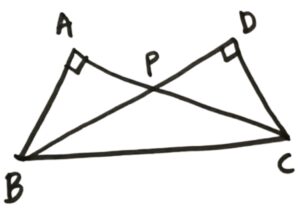
Step 1: Identify similar triangles
In ΔAPB and ΔDPC:
1. ∠APB = ∠DPC (vertically opposite angles)
2. ∠BAP = ∠CDP ( 90 degree each )
3. ∠ABP = ∠DCP (remaining angles)
∴ ΔAPB ∼ ΔDPC (by AA similarity)
Step 2: Use property of similar triangles
From ΔAPB ∼ ΔDPC:
Corresponding sides are proportional:
AP/DP = PB/PC = AB/DC
Step 3: Prove required relation
From AP/DP = PB/PC
Cross multiply: AP × PC = PB × DP
∴ AP × PC = BP × DP
Basic Proportionality Theorem Application
If a line is drawn parallel to one side of a triangle to intersect the other two sides in distinct points, then prove that the other two sides are divided in the same ratio.
Show Answer
✅ Proof (Basic Proportionality Theorem/Thales Theorem)
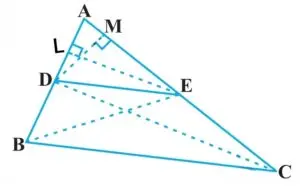
Given:
In ΔABC, DE || BC, intersecting AB at D and AC at E.
To prove: AD/DB = AE/EC
Proof:
1. Join BE and CD.
2. Draw EL ⊥ AB and DM ⊥ AC.
3. Area of ΔADE = ½ × AD × EL
Area of ΔBDE = ½ × DB × EL
∴ Area(ΔADE)/Area(ΔBDE) = AD/DB … (i)
4. Similarly, Area(ΔADE) = ½ × AE × DM
Area(ΔCDE) = ½ × EC × DM
∴ Area(ΔADE)/Area(ΔCDE) = AE/EC … (ii)
5. But ΔBDE and ΔCDE are on same base DE and between same parallels DE and BC.
∴ Area(ΔBDE) = Area(ΔCDE)
⇒ Area(ΔADE)/Area(ΔBDE) = Area(ΔADE)/Area(ΔCDE)
6. From (i) and (ii):
AD/DB = AE/EC
Hence proved.
Similar Triangles with Medians
If AD and PM are medians of triangles ABC and PQR respectively where ΔABC ∼ ΔPQR, prove that AB/PQ = AD/PM.
Show Answer
✅ Proof
Step 1: Given information
Given: ΔABC ∼ ΔPQR
∴ AB/PQ = BC/QR = AC/PR … (i)
Also: AD is median of ΔABC ⇒ BD = DC = ½BC
PM is median of ΔPQR ⇒ QM = MR = ½QR
Step 2: Show ΔABD ∼ ΔPQM
In ΔABD and ΔPQM:
1. ∠B = ∠Q (from ΔABC ∼ ΔPQR)
2. AB/PQ = BC/QR (from i)
But BC/QR = 2BD/2QM = BD/QM
∴ AB/PQ = BD/QM
Step 3: Apply SAS similarity
In ΔABD and ΔPQM:
∠B = ∠Q
AB/PQ = BD/QM (proved above)
∴ ΔABD ∼ ΔPQM (by SAS similarity)
From similarity: AB/PQ = AD/PM
Hence proved.
Parallelogram Coordinates
If A(-2, 1), B(a, 0), C(4, b) and D(1, 2) are the vertices of a parallelogram ABCD, find the values of a and b.
Show Answer
✅ Solution
Step 1: Use property of parallelogram
In a parallelogram, diagonals bisect each other.
Let diagonals AC and BD intersect at O.
Then O is midpoint of both AC and BD.
Step 2: Find midpoint of AC
Midpoint of AC = \(\left(\frac{-2+4}{2}, \frac{1+b}{2}\right)\) = \(\left(1, \frac{1+b}{2}\right)\)
Step 3: Find midpoint of BD
Midpoint of BD = \(\left(\frac{a+1}{2}, \frac{0+2}{2}\right)\) = \(\left(\frac{a+1}{2}, 1\right)\)
Step 4: Equate midpoints
Since both represent the same point O:
1 = (a+1)/2 ⇒ a+1 = 2 ⇒ a = 1
(1+b)/2 = 1 ⇒ 1+b = 2 ⇒ b = 1
Answer: a = 1, b = 1
Section Formula Application
In what ratio does the point (x, 0) divide the line segment joining the points P(2, -2) and Q(3, 7)?
Show Answer
✅ Solution
Step 1: Let ratio be k:1
Let point R(x, 0) divide PQ in ratio k:1
Using section formula:
x-coordinate: x = \(\frac{k×3 + 1×2}{k+1}\) = \(\frac{3k+2}{k+1}\)
y-coordinate: 0 = \(\frac{k×7 + 1×(-2)}{k+1}\) = \(\frac{7k-2}{k+1}\)
Step 2: Solve for k using y-coordinate
0 = \(\frac{7k-2}{k+1}\)
7k – 2 = 0
7k = 2
k = 2/7
Step 3: Find x-coordinate
x = \(\frac{3(2/7)+2}{(2/7)+1}\) = \(\frac{6/7+2}{2/7+1}\) = \(\frac{6/7+14/7}{2/7+7/7}\)
= \(\frac{20/7}{9/7}\) = 20/9
Answer: Ratio = 2:7, Point = (20/9, 0)
Trisection Points
Let P and Q be the points of trisection of the line segment joining the points A(2, -2) and B(-7, 4) such that P is nearer to A. Find the coordinates of P and Q.
Show Answer
✅ Solution
Step 1: Understand trisection
Trisection means dividing into 3 equal parts.
P divides AB in ratio 1:2 (since P is nearer to A)
Q divides AB in ratio 2:1 (Q is nearer to B)
Step 2: Find coordinates of P (ratio 1:2)
P divides AB in ratio 1:2
P = \(\left(\frac{1×(-7)+2×2}{1+2}, \frac{1×4+2×(-2)}{1+2}\right)\)
= \(\left(\frac{-7+4}{3}, \frac{4-4}{3}\right)\) = \(\left(\frac{-3}{3}, \frac{0}{3}\right)\) = (-1, 0)
Step 3: Find coordinates of Q (ratio 2:1)
Q divides AB in ratio 2:1
Q = \(\left(\frac{2×(-7)+1×2}{2+1}, \frac{2×4+1×(-2)}{2+1}\right)\)
= \(\left(\frac{-14+2}{3}, \frac{8-2}{3}\right)\) = \(\left(\frac{-12}{3}, \frac{6}{3}\right)\) = (-4, 2)
Answer: P(-1, 0), Q(-4, 2)
Right Angled Isosceles Triangle
Prove that the points (3, 0), (6, 4) and (-1, 3) are the vertices of a right angled isosceles triangle.
Show Answer
✅ Solution
Step 1: Calculate distances
Let A(3,0), B(6,4), C(-1,3)
AB = √[(6-3)² + (4-0)²] = √(3² + 4²) = √(9+16) = √25 = 5
BC = √[(-1-6)² + (3-4)²] = √((-7)² + (-1)²) = √(49+1) = √50
AC = √[(-1-3)² + (3-0)²] = √((-4)² + 3²) = √(16+9) = √25 = 5
Step 2: Check for isosceles triangle
AB = AC = 5
BC = √50
∴ Two sides are equal ⇒ Triangle is isosceles.
Step 3: Check for right angle
Check Pythagoras theorem:
AB² + AC² = 5² + 5² = 25 + 25 = 50
BC² = (√50)² = 50
∴ AB² + AC² = BC²
Hence, triangle is right angled at A (since sides containing right angle are equal).
Conclusion: The points form a right angled isosceles triangle.
Find Coordinates with Given Ratio
If A and B are (-2, -2) and (2, -4) respectively, find the coordinates of P such that AP = 3/7 AB and P lies on the line segment AB.
Show Answer
✅ Solution
Step 1: Understand given condition
AP = (3/7)AB
This means P divides AB in ratio 3:4
Because: AP = 3/7 AB
⇒ AP/AB = 3/7
⇒ AP:PB = 3:(7-3) = 3:4
Step 2: Apply section formula
A(-2,-2), B(2,-4), ratio = 3:4
P = \(\left(\frac{3×2 + 4×(-2)}{3+4}, \frac{3×(-4) + 4×(-2)}{3+4}\right)\)
Step 3: Calculate coordinates
x-coordinate = \(\frac{6 – 8}{7}\) = \(\frac{-2}{7}\)
y-coordinate = \(\frac{-12 – 8}{7}\) = \(\frac{-20}{7}\)
Answer: P\(\left(\frac{-2}{7}, \frac{-20}{7}\right)\)