
Flag Dimensions Problem
In a painting competition of a school, a child made Indian national flag whose perimeter was 50 cm. Its area will be decreased by 6 square cm, if length is decreased by 3 cm and breadth is increased by 2 cm. Find the dimensions of the flag.
Show Answer
✅ Solution
Step 1: Let dimensions
Let length = l cm, breadth = b cm
Perimeter = 2(l + b) = 50
⇒ l + b = 25 … (i)
Step 2: Area condition
Original area = l × b
New length = (l – 3) cm
New breadth = (b + 2) cm
New area = (l – 3)(b + 2)
Given: New area = Original area – 6
(l – 3)(b + 2) = lb – 6
Step 3: Solve equations
Expand: lb + 2l – 3b – 6 = lb – 6
2l – 3b = 0 … (ii)
From (i): l = 25 – b
Substitute in (ii): 2(25 – b) – 3b = 0
50 – 2b – 3b = 0
50 = 5b ⇒ b = 10 cm
l = 25 – 10 = 15 cm
Answer: Length = 15 cm, Breadth = 10 cm
Taxi Charges Problem (NCERT, CBSE 2000)
The taxi charges in a city comprise of a fixed charge together with the charge for the distance covered. For a journey of 10 km the charge paid is ₹75 and for a journey of 15 km the charge paid is ₹110. What will a person have to pay for travelling a distance of 25 km?
Show Answer
✅ Solution
Step 1: Define variables
Let fixed charge = ₹x
Charge per km = ₹y
Step 2: Form equations
For 10 km: x + 10y = 75 … (i)
For 15 km: x + 15y = 110 … (ii)
Step 3: Solve equations
Subtract (i) from (ii):
(x + 15y) – (x + 10y) = 110 – 75
5y = 35 ⇒ y = 7
From (i): x + 10(7) = 75
x + 70 = 75 ⇒ x = 5
Step 4: Find charge for 25 km
For 25 km: x + 25y = 5 + 25(7)
= 5 + 175 = ₹180
Answer: ₹180
System with No Solution
For what value of k, will the system of equations have no solution?
x + 2y = 5
3x + ky – 15 = 0
Show Answer
✅ Solution
Step 1: Write in standard form
Equations:
x + 2y = 5 ⇒ x + 2y – 5 = 0
3x + ky – 15 = 0
Here: a₁ = 1, b₁ = 2, c₁ = -5
a₂ = 3, b₂ = k, c₂ = -15
Step 2: Condition for no solution
For no solution: a₁/a₂ = b₁/b₂ ≠ c₁/c₂
1/3 = 2/k ≠ (-5)/(-15) = 1/3
Step 3: Solve for k
1/3 = 2/k ⇒ k = 6
Check: 1/3 = 2/6 = 1/3, but c₁/c₂ = (-5)/(-15) = 1/3
So 1/3 = 1/3 = 1/3, which means equal ratios, not unequal.
Actually, for no solution: a₁/a₂ = b₁/b₂ ≠ c₁/c₂
Here 1/3 = 2/k and 1/3 ≠ 1/3 is false.
Correct approach: For no solution, lines must be parallel but not coincident.
1/3 = 2/k ⇒ k = 6, but then c₁/c₂ = 1/3, so lines are coincident.
∴ System has infinite solutions when k = 6.
For no solution, k must be such that 1/3 = 2/k but c₁/c₂ ≠ 1/3, which is impossible here.
Answer: No value of k gives no solution; for k = 6, infinite solutions.
Graph and Area Problem (CBSE 2002)
Draw the graphs of 2x + y = 6 and 2x – y + 2 = 0. Shade the region bounded by these lines and x-axis. Find the area of the shaded region.
Show Answer
✅ Solution
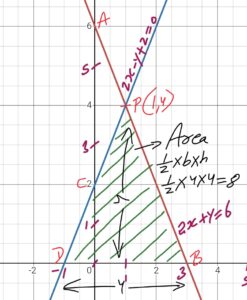
Step 1: Find intersection point
Solve: 2x + y = 6 … (i)
2x – y = -2 … (ii)
Add (i) and (ii): 4x = 4 ⇒ x = 1
From (i): 2(1) + y = 6 ⇒ y = 4
Intersection point: P(1, 4)
Step 2: Find x-intercepts
For 2x + y = 6:
When x = 0: 2(0)+y= 6 ⇒ y = 6 ⇒ A(0, 6)
When y = 0: 2x + 0 = 6 ⇒ x = 3 ⇒ B(3, 0)
For 2x – y + 2 = 0:
When x = 0: 2(0)-y+2= 0 ⇒ y = 2 ⇒ C(0, 2)
When y = 0: 2x – 0+2 = 0 ⇒ 2x = -2 ⇒ D(-1, 0)
Step 3: Calculate area
Shaded region is triangle with vertices:
A(0, 6), B(3, 0), C(0, 2), D(-1,0)
Base DB = 3 – (-1) = 4 units
Height = y-coordinate of P = 4 units
Area = ½ × base × height
= ½ × 4 × 4 = 8 square units
Answer: Area = 8 square units
Quadratic with Equal Roots
Find the value of m for which the quadratic equation (m-1)x² + 2(m-1)x + 1 = 0 has equal and real roots.
Show Answer
✅ Solution
Step 1: Condition for equal roots
For ax² + bx + c = 0, equal roots when discriminant D = 0
D = b² – 4ac = 0
Here: a = m-1, b = 2(m-1), c = 1
Step 2: Apply discriminant condition
[2(m-1)]² – 4(m-1)(1) = 0
4(m-1)² – 4(m-1) = 0
4(m-1)[(m-1) – 1] = 0
4(m-1)(m-2) = 0
Step 3: Solve for m
m-1 = 0 ⇒ m = 1
m-2 = 0 ⇒ m = 2
But if m = 1, then a = m-1 = 0, which makes it not quadratic.
So m ≠ 1.
Answer: m = 2
Solve Rational Equation
Solve for x: \(\frac{1}{x+1} + \frac{3}{5x+1} = \frac{5}{x+4}, x \neq -1, -\frac{1}{5}, -4\)
Show Answer
✅ Solution
Step 1: Combine LHS
\(\frac{1}{x+1} + \frac{3}{5x+1} = \frac{(5x+1) + 3(x+1)}{(x+1)(5x+1)}\)
\(= \frac{5x+1 + 3x+3}{5x^2 + x + 5x + 1}\)
\(= \frac{8x+4}{5x^2 + 6x + 1}\)
Step 2: Equate with RHS
\(\frac{8x+4}{5x^2 + 6x + 1} = \frac{5}{x+4}\)
Cross multiply: (8x+4)(x+4) = 5(5x²+6x+1)
8x² + 32x + 4x + 16 = 25x² + 30x + 5
8x² + 36x + 16 = 25x² + 30x + 5
Step 3: Solve quadratic
0 = 25x² + 30x + 5 – 8x² – 36x – 16
0 = 17x² – 6x – 11
17x² – 6x – 11 = 0
Using quadratic formula or factorization:
17x² – 17x + 11x – 11 = 0
17x(x-1) + 11(x-1) = 0
(x-1)(17x+11) = 0
x = 1 or x = -11/17
Answer: x = 1 or x = -11/17
Flight Time Problem
In a flight of 600 km, an aircraft was slowed due to bad weather. Its average speed for the trip was reduced by 200 km/hr and time of flight increased by 30 minutes. Find the original duration of flight.
Show Answer
✅ Solution
Let the original speed of aircraft be \( x \) km/h.
New speed = \( (x – 200) \) km/h.
Duration of flight at original speed:
\[ \frac{600}{x} \] hours
Duration of flight at reduced speed:
\[ \frac{600}{x – 200} \] hours
According to the question, the difference between these durations is \(\frac{1}{2}\) hour:
\[ \frac{600}{x-200} – \frac{600}{x} = \frac{1}{2} \]
Solution
\[
\frac{600}{x-200} – \frac{600}{x} = \frac{1}{2}
\]
\[
600 \left( \frac{x – (x-200)}{x(x-200)} \right) = \frac{1}{2}
\]
\[
600 \left( \frac{200}{x(x-200)} \right) = \frac{1}{2}
\]
\[
\frac{600 \times 200 \times 2}{x(x-200)} = 1
\]
\[
\frac{240000}{x(x-200)} = 1
\]
\[
x(x – 200) = 240000
\]
\[
x^2 – 200x – 240000 = 0
\]
\[
x^2 – 200x + 400x – 240000 = 0 \quad
\]
\[
x(x – 600) + 400(x – 600) = 0
\]
\[
(x + 400)(x – 600) = 0
\]
\[
x = 600 \quad \text{or} \quad x = -400
\]
Since speed cannot be negative, the original speed is \( x = 600 \) km/h
Solving: x = 600 or x = -400 (discard negative)
Original speed = 600 km/hr
Original time = 600/600 = 1 hour
Answer: Original duration = 1 hour
Solve Quadratic with Surds
Solve for x: \(\sqrt{3}x^2 – 2\sqrt{2}x – 2\sqrt{3} = 0\)
Show Answer
✅ Solution
Step 1: Use quadratic formula
Equation: \(\sqrt{3}x^2 – 2\sqrt{2}x – 2\sqrt{3} = 0\)
Here: a = √3, b = -2√2, c = -2√3
Discriminant D = b² – 4ac
= (-2√2)² – 4(√3)(-2√3)
= 8 + 8(3) = 8 + 24 = 32
Step 2: Apply quadratic formula
x = \(\frac{-b \pm \sqrt{D}}{2a}\)
= \(\frac{2\sqrt{2} \pm \sqrt{32}}{2\sqrt{3}}\)
= \(\frac{2\sqrt{2} \pm 4\sqrt{2}}{2\sqrt{3}}\)
Step 3: Find two solutions
First solution: x = \(\frac{2\sqrt{2} + 4\sqrt{2}}{2\sqrt{3}}\) = \(\frac{6\sqrt{2}}{2\sqrt{3}}\) = \(\frac{3\sqrt{2}}{\sqrt{3}}\) = \(\sqrt{6}\)
Second solution: x = \(\frac{2\sqrt{2} – 4\sqrt{2}}{2\sqrt{3}}\) = \(\frac{-2\sqrt{2}}{2\sqrt{3}}\) = \(\frac{-\sqrt{2}}{\sqrt{3}}\) = \(-\sqrt{\frac{2}{3}}\)
Answer: x = √6 or x = -√(2/3)
Train Speed Problem
A train travels at a certain average speed for a distance of 63 km and then travels a distance of 72 km at an average speed of 6 km/hr more than its original speed. If it takes 3 hours to complete total journey, what is the original average speed?
Show Answer
✅ Solution
Step 1: Define variables
Let original speed = x km/hr
Time for first part = 63/x hours
Speed for second part = (x+6) km/hr
Time for second part = 72/(x+6) hours
Step 2: Form equation
Total time = 3 hours
63/x + 72/(x+6) = 3
Step 3: Solve equation
Multiply by x(x+6):
63(x+6) + 72x = 3x(x+6)
63x + 378 + 72x = 3x² + 18x
135x + 378 = 3x² + 18x
3x² + 18x – 135x – 378 = 0
3x² – 117x – 378 = 0
Divide by 3: x² – 39x – 126 = 0
Step 4: Find x
x² – 39x – 126 = 0
(x-42)(x+3) = 0
x = 42 or x = -3 (discard negative)
Answer: Original average speed = 42 km/hr
Arithmetic Progression Sum
If in an AP, S₅ + S₇ = 167, and S10= 235 then find the AP, where Sₙ denotes the sum of its first n terms.
Show Answer
✅ Solution
Step 1: Define the formula and set up the equations
The sum of the first \(n\) terms of an arithmetic progression (AP) is given by the formula: \[S_n = \frac{n}{2} \times (2a + (n-1)d)\] where \(a\) is the first term and \(d\) is the common difference.
Using the given conditions, we can set up two equations:
From \(S_5 + S_7 = 167\):
\[\frac{5}{2}(2a + 4d) + \frac{7}{2}(2a + 6d) = 167\]
From \(S_{10} = 235\):
\[\frac{10}{2}(2a + 9d) = 235\]
Step 2: Simplify the equations
Simplifying the first equation:
\[5(2a + 4d) + 7(2a + 6d) = 334\]
\[10a + 20d + 14a + 42d = 334\]
\[24a + 62d = 334\]
Simplifying the second equation:
\[5(2a + 9d) = 235\]
Step 3: Solve the system of linear equations
Multiply Equation 2 by 6 to eliminate \(a\):
\[6 \times (2a + 9d) = 6 \times 47\]
Subtract Equation 1 from Equation 3:
\[(12a + 54d) – (12a + 31d) = 282 – 167\]
\[23d = 115\]
\[d = 5\]
Substitute the value of \(d\) into Equation 2 to find \(a\):
\[2a + 9(5) = 47\]
\[2a + 45 = 47\]
\[2a = 2\]
\[a = 1\]
Step 4: Form the Arithmetic Progression (AP)
With the first term \(a = 1\) and the common difference \(d = 5\), the AP is formed by adding the common difference to each successive term.
The sequence is: \(1, 1+5, 6+5, 11+5, \ldots\)
Answer:
The arithmetic progression is \(1, 6, 11, 16, \ldots\).