
📌 SECTION C
SA · 6 Questions · 3 marks each
Short Answer type – internal choice in Q26 & Q27
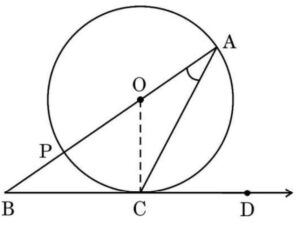
In the given figure, O is the centre of the circle and BCD is tangent to it at C. Prove that \(\angle \mathrm{BAC}+\angle \mathrm{ACD}=90^{\circ}\).
🔍 VIEW PROOF & ANSWER
✅ PROOF
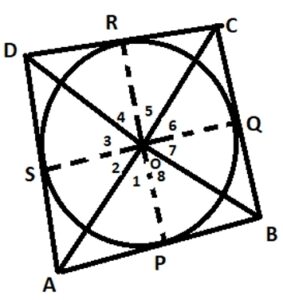
Prove that opposite sides of a quadrilateral circumscribing a circle subtend supplementary angles at the centre.
🔍 VIEW PROOF
Prove that: \(\displaystyle \frac{\tan \theta}{1-\cot \theta}+\frac{\cot \theta}{1-\tan \theta}\) \(=1+\sec \theta \csc \theta\)
🔍 VIEW PROOF
Step 1: Express in terms of \(\sin \theta\) and \(\cos \theta\) Substitute \(\tan \theta = \frac{\sin \theta}{\cos \theta}\) and \(\cot \theta = \frac{\cos \theta}{\sin \theta}\) into the expression: \[LHS = \frac{\frac{\sin \theta}{\cos \theta}}{1 – \frac{\cos \theta}{\sin \theta}} + \frac{\frac{\cos \theta}{\sin \theta}}{1 – \frac{\sin \theta}{\cos \theta}}\]
Step 2: Simplify the denominators Find a common denominator for the terms within the denominators: \[LHS = \frac{\frac{\sin \theta}{\cos \theta}}{\frac{\sin \theta – \cos \theta}{\sin \theta}} + \frac{\frac{\cos \theta}{\sin \theta}}{\frac{\cos \theta – \sin \theta}{\cos \theta}}\] Step 3: Multiply by the reciprocals Simplify the complex fractions: \[LHS = \frac{\sin^2 \theta}{\cos \theta (\sin \theta – \cos \theta)} + \frac{\cos^2 \theta}{\sin \theta (\cos \theta – \sin \theta)}\] To have a common denominator, rewrite \((\cos \theta – \sin \theta)\) as \(-(\sin \theta – \cos \theta)\): \[LHS = \frac{\sin^2 \theta}{\cos \theta (\sin \theta – \cos \theta)} – \frac{\cos^2 \theta}{\sin \theta (\sin \theta – \cos \theta)}\]
Step 4: Combine the fractions Now, find the common denominator, which is \(\sin \theta \cos \theta (\sin \theta – \cos \theta)\): \[LHS = \frac{\sin^3 \theta – \cos^3 \theta}{\sin \theta \cos \theta (\sin \theta – \cos \theta)}\]
Step 5: Factor the numerator Use the algebraic identity \(a^3 – b^3 = (a – b)(a^2 + ab + b^2)\): \[LHS = \frac{(\sin \theta – \cos \theta)(\sin^2 \theta + \sin \theta \cos \theta + \cos^2 \theta)}{\sin \theta \cos \theta (\sin \theta – \cos \theta)}\] Cancel the common factor \((\sin \theta – \cos \theta)\) from the numerator and denominator: \[LHS = \frac{\sin^2 \theta + \sin \theta \cos \theta + \cos^2 \theta}{\sin \theta \cos \theta}\]
Step 6: Use Pythagorean identity and simplify Apply \(\sin^2 \theta + \cos^2 \theta = 1\): \[LHS = \frac{1 + \sin \theta \cos \theta}{\sin \theta \cos \theta}\] Separate the terms: \[LHS = \frac{1}{\sin \theta \cos \theta} + \frac{\sin \theta \cos \theta}{\sin \theta \cos \theta}\] \[LHS = \left(\frac{1}{\cos \theta}\right) \left(\frac{1}{\sin \theta}\right) + 1\] Since \(\frac{1}{\cos \theta} = \sec \theta\) and \(\frac{1}{\sin \theta} = \csc \theta\): \[LHS = \sec \theta \csc \theta + 1\]
Answer: \(1 + \sec \theta \csc \theta = RHS\)
Prove that: \(\frac{\sin A+\cos A}{\sin A-\cos A}+\frac{\sin A-\cos A}{\sin A+\cos A}\) \(=\frac{2}{2 \sin ^{2} A-1}\)
🔍 VIEW PROOF
Step 1: Combine the fractions using a common denominator. $$LHS = \frac{(\sin A + \cos A)^2 + (\sin A – \cos A)^2}{(\sin A – \cos A)(\sin A + \cos A)}$$
Step 2: Expand the numerator and simplify the denominator using the difference of squares. $$= \frac{(\sin^2 A + 2\sin A\cos A + \cos^2 A) + (\sin^2 A – 2\sin A\cos A + \cos^2 A)}{\sin^2 A – \cos^2 A}$$
Step 3: Cancel terms and apply the identity \(\sin^2 A + \cos^2 A = 1\). $$LHS = \frac{2(\sin^2 A + \cos^2 A)}{\sin^2 A – \cos^2 A} = \frac{2}{\sin^2 A – \cos^2 A}$$
Step 4: Substitute \(\cos^2 A = 1 – \sin^2 A\) to match the target denominator. $$LHS = \frac{2}{\sin^2 A – (1 – \sin^2 A)} = \frac{2}{2\sin^2 A – 1}$$ Therefore, \(LHS = RHS\).
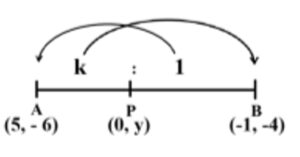
Find the ratio in which the y-axis divides the line segment joining (5,-6) and (-1,-4). Also find the point of intersection.
🔍 VIEW ANSWER
✅ Ratio = 5 : 1, Point = (0, -13/3)
Prove that \(\frac{1}{\sqrt{5}}\) is an irrational number.
🔍 VIEW PROOF
Let \( 1/\sqrt{5} \) be a rational number.
Therefore, \( 1/\sqrt{5} = \frac{a}{b} \) — (where \( a \) and \( b \) are co‑primes, \( b \neq 0 \))
⇒ \( \sqrt{5} = \frac{b}{a} \) — (\( b/a \) is rational as \( a \) and \( b \) are integers)
Now, let \( \sqrt{5} \) be a rational number.
Therefore, \( \sqrt{5} = \frac{a}{b} \) — (\( a \) and \( b \) are co‑primes, \( b \neq 0 \))
Squaring both sides,
⇒ \( 5 = \frac{a^2}{b^2} \)
⇒ \( 5 b^2 = a^2 \)
⇒ \( a^2 \) is divisible by \( 5 \)
⇒ \( a \) is divisible by \( 5 \) — (i) (lemma: if a prime \( p \) divides \( m^2 \), then \( p \) divides \( m \))
Similarly, let \( a = 5c \).
Squaring both sides,
⇒ \( a^2 = 25c^2 \)
⇒ \( 5 b^2 = 25c^2 \)
Dividing both sides by \( 5 \),
⇒ \( b^2 = 5c^2 \)
⇒ \( b^2 \) is divisible by \( 5 \)
⇒ \( b \) is divisible by \( 5 \) — (ii)
From (i) and (ii) we get that \( 5 \) is also a factor of \( a \) and \( b \), which contradicts that \( a \) and \( b \) are co‑primes.
So our assumption is incorrect. Hence \( \sqrt{5} \) is an irrational number.
From the above we conclude that LHS contradicts RHS, as \( \sqrt{5} \) is an irrational number and \( b/a \) is rational.
Hence, \( 1/\sqrt{5} \) is an irrational number.
A room is cylinder surmounted by hemispherical dome. Base radius of hemisphere = half of height of cylindrical part. Room contains \(\frac{1408}{21} \ \text{m}^3\) of air. Find height of cylindrical part. (\(\pi = \frac{22}{7}\))
🔍 VIEW SOLUTION
✅ Height of cylinder = 4 m
Two dice are thrown at the same time. Determine the probability that the difference of the numbers on the two dice is 2.
🔍 VIEW ANSWER
✅ Probability = \(\frac{8}{36} = \frac{2}{9}\)