
Section B
Section B consists of 5 questions of 2 marks each.
Q.21. (A) The A.P 8, 10, 12,…… has 60 terms. Find the sum of last 10 terms.
OR
(B) Find the middle term of A.P 6,13, 20, ……., 230
📥 View Answer for (A)
Solution for (A):
Given AP: 8, 10, 12,… with 60 terms
First term (a) = 8, Common difference (d) = 2
60th term: \(t_{60} = a + 59d = 8 + 59(2) = 126\)
51st term: \(t_{51} = a + 50d = 8 + 50(2) = 108\)
Sum of last 10 terms (51st to 60th):
\(S = \frac{n}{2}[first\ term + last\ term] \) \(= \frac{10}{2}[108 + 126] = 5 × 234 = 1170\)
Answer: 1170
📥 View Answer for (B)
Solution for (B):
Given AP: 6, 13, 20,…, 230
First term (a) = 6, Common difference (d) = 7
Let number of terms = n
Last term: \(a + (n-1)d = 230\)
\(6 + (n-1)7 = 230\)
\((n-1)7 = 224\)
\(n-1 = 32\)
\(n = 33\) (odd number of terms)
Middle term position = \(\frac{n+1}{2} = \frac{34}{2} = 17\)
17th term: \(t_{17} = a + 16d = 6 + 16(7) = 6 + 112 = 118\)
Answer: 118
Q.22. If \( \sin(A + B) = 1 \) and \( \cos(A – B) = \frac{\sqrt{3}}{2}, 0^\circ < A, B < 90^\circ \), find the measure of angles \( A \) and \( B \).
📥 View Answer & Solution
Step-by-Step Solution:
Given: \(\sin(A + B) = 1\)
We know: \(\sin 90^\circ = 1\)
Therefore: \(A + B = 90^\circ\) …(1)
Also given: \(\cos(A – B) = \frac{\sqrt{3}}{2}\)
We know: \(\cos 30^\circ = \frac{\sqrt{3}}{2}\)
Therefore: \(A – B = 30^\circ\) …(2)
Adding equations (1) and (2):
\((A + B) + (A – B) = 90^\circ + 30^\circ\)
\(2A = 120^\circ\)
\(A = 60^\circ\)
Substituting in equation (1):
\(60^\circ + B = 90^\circ\)
\(B = 30^\circ\)
Answer: A = 60°, B = 30°
Q.23. If AP and DQ are medians of triangles ABC and DEF respectively, where \( \triangle ABC \sim \triangle DEF \), then prove that \( \frac{AB}{DE} = \frac{AP}{DQ} \)
📥 View Answer & Solution
Proof: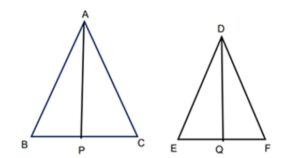
Given: \(\triangle ABC \sim \triangle DEF\)
AP is median of ΔABC, DQ is median of ΔDEF
Step 1: Since \(\triangle ABC \sim \triangle DEF\), we have:
\(\frac{AB}{DE} = \frac{BC}{EF}\) …(1)
Step 2: AP is median ⇒ P is midpoint of BC ⇒ \(BP = \frac{1}{2}BC\)
DQ is median ⇒ Q is midpoint of EF ⇒ \(EQ = \frac{1}{2}EF\)
Step 3: From (1): \(\frac{AB}{DE} = \frac{2BP}{2EQ} = \frac{BP}{EQ}\) …(2)
Step 4: Consider ΔABP and ΔDEQ:
From (2): \(\frac{AB}{DE} = \frac{BP}{EQ}\)
Also, \(\angle B = \angle E\) (corresponding angles of similar triangles)
Step 5: By SAS similarity criterion:
\(\triangle ABP \sim \triangle DEQ\)
Step 6: Corresponding sides of similar triangles are proportional:
\(\frac{AB}{DE} = \frac{AP}{DQ}\) (By CPST – Corresponding Parts of Similar Triangles)
Hence Proved: \(\frac{AB}{DE} = \frac{AP}{DQ}\)
Q.24. (A) A horse, a cow and a goat are tied, each by ropes of length 14m, at the corners A, B and C respectively, of a grassy triangular field ABC with sides of lengths 35m, 40m and 50 m. Find the area of grass field that can be grazed by them.
OR
(B) Find the area of the major segment (in terms of \( \pi \)) of a circle of radius 5cm, formed by a chord subtending an angle of \( 90^\circ \) at the centre.
📥 View Answer for (A)
Solution for (A):
Each animal can graze a sector of circle with radius 14m
The three sectors together form a semi-circle because:
Sum of angles at vertices of triangle = 180°
Area grazed = Area of semi-circle with radius 14m
Area = \(\frac{1}{2} \times \pi r^2 = \frac{1}{2} \times \frac{22}{7} \times 14^2\)
= \(\frac{1}{2} \times \frac{22}{7} \times 196\)
= \(\frac{1}{2} \times 22 \times 28 = 308 \text{ m}^2\)
Answer: 308 m²
📥 View Answer for (B)
Solution for (B):
Radius (r) = 5 cm
Angle subtended at center = 90°
Step 1: Area of minor segment = Area of sector – Area of triangle
= \(\frac{90^\circ}{360^\circ} \times \pi r^2 – \frac{1}{2} \times r^2\)
= \(\frac{1}{4} \times \pi \times 25 – \frac{1}{2} \times 25\)
= \(\frac{25\pi}{4} – \frac{25}{2} \text{ cm}^2\)
Step 2: Area of major segment = Area of circle – Area of minor segment
= \(\pi r^2 – \left(\frac{25\pi}{4} – \frac{25}{2}\right)\)
= \(25\pi – \frac{25\pi}{4} + \frac{25}{2}\)
= \(\frac{100\pi – 25\pi}{4} + \frac{25}{2}\)
= \(\frac{75\pi}{4} + \frac{25}{2} \text{ cm}^2\)
Answer: \(\left(\frac{75\pi}{4} + \frac{25}{2}\right) \text{ cm}^2\)
Q.25. A \( \triangle ABC \) is drawn to circumscribe a circle of radius 4 cm such that the segments BD and DC are of lengths 10 cm and 8 cm respectively. Find the lengths of the sides AB and AC, if it is given that \( \text{ar}(\triangle ABC) = 90 \text{cm}^2 \)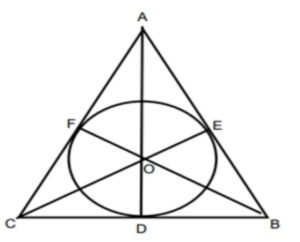
For Visually Impaired candidates: A circle is inscribed in a right-angled triangle ABC, right angled at B. If BC=7cm and AB=24cm, find the radius of the circle
📥 View Answer for Main Question
Solution:
Given: Circle inscribed in ΔABC, radius (r) = 4 cm
BD = 10 cm, DC = 8 cm
Area of ΔABC = 90 cm²
Step 1: Let tangents from vertices:
BD = BE = 10 cm (tangents from B)
CD = CF = 8 cm (tangents from C)
Let AE = AF = x (tangents from A)
Step 2: Area of ΔABC = Area(ΔAOB) + Area(ΔBOC) + Area(ΔAOC)
= \(\frac{1}{2} \times r \times AB + \frac{1}{2} \times r \times BC + \frac{1}{2} \times r \times AC\)
= \(\frac{r}{2}(AB + BC + AC)\)
Step 3: Sides: AB = x + 10, BC = 10 + 8 = 18, AC = x + 8
Perimeter = (x + 10) + 18 + (x + 8) = 2x + 36
Step 4: Using area formula:
90 = \(\frac{4}{2}(2x + 36) = 2(2x + 36)\)
90 = 4x + 72
4x = 18
x = 4.5 cm
Step 5: AB = x + 10 = 4.5 + 10 = 14.5 cm
AC = x + 8 = 4.5 + 8 = 12.5 cm
Answer: AB = 14.5 cm, AC = 12.5 cm
📥 View Answer for Visually Impaired
Solution for Visually Impaired:
Right triangle ABC, right angled at B
AB = 24 cm, BC = 7 cm
Step 1: Find AC using Pythagoras theorem:
\(AC^2 = AB^2 + BC^2\) \(= 24^2 + 7^2\) \(= 576 + 49 = 625\)
AC = 25 cm
Step 2: Area of ΔABC = \(\frac{1}{2} \times AB \times BC = \frac{1}{2} \times 24 \times 7 = 84 \text{ cm}^2\) …(1)
Step 3: Let radius of inscribed circle = r
Area of ΔABC = Area(ΔAOB) + Area(ΔBOC) + Area(ΔAOC)
= \(\frac{1}{2} \times r \times AB + \frac{1}{2} \times r \times BC + \frac{1}{2} \times r \times AC\)
= \(\frac{r}{2}(AB + BC + AC)\) \(= \frac{r}{2}(24 + 7 + 25)\) \(= \frac{r}{2} \times 56 = 28r\) …(2)
Step 4: Equate (1) and (2):
84 = 28r
r = 3 cm
Answer: Radius = 3 cm
🎯 Section B Analysis
Questions
5
Q21 to Q25
Marks Each
2
Total: 10 marks
Time Allocation
15-20 min
Recommended time
💡 Important Note: Section B questions have internal choices in some questions. You need to attempt only one option in such questions. Manage your time wisely and choose the option you’re most confident about.