
MATHEMATICS STANDARD – Code No.041
SAMPLE QUESTION PAPER
CLASS – X (2025-26)
Maximum Marks: 80 | Time Allowed: 3 hours
📋 General Instructions:
Read the following instructions carefully and follow them:
- This question paper contains 38 questions. All Questions are compulsory.
- This Question Paper is divided into 5 Sections A, B, C, D and E.
- In Section A, Question numbers 1-18 are multiple choice questions (MCQs) and questions no. 19 and 20 are Assertion- Reason based questions of 1 mark each.
- In Section B, Question numbers 21-25 are very short answer (VSA) type questions, carrying 02 marks each.
- In Section C, Question numbers 26-31 are short answer (SA) type questions, carrying 03 marks each.
- In Section D, Question numbers 32-35 are long answer (LA) type questions, carrying 05 marks each.
- In Section E, Question numbers 36-38 are case study-based questions carrying 4 marks each with sub parts of the values of 1, 1 and 2 marks each respectively.
- There is no overall choice. However, an internal choice in 2 questions of Section B, 2 questions of Section C and 2 questions of Section D has been provided. An internal choice has been provided in all the 2 marks questions of Section E.
- Draw neat and clean figures wherever required. Take π = 22/7 wherever required if not stated.
- Use of calculators is not allowed.
Section A
Section A consists of 20 questions of 1 mark each.
Q.1. If \( a = 2^2 \times 3^x \), \( b = 2^2 \times 3 \times 5 \), \( c = 2^2 \times 3 \times 7 \) and LCM \( (a, b, c) = 3780 \), then \( x \) is equal to
📥 View Answer & Solution
Answer: (C) 3
Step-by-Step Solution:
LCM(a, b, c) = \(2^2 \times 3^{\max(x,1,1)} \times 5 \times 7\)
Given LCM = 3780 = \(2^2 \times 3^3 \times 5 \times 7\)
Therefore, \(3^{\max(x,1,1)} = 3^3\)
This implies \(\max(x, 1) = 3\)
Hence, \(x = 3\)
Q.2. The shortest distance (in units) of the point (2,3) from y-axis is
📥 View Answer & Solution
Answer: (A) 2
Step-by-Step Solution:
The shortest distance of any point from the y-axis is the absolute value of its x-coordinate.
For point (2,3), x-coordinate = 2.
Therefore, shortest distance from y-axis = |2| = 2 units.
Q.3. If the lines given by \( 3x + 2ky = 2 \) and \( 2x + 5y + 1 = 0 \) are not parallel, then k has to be
📥 View Answer & Solution
Condition for Non-Parallel Lines
Step 1: Set up the condition for non-parallel lines
For two linear equations in the form
\( A_1x + B_1y + C_1 = 0 \) and
\( A_2x + B_2y + C_2 = 0 \),
the lines are not parallel if:
\[\frac{A_1}{A_2} \ne \frac{B_1}{B_2}\]
The given equations are:
\( 3x + 2ky = 2 \) (or \( 3x + 2ky – 2 = 0 \))
\( 2x + 5y + 1 = 0 \)
Here,
\( A_1 = 3,\; B_1 = 2k,\; A_2 = 2,\; B_2 = 5 \)
Step 2: Substitute the values into the condition
\[\frac{3}{2} \ne \frac{2k}{5}\]
Step 3: Solve for \( k \)
\[3 \times 5 \ne 2k \times 2\]
\[15 \ne 4k\]
\[k \ne \frac{15}{4}\]
Answer:
(B) \( k \ne \frac{15}{4} \)
Q.4. A quadrilateral ABCD is drawn to circumscribe a circle. If BC=7cm, CD=4cm and AD=3cm, then the length of AB is
📥 View Answer & Solution
Answer: (C) 6cm
Step-by-Step Solution:
For a quadrilateral circumscribing a circle, the sums of lengths of opposite sides are equal.
AB + CD = AD + BC
AB + 4 = 3 + 7
AB + 4 = 10
AB = 10 – 4 = 6 cm
Q.5. If \( \sec\theta + \tan\theta = x \), then \( \sec\theta – \tan\theta \) will be
📥 View Answer & Solution
Answer: (D) \( \frac{1}{x} \)
Step-by-Step Solution:
We know the trigonometric identity: \(\sec^2\theta – \tan^2\theta = 1\)
This can be factored as: \((\sec\theta + \tan\theta)(\sec\theta – \tan\theta) = 1\)
Given: \(\sec\theta + \tan\theta = x\)
Therefore: \(x \times (\sec\theta – \tan\theta) = 1\)
Hence: \(\sec\theta – \tan\theta = \frac{1}{x}\)
Q.6. Which one of the following is not a quadratic equation?
📥 View Answer & Solution
Answer: (D) \( (x+2)(x+1) = x^2 + 2x + 3 \)
Step-by-Step Solution:
Simplify option (D):
\((x+2)(x+1) = x^2 + 2x + 3\)
\(x^2 + 3x + 2 = x^2 + 2x + 3\)
\(x^2 + 3x + 2 – x^2 – 2x – 3 = 0\)
\(x – 1 = 0\)
This is a linear equation (degree 1), not a quadratic equation (degree 2).
Q.7 Given below is the picture of the Olympic rings made by taking five congruent circles of radius 1 cm each, intersecting in such a way that the chord formed by joining the points of intersection of two circles is also of length 1 cm. Find the total area of all the dotted regions, assuming the thickness of the rings is negligible.
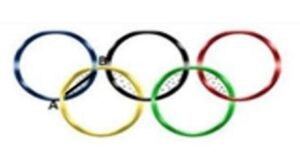
For Visually Impaired candidates: The area of the circle that can be inscribed in a square of 6 cm is
📥 View Answer & Solution
Solution
Explanation:
Let \( O \) be the center of the circle.
Given: \( OA = OB = AB = 1 \, \text{cm} \).
Therefore, \( \triangle OAB \) is an equilateral triangle.
\[ \angle AOB = 60^\circ \]
The required area consists of 8 identical circular segments.
Area of one segment with radius \( r = 1 \, \text{cm} \) and central angle \( \theta = 60^\circ \):
\[ \text{Area of segment} \] = \[ \text{Area of sector} – \text{Area of triangle} \]
\[ = \frac{60^\circ}{360^\circ} \times \pi \times 1^2 – \frac{\sqrt{3}}{4} \times 1^2 \]
\[ = \frac{\pi}{6} – \frac{\sqrt{3}}{4} \]
Total area for 8 such segments:
\[ \text{Total Area} = 8 \times \left( \frac{\pi}{6} – \frac{\sqrt{3}}{4} \right) \, \text{cm}^2 \]
For Visually Impaired candidates: Solution
Answer:
For Visually Impaired candidates answer: (D) \(9\pi \text{cm}^2\)
Diameter of inscribed circle = side of square = 6 cm
Radius = 3 cm
Area = \(\pi \times (3)^2 = 9\pi \text{cm}^2\)
Q.8. A pair of dice is tossed. The probability of not getting the sum eight is
📥 View Answer & Solution
Answer: (B) \( \frac{31}{36} \)
Step-by-Step Solution:
Total possible outcomes when two dice are tossed: 6 × 6 = 36
Favorable outcomes for sum = 8: (2,6), (3,5), (4,4), (5,3), (6,2) → 5 outcomes
Probability of getting sum 8 = \(\frac{5}{36}\)
Probability of NOT getting sum 8 = 1 – \(\frac{5}{36}\) = \(\frac{31}{36}\)
Q.9. If \( 2\sin 5x = \sqrt{3}, 0\leq x \leq 90^\circ \), then \( x \) is equal to
📥 View Answer & Solution
Answer: (B) 12°
Step-by-Step Solution:
\(2\sin 5x = \sqrt{3}\)
\(\sin 5x = \frac{\sqrt{3}}{2}\)
We know: \(\sin 60^\circ = \frac{\sqrt{3}}{2}\)
Therefore: \(5x = 60^\circ\)
\(x = \frac{60^\circ}{5} = 12^\circ\)
Q.10. The sum of two numbers is 1215 and their HCF is 81, then the possible pairs of such numbers are
📥 View Answer & Solution
Answer: (C) 4
Step-by-Step Solution:
Let the numbers be 81a and 81b, where a and b are co-prime (HCF=1).
81a + 81b = 1215
81(a + b) = 1215
a + b = 15
Possible co-prime pairs (a, b) where a & b are co-prime and a ≤ b:
(1, 14), (2, 13), (4, 11), (7, 8)
Total pairs = 4
Questions 11-20 continue in Section A…
This sample paper continues with more questions covering all sections (B, C, D, E) with detailed solutions available for each question.
💡 How to Use This Sample Paper Effectively
1. Attempt all questions without looking at solutions first.
2. Time yourself strictly (3 hours total).
3. Use the answer key to check your responses.
4. Study the step-by-step solutions for questions you got wrong.
5. Analyze your mistakes and revise those concepts.
📚 Complete Solutions Available: Detailed solutions for all 38 questions from Sections A through E are available. Click on “View Answer & Solution” for each question to see comprehensive explanations.
Section A – Continued (Questions 11-20)
All questions carry 1 mark each
Q.11. If the area of the base of a right circular cone is 51cm² and it’s volume is 85cm³, then the height of the cone is given as
📥 View Answer & Solution
Answer: (D) 5cm
Step-by-Step Solution:
Volume of cone = \(\frac{1}{3} \times \text{Base Area} \times \text{Height}\)
Given: Base Area = 51 cm², Volume = 85 cm³
\(85 = \frac{1}{3} \times 51 \times h\)
\(85 = 17 \times h\)
\(h = \frac{85}{17} = 5\) cm
Q.12. If zeroes of the quadratic polynomial \( ax^2 + bx + c \) (a, c ≠ 0) are equal, then
📥 View Answer & Solution
Answer: (D) c and a must have same signs
Step-by-Step Solution:
For equal roots of quadratic equation \(ax^2 + bx + c = 0\):
Discriminant = \(b^2 – 4ac = 0\)
\(b^2 = 4ac\)
Since \(b^2\) is always positive or zero, \(4ac > 0\)
Therefore, \(ac > 0\)
This means a and c must have the same sign (both positive or both negative).
Q.13. The area (in cm²) of a sector of a circle of radius 21cm cut off by an arc of length 22cm is
📥 View Answer & Solution
Answer: (C) 231
Step-by-Step Solution:
Area of sector = \(\frac{1}{2} \times \text{radius} \times \text{arc length}\)
Given: radius (r) = 21 cm, arc length (l) = 22 cm
Area = \(\frac{1}{2} \times 21 \times 22\)
Area = \(\frac{1}{2} \times 462 = 231\) cm²
Q.14. If \( \triangle ABC \sim \triangle DEF \), AB=6cm, DE=9cm, EF=6cm and FD=12cm, then the perimeter of \( \triangle ABC \) is
📥 View Answer & Solution
Answer: (C) 18cm
Step-by-Step Solution:
For similar triangles, ratio of corresponding sides = ratio of perimeters
\(\frac{AB}{DE} = \frac{6}{9} = \frac{2}{3}\)
Perimeter of ΔDEF = DE + EF + FD = 9 + 6 + 12 = 27 cm
Let perimeter of ΔABC = P
\(\frac{P}{27} = \frac{2}{3}\)
\(P = 27 \times \frac{2}{3} = 18\) cm
Q.15. If the probability of the letter chosen at random from the letters of the word “Mathematics” to be a vowel is \( \frac{2}{2x+1} \), then \( x \) is equal to
📥 View Answer & Solution
Answer: (B) \( \frac{9}{4} \)
Step-by-Step Solution:
Word: MATHEMATICS
Total letters = 11 (M, A, T, H, E, M, A, T, I, C, S)
Vowels: A, E, A, I → 4 vowels
Probability of choosing vowel = \(\frac{4}{11}\)
Given: \(\frac{2}{2x+1} = \frac{4}{11}\)
Cross multiply: \(2 \times 11 = 4 \times (2x+1)\)
\(22 = 8x + 4\)
\(8x = 18\)
\(x = \frac{18}{8} = \frac{9}{4}\)
Q.16. The points A(9,0), B(9, -6), C(-9,0) and D(-9,6) are the vertices of a
📥 View Answer & Solution
Answer: (C) Parallelogram
Step-by-Step Solution:
Plotting the points:
A(9,0), B(9,-6), C(-9,0), D(-9,6)
Calculate distances:
AB = √[(9-9)² + (-6-0)²] = √36 = 6 units
BC = √[(-9-9)² + (0+6)²] = √(324+36) = √360
CD = √[(-9+9)² + (6-0)²] = √36 = 6 units
DA = √[(9+9)² + (0-6)²] = √(324+36) = √360
Opposite sides are equal (AB=CD=6, BC=DA=√360) but diagonals are not equal, so it’s a parallelogram.
Q.17. The median of a set of 9 distinct observation is 20.5. If each of the observations of a set is increased by 2, then the median of a new set
📥 View Answer & Solution
Answer: (A) is increased by 2
Step-by-Step Solution:
Number of observations (n) = 9 (odd)
Position of median = \(\frac{n+1}{2} = \frac{10}{2} = 5\)th observation
Original median = 20.5 (5th observation in ordered set)
When each observation is increased by 2, the 5th observation becomes 20.5 + 2 = 22.5
Therefore, new median = 22.5 = original median + 2
The median increases by the same constant (2) added to each observation.
Q.18. If the length of the shadow of a vertical pole is √3 times its height, then the Sun’s altitude is
📥 View Answer & Solution
Answer: (A) 30°
Step-by-Step Solution:
Let height of pole = h
Length of shadow = √3h
In right triangle: tanθ = \(\frac{\text{opposite}}{\text{adjacent}} = \frac{h}{\sqrt{3}h} = \frac{1}{\sqrt{3}}\)
We know: tan30° = \(\frac{1}{\sqrt{3}}\)
Therefore, θ = 30°
The Sun’s altitude is 30° above the horizon.
Q.19. Assertion (A): The length of the minute hand of a clock is 14 cm. The area swept by it in 5 minutes is \( \frac{154}{3} \) cm².
Reason (R): The area of a sector of angle θ is \( \frac{\theta}{360} \times \pi r^2 \)
📥 View Answer & Solution
Answer: (A) Both A and R are true and R is the correct explanation of A
Step-by-Step Solution:
Minute hand completes 360° in 60 minutes.
In 5 minutes, angle swept = \(\frac{5}{60} \times 360° = 30°\)
Radius (r) = 14 cm
Area swept = \(\frac{30}{360} \times \frac{22}{7} \times 14^2\)
= \(\frac{1}{12} \times \frac{22}{7} \times 196\)
= \(\frac{1}{12} \times 22 \times 28 = \frac{616}{12} = \frac{154}{3}\) cm²
Assertion is true. Reason is the correct formula and explains Assertion correctly.
Q.20. Assertion (A): The probability of an event that cannot happen is 0.
Reason (R): The probability of an event lies between 0 and 1 (both inclusive).
📥 View Answer & Solution
Answer: (A) Both A and R are true and R is the correct explanation of A
Step-by-Step Solution:
Assertion (A): An impossible event has probability 0. This is true by definition.
Reason (R): Probability always lies between 0 and 1 inclusive. This is a fundamental property of probability.
Reason correctly explains why the probability of an impossible event is 0, as 0 is the lower bound of possible probability values.
📊 Section A Summary
Total Questions
20
Marks Each
1
Total Marks
20
Section A covers topics from: Number Systems, Coordinate Geometry, Trigonometry, Probability, Geometry, Algebra, and Statistics.
➡️ Continue to Section B
Section B contains Very Short Answer (VSA) type questions (21-25) carrying 2 marks each.
These questions require brief calculations and concise answers.
💡 Pro Tip: Practice these questions by covering the answers first. Time yourself to complete Section A within 25-30 minutes during actual exam practice.