Circle – Solved Questions (Class 10) – Part 2
Q1. In the figure, if TP and TQ are two tangents to a circle with centre O such that \( \angle POQ = 110^\circ \), then find \( \angle PTQ \).
Solution:
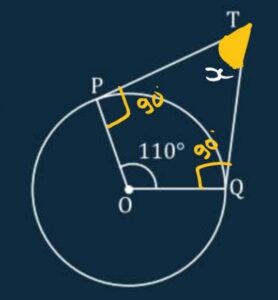
Given:
- TP and TQ are tangents ⇒ \( \angle OPT = \angle OQT = 90^\circ \)
- \( \angle POQ = 110^\circ \)
In quadrilateral \( OPTQ \), sum of angles = \( 360^\circ \):
\[
\angle OPT + \angle OQT + \angle POQ + \angle PTQ = 360^\circ
\]
\[
90^\circ + 90^\circ + 110^\circ + \angle PTQ = 360^\circ
\]
\[
290^\circ + \angle PTQ = 360^\circ
\]
\[
\angle PTQ = 360^\circ – 290^\circ = 70^\circ
\]
Answer: \( 70^\circ \)
Q2. If tangents PA and PB from a point P to a circle with centre O are inclined to each other at an angle of \( 80^\circ \), then find \( \angle POA \).
Solution:
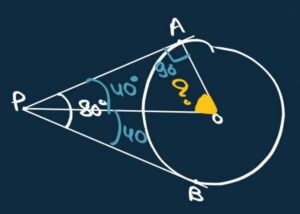
Given: \( \angle APB = 80^\circ \)
Since tangents from an external point are equal, triangle \( \triangle APB \) is isosceles, and OP bisects \( \angle APB \):
\[
\angle APO = \frac{1}{2} \times 80^\circ = 40^\circ
\]
In right triangle \( \triangle OAP \) (because radius ⊥ tangent):
\[
\angle OAP = 90^\circ
\]
\[
\angle POA = 180^\circ – 90^\circ – 40^\circ = 50^\circ
\]
Answer: \( 50^\circ \)
Q3. PQ is a tangent to a circle with centre O at point P. If \( \triangle OPQ \) is isosceles, find \( \angle OQP \).
Solution:
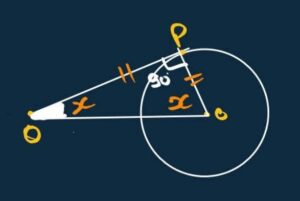
Since PQ is tangent at P, \( OP \perp PQ \) ⇒ \( \angle OPQ = 90^\circ \)
Given: \( \triangle OPQ \) is isosceles.
Possible equal sides: only \( OQ = OP \) or \( OQ = PQ \). But \( \angle OPQ = 90^\circ \), so equal angles must be at O and Q.
Thus, \( \angle OQP = \angle QOP \)
Using angle sum:
\[
\angle OPQ + \angle OQP + \angle QOP = 180^\circ
\]
\[
90^\circ + 2\angle OQP = 180^\circ
\]
\[
2\angle OQP = 90^\circ \Rightarrow \angle OQP = 45^\circ
\]
Answer: \( 45^\circ \)
Q4. From an external point P, two tangents PA and PB are drawn to a circle with centre O. Prove that OP is the perpendicular bisector of AB.
Proof:
Given: PA and PB are tangents ⇒ \( PA = PB \) and \( OA = OB \) (radii)
In \( \triangle OAP \) and \( \triangle OBP \):
- \( PA = PB \)
- \( OA = OB \)
- \( OP = OP \) (common)
⇒ \( \triangle OAP \cong \triangle OBP \) (SSS)
So, \( \angle APO = \angle BPO \) ⇒ OP bisects \( \angle APB \)
Now consider \( \triangle APB \): isosceles with \( PA = PB \), so the angle bisector from P is also the median and altitude.
Thus, OP bisects AB at right angles.
Hence, OP is the perpendicular bisector of AB.
Q5. Two tangent segments PA and PB are drawn to a circle with centre O such that \( \angle APB = 120^\circ \). Prove that \( OP = 2AP \).
Proof:
Since \( PA = PB \), OP bisects \( \angle APB \):
\[
\angle APO = \frac{120^\circ}{2} = 60^\circ
\]
In right triangle \( \triangle OAP \) (\( \angle OAP = 90^\circ \)):
\[
\sin(\angle APO) = \frac{OA}{OP}, \quad \cos(\angle APO) = \frac{AP}{OP}
\]
But easier: use \( \cos 60^\circ = \frac{AP}{OP} \)
\[
\cos 60^\circ = \frac{1}{2} = \frac{AP}{OP} \Rightarrow OP = 2AP
\]
Hence proved.
Q6. Two tangents inclined at \( 60^\circ \) are drawn to a circle of radius 3 cm. Find the length of each tangent.
Solution:
Let P be external point, PA and PB tangents, \( \angle APB = 60^\circ \), radius \( OA = 3 \) cm.
OP bisects \( \angle APB \) ⇒ \( \angle APO = 30^\circ \)
In right triangle \( \triangle OAP \):
\[
\tan(30^\circ) = \frac{OA}{AP} = \frac{3}{AP}
\]
\[
\frac{1}{\sqrt{3}} = \frac{3}{AP} \Rightarrow AP = 3\sqrt{3} \text{ cm}
\]
Answer: \( 3\sqrt{3} \) cm
Q7. Two tangents TP and TQ are drawn from external point T to a circle with centre O. Prove that \( \angle PTQ = 2 \angle OPQ \).
Proof:
Since TP = TQ, triangle \( \triangle TPQ \) is isosceles.
Also, \( \angle OPT = 90^\circ \) (radius ⊥ tangent)
Let \( \angle OPQ = x \). Then in \( \triangle OPQ \), but better:
In \( \triangle TPO \):
\[
\angle TPO = 90^\circ – x \quad (\text{since } \angle OPQ = x \text{ and } \angle OPT = 90^\circ)
\]
But \( \angle TPO = \angle TQO \), and
\[
\angle PTQ = 180^\circ – 2\angle TPO = 180^\circ – 2(90^\circ – x) = 2x
\]
\[
\Rightarrow \angle PTQ = 2 \angle OPQ
\]
Hence proved.
Q8. In the figure, two tangents RQ and RP are drawn from external point R to the circle with centre O. If \( \angle PRQ = 120^\circ \), prove that \( OR = PR + RQ \).
Proof:
Given: \( \angle PRQ = 120^\circ \), and \( PR = RQ \) (tangents from same point)
OP and OQ are radii ⇒ \( \angle OPR = \angle OQR = 90^\circ \)
OP bisects \( \angle PRQ \) ⇒ \( \angle PRO = 60^\circ \)
In right triangle \( \triangle OPR \):
\[
\sin(60^\circ) = \frac{OP}{OR} \Rightarrow OR = \frac{OP}{\sin 60^\circ} = \frac{r}{\sqrt{3}/2} = \frac{2r}{\sqrt{3}}
\]
\[
\tan(60^\circ) = \frac{OP}{PR} \Rightarrow PR = \frac{r}{\sqrt{3}}
\]
So,
\[
PR + RQ = 2PR = 2 \cdot \frac{r}{\sqrt{3}} = \frac{2r}{\sqrt{3}} = OR
\]
Hence, \( OR = PR + RQ \). Proved.
Q9. If all sides of a parallelogram touch a circle, show that the parallelogram is a rhombus.
Proof:
Let parallelogram ABCD touch a circle at P, Q, R, S on AB, BC, CD, DA respectively.
Then, using equal tangents:
\[
AP = AS,\quad BP = BQ,\quad CQ = CR,\quad DR = DS
\]
Now,
\[
AB + CD = (AP + BP) + (CR + DR) = (AS + BQ) + (CQ + DS)
\]
\[
= (AS + DS) + (BQ + CQ) = AD + BC
\]
But in a parallelogram, \( AB = CD \) and \( AD = BC \), so:
\[
AB + AB = AD + AD \Rightarrow 2AB = 2AD \Rightarrow AB = AD
\]
Thus, adjacent sides are equal ⇒ all sides equal ⇒ ABCD is a rhombus.
Hence proved.
Q10. In the figure, PA and PB are tangents from external point P to a circle with centre O. LN touches the circle at M. Prove that \( PL + LM = PN + MN \).
Proof:
Let LN intersect PA at L and PB at N.
From external points:
- From L: \( LA = LM \) (tangents to circle)
- From N: \( NB = NM \)
- From P: \( PA = PB \)
Now,
\[
PL + LM = PL + LA = PA
\]
\[
PN + MN = PN + NB = PB
\]
But \( PA = PB \), so:
\[
PL + LM = PN + MN
\]
Hence proved.