Circle – Solved Questions (Class 10)
Q1. A tangent PQ at a point P of a circle of radius 5 cm meets a line through the centre O at a point Q so that OQ = 13 cm. Find the length of PQ. [ NCERT ]
Solution:
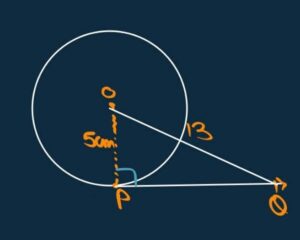
Given:
- Radius \( OP = 5 \) cm
- \( OQ = 13 \) cm
- PQ is a tangent at point P
- ⇒ \( OP \perp PQ \)
So, triangle \( \triangle OPQ \)
is a right-angled triangle at P.
Using Pythagoras Theorem:
\[
OQ^2 = OP^2 + PQ^2
\]
\[
13^2 = 5^2 + PQ^2
\]
\[
169 = 25 + PQ^2
\]
\[
PQ^2 = 169 – 25 = 144
\]
\[
PQ = \sqrt{144} = 12 \text{ cm}
\]
Answer: \( PQ = 12 \) cm
Q2. Fill in the blanks: [NCERT]
- The common point of a tangent and the circle is called point of contact.
- A circle may have two parallel tangents.
- A tangent to a circle intersects it in one point(s).
- A line intersecting a circle in two points is called a secant.
- The angle between tangent at a point on a circle and the radius through the point is 90°.
Q3. How many tangents can a circle have?
Answer: A circle can have infinitely many tangents, since there are infinitely many points on its circumference, and at each point, one tangent can be drawn.
Q4. In the figure, if \( AB = AC \), prove that \( BE = EC \).
Given:
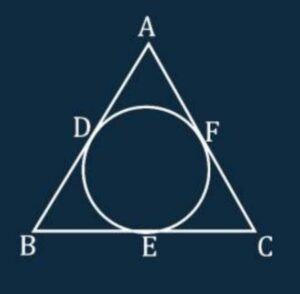
\( AB = AC \), and a circle touches the sides of
\( \triangle ABC \) at D, E, F respectively.
To Prove: \( BE = EC \)
Proof:
From the property of tangents from an external point to a circle:
\[AD = AF\],\[\quad BD = BE\],\[\quad CE = CF\]
Now, \( AB = AC \)
\[
\Rightarrow AD + BD = AF + CF
\]
Substitute equal tangents:
\[
AD + BE = AD + CE\]
\[\quad (\text{since } AF = AD,\ CF = CE)
\]
\[
\Rightarrow BE = CE
\]
Hence proved.
Q5. \( \triangle ABC \) is an isosceles triangle in which \( AB = AC \), circumscribed about a circle. Prove that the base is bisected by the point of contact. [ CBSE 2008,2012,2014]
Proof:
Let the incircle touch BC at E, AB at D, and AC at F.
Since tangents from an external point are equal:
\[
BD = BE,\quad CD = CF,\quad AD = AF
\]
Given: \( AB = AC \)
\[
\Rightarrow AD + BD = AF + CF
\]
\[\Rightarrow AD + BE = AD + CE\]
\[\quad (\text{as } AF = AD)\]
\[
\Rightarrow BE = CE
\]
So, point E bisects BC.
Hence proved.
Q6. A circle is touching the side BC of \( \triangle ABC \) at P and touching AB and AC produced at Q and R respectively. Prove that \( AQ = \frac{1}{2} \times \text{(Perimeter of } \triangle ABC) \). [ CBSE 2000, 2001, 2002, NCERT EXEMPLAR ]
Proof:
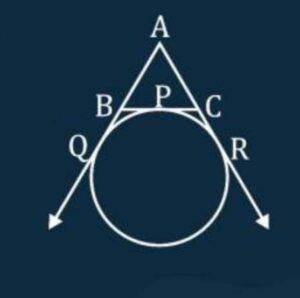
Let the tangents be:
\[
AQ = AR,\quad BQ = BP,\quad CP = CR
\]
Now, perimeter of \( \triangle ABC = AB + BC + AC \)
\[
= (AQ – BQ) + (BP + PC) + (AR – CR)
\]
\[
= (AQ – BP) + (BP + CP) + (AQ – CP)\]
\[\quad (\text{since } BQ = BP,\ CR = CP,\ AR = AQ\]
\[
= AQ – BP + BP + CP + AQ – CP = 2AQ
\]
\[
\Rightarrow AQ = \frac{1}{2}(AB + BC + AC)
\]
Hence proved.
Q7. From a point P which is at a distance of 13 cm from the centre O of a circle of radius 5 cm, the pair of tangents PQ and PR to the circle are drawn. Find the area of quadrilateral PQOR.
Solution:
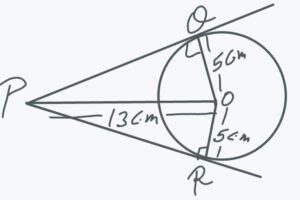
Given:
- \( OP = 13 \) cm
- Radius \( OQ = OR = 5 \) cm
- \( PQ \) and \( PR \) are tangents
- ⇒ \( \angle OQP = \angle ORP = 90^\circ \)
First, find length of tangent \( PQ \):
\[
PQ = \sqrt{OP^2 – OQ^2} = \sqrt{13^2 – 5^2}\] \[= \sqrt{169 – 25} = \sqrt{144} = 12 \text{ cm}
\]
Area of \( \triangle OPQ = \frac{1}{2} \times OQ \times PQ\)
\( = \frac{1}{2} \times 5 \times 12 = 30 \text{ cm}^2 \)
Similarly, area of
\( \triangle OPR = 30 \text{ cm}^2 \)
So, area of quadrilateral
\( PQOR = 30 + 30 = 60 \text{ cm}^2 \)
Answer: \( 60 \text{ cm}^2 \)
Q8. A circle touches all the four sides of a quadrilateral ABCD. Prove that: \( AB + CD = BC + DA \). [ CBSE 2008, 2009, 2015, 2016, 2018, NCERT ]
Proof:
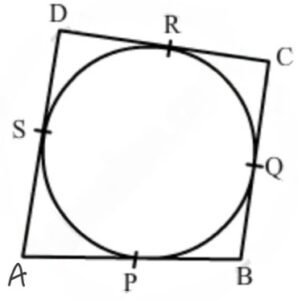
Let the circle touch sides AB, BC, CD, DA at P, Q, R, S respectively.
Then, tangents from same external point are equal:
\[
AP = AS,\quad BP = BQ,\quad CQ = CR,\quad DR = DS
\]
Now, consider:
\[
AB + CD = (AP + BP) + (CR + DR)
\]
\[
= (AS + BQ) + (CQ + DS)
\]
\[
= (AS + DS) + (BQ + CQ) = AD + BC
\]
Thus, \( AB + CD = BC + DA \)
Hence proved.
Q9. If a hexagon ABCDEF circumscribes a circle, prove that: \( AB + CD + EF = BC + DE + FA \). [ NCERT EXEMPLAR]
Proof:
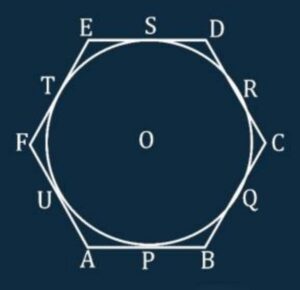
Let the circle touch the sides AB, BC, CD, DE, EF, FA at points P, Q, R, S, T, U respectively.
Using equal tangents from external points:
\[
AP = AU,\quad BP = BQ,\quad CQ = CR\]
\[,\quad DR = DS,\quad ET = ES,\quad FT = FU
\]
Now compute LHS:
\[
AB + CD + EF \]
\[= (AP + BP) + (CR + DR) + (ET + FT)
\]
\[
= (AU + BQ) + (CQ + DS) + (ES + FU)
\]
\[
= (BQ + CQ) + (DS + ES) + (FU + AU)
\]
\[
= BC + DE + FA
\]
Thus, \( AB + CD + EF = BC + DE + FA \)
Hence proved.