Real Number Previous Year Solved Questions 2025
1. If the HCF of two positive integers a and b is 1, then their LCM is: (1 Mark) (CBSE 2025)
(A) a+b
(B) a
(C) b
(D) ab
(A) a+b
(B) a
(C) b
(D) ab
View Answer
1. (D) ab
2. The number 3+√2 is : (1 Mark) (CBSE 2025)
(A) a rational number
(B) an irrational number
(C) an integer
(D) a natural number
(A) a rational number
(B) an irrational number
(C) an integer
(D) a natural number
View Answer
2. (B) an irrational number
3. Two statements are given, one labelled as Assertion (A) and the other is labelled as Reason (R). Select the correct answer from the codes:
Assertion (A): For any two natural numbers a and b, the HCF of a and b is a factor of the LCM of a and b.
Reason (R): HCF of any two natural numbers divides both the numbers. (1 Mark)(CBSE 2025)
(A) Both A and R are true and R is the correct explanation of A
(B) Both A and R are true, but R is not the correct explanation of A
(C) A is true, but R is false
(D) A is false, but R is true
Assertion (A): For any two natural numbers a and b, the HCF of a and b is a factor of the LCM of a and b.
Reason (R): HCF of any two natural numbers divides both the numbers. (1 Mark)(CBSE 2025)
(A) Both A and R are true and R is the correct explanation of A
(B) Both A and R are true, but R is not the correct explanation of A
(C) A is true, but R is false
(D) A is false, but R is true
View Answer
3. (A) Both Assertion (A) and Reason (R) are true and Reason (R) is the correct explanation of Assertion (A).
4. If HCF(98,28)=m and LCM(98,28)=n, then the value of n – 7m is : (1 Mark) (CBSE 2025)
(A) 0
(B) 28
(C) 98
(D) 198
(A) 0
(B) 28
(C) 98
(D) 198
View Answer
4. (C) 98
1. Prime factorization of 98 = 2 × 7²
2. Prime factorization of 28 = 2² × 7
3. HCF = 2¹ × 7¹ = 14 ∴ m = 14
4. LCM = 2² × 7² = 196 ∴ n = 196
5. n – 7m = 196 – 7×14 = 196 – 98 = 98
1. Prime factorization of 98 = 2 × 7²
2. Prime factorization of 28 = 2² × 7
3. HCF = 2¹ × 7¹ = 14 ∴ m = 14
4. LCM = 2² × 7² = 196 ∴ n = 196
5. n – 7m = 196 – 7×14 = 196 – 98 = 98
5. If (-1)ⁿ + (1)⁸ = 0, then n is : (1 Mark) (CBSE 2025)
(A) any positive integer
(B) any negative integer
(C) any odd number
(D) any even number
(A) any positive integer
(B) any negative integer
(C) any odd number
(D) any even number
View Answer
5. (C) any odd number
6. Which of the following is a rational number between √3 and √5? (1 Mark) (CBSE 2025)
(A) 1.4142387954012…
(B) 2.326
(C) π
(D) 1.857142
(A) 1.4142387954012…
(B) 2.326
(C) π
(D) 1.857142
View Answer
6. (D) 1.857142
7. Prove that √3 is an irrational number. (3 Mark) (CBSE 2025)
View Answer
Proof that √3 is Irrational
Step 1: Assume √3 is rational: √3 = p/q where p,q are co-prime, q≠0
Step 2: Square both sides: 3 = p²/q² ⇒ 3q² = p²
Step 3: p² is divisible by 3 ⇒ p is divisible by 3. Let p = 3m
Step 4: Substitute: 3q² = (3m)² ⇒ 3q² = 9m² ⇒ q² = 3m²
Step 5: q² is divisible by 3 ⇒ q is divisible by 3
Step 6: Contradiction: Both p and q divisible by 3, but assumed co-prime
Conclusion: √3 is irrational
Step 1: Assume √3 is rational: √3 = p/q where p,q are co-prime, q≠0
Step 2: Square both sides: 3 = p²/q² ⇒ 3q² = p²
Step 3: p² is divisible by 3 ⇒ p is divisible by 3. Let p = 3m
Step 4: Substitute: 3q² = (3m)² ⇒ 3q² = 9m² ⇒ q² = 3m²
Step 5: q² is divisible by 3 ⇒ q is divisible by 3
Step 6: Contradiction: Both p and q divisible by 3, but assumed co-prime
Conclusion: √3 is irrational
8. The factor tree of a number x is shown. Find the values of x, y, a and b. Hence, write the product of the prime factors of the number x so obtained. (3 Mark) (CBSE 2025)
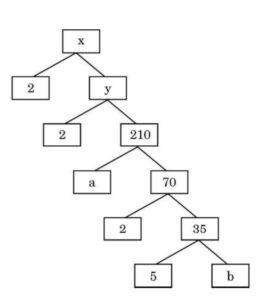 (3 Mark) (CBSE 2025)
View Answer
8. b = 7
a = 3
y = 420
x = 840
x = 840 = 2³ × 3 × 5 × 7
a = 3
y = 420
x = 840
x = 840 = 2³ × 3 × 5 × 7
9. Prove that 1/√5 is an irrational number. (3 Mark) (CBSE 2025)
View Answer
Proof that 1/√5 is Irrational
Step 1: Assume 1/√5 is rational: 1/√5 = p/q where p,q are co-prime
Step 2: Rearrange: √5 = q/p
Step 3: Square both sides: 5 = q²/p² ⇒ 5p² = q²
Step 4: q² is divisible by 5 ⇒ q is divisible by 5. Let q = 5a
Step 5: Substitute: 5p² = (5a)² ⇒ 5p² = 25a² ⇒ p² = 5a²
Step 6: p² is divisible by 5 ⇒ p is divisible by 5
Step 7: Contradiction: Both p and q divisible by 5, but assumed co-prime
Conclusion: 1/√5 is irrational
Step 1: Assume 1/√5 is rational: 1/√5 = p/q where p,q are co-prime
Step 2: Rearrange: √5 = q/p
Step 3: Square both sides: 5 = q²/p² ⇒ 5p² = q²
Step 4: q² is divisible by 5 ⇒ q is divisible by 5. Let q = 5a
Step 5: Substitute: 5p² = (5a)² ⇒ 5p² = 25a² ⇒ p² = 5a²
Step 6: p² is divisible by 5 ⇒ p is divisible by 5
Step 7: Contradiction: Both p and q divisible by 5, but assumed co-prime
Conclusion: 1/√5 is irrational