Section C
Section C consists of 6 questions of 3 marks each.
Q.26. In Figure, XY and X’Y’ are two parallel tangents to a circle with centre O and another tangent AB with point of contact C intersecting XY at A and X’Y’ at B. Prove that \( \angle AOB = 90^\circ \)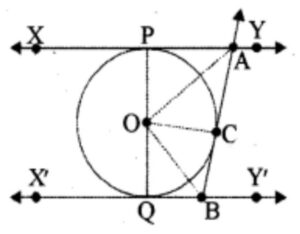
For Visually Impaired candidates: Two tangents PA and PB are drawn to a circle with centre O from an external point P. Prove that \( \angle APB = 2(\angle OAB) \)
📥 View Answer for Main Question
Proof:
Given: XY ∥ X’Y’, both are tangents to circle with center O
AB is another tangent touching circle at C
Step 1: Join OA, OB, OC
Since tangents from external point are equal:
AP = AC (from point A)
BQ = BC (from point B)
Step 2: In ΔAPO and ΔACO:
AP = AC (tangents from A)
OP = OC (radii)
OA = OA (common)
∴ ΔAPO ≅ ΔACO (by SSS)
⇒ ∠POA = ∠COA …(1)
Step 3: Similarly, ΔBQO ≅ ΔBCO
⇒ ∠QOB = ∠COB …(2)
Step 4: Since XY ∥ X’Y’, points P, O, Q are collinear
∠POQ = 180° (straight line)
Step 5: ∠POQ = ∠POA + ∠AOC + ∠COB + ∠BOQ
180° = ∠COA + ∠COA + ∠COB + ∠COB (from 1 & 2)
180° = 2(∠COA + ∠COB)
180° = 2∠AOB
∠AOB = 90°
Hence Proved: ∠AOB = 90°
📥 View Answer for Visually Impaired
Proof:
Given: PA and PB are tangents from external point P to circle with center O
Step 1: PA = PB (tangents from external point)
In ΔPAB, PA = PB ⇒ ∠PAB = ∠PBA = x (angles opposite equal sides)
Step 2: In ΔPAB:
∠PAB + ∠PBA + ∠APB = 180°
x + x + ∠APB = 180°
∠APB = 180° – 2x …(1)
Step 3: Radius is perpendicular to tangent at point of contact
OA ⊥ PA ⇒ ∠OAP = 90°
∠PAB + ∠OAB = 90°
x + ∠OAB = 90°
x = 90° – ∠OAB …(2)
Step 4: Substitute (2) in (1):
∠APB = 180° – 2(90° – ∠OAB)
∠APB = 180° – 180° + 2∠OAB
∠APB = 2∠OAB
Hence Proved: ∠APB = 2∠OAB
Q.27. In a workshop, the number of teachers of English, Hindi and Science are 36, 60 and 84 respectively. Find the minimum number of rooms required, if in each room the same number of teachers are to be seated and all of them being of the same subject.
📥 View Answer & Solution
Solution:
Step 1: Find HCF of 36, 60, and 84
36 = 2² × 3²
60 = 2² × 3 × 5
84 = 2² × 3 × 7
HCF = 2² × 3 = 4 × 3 = 12
Step 2: Maximum teachers per room = HCF = 12
Step 3: Number of rooms required:
For English teachers: 36 ÷ 12 = 3 rooms
For Hindi teachers: 60 ÷ 12 = 5 rooms
For Science teachers: 84 ÷ 12 = 7 rooms
Step 4: Total rooms = 3 + 5 + 7 = 15
Answer: Minimum 15 rooms required
Q.28. Find the zeroes of the quadratic polynomial \( 2x^2 – (1 + 2\sqrt{2})x + \sqrt{2} \) and verify the relationship between the zeroes and coefficients of the polynomial.
📥 View Answer & Solution
Solution:
Step 1: Find zeroes by factorization
\(2x^2 – (1 + 2\sqrt{2})x + \sqrt{2}\)
= \(2x^2 – x – 2\sqrt{2}x + \sqrt{2}\)
= \(x(2x – 1) – \sqrt{2}(2x – 1)\)
= \((2x – 1)(x – \sqrt{2})\)
Step 2: Zeroes are:
\(2x – 1 = 0\) ⇒ \(x = \frac{1}{2}\)
\(x – \sqrt{2} = 0\) ⇒ \(x = \sqrt{2}\)
Step 3: Verification with coefficients:
For \(ax^2 + bx + c = 0\):
Sum of zeroes = \(-b/a\)
Product of zeroes = \(c/a\)
Step 4: Calculate sum:
\(\alpha + \beta = \frac{1}{2} + \sqrt{2} = \frac{1 + 2\sqrt{2}}{2}\)
\(-b/a = -\frac{[-(1 + 2\sqrt{2})]}{2} = \frac{1 + 2\sqrt{2}}{2}\) ✓
Step 5: Calculate product:
\(\alpha \times \beta = \frac{1}{2} \times \sqrt{2} = \frac{\sqrt{2}}{2}\)
\(c/a = \frac{\sqrt{2}}{2}\) ✓
Answer: Zeroes are 1/2 and √2. Relationship verified.
Q.29. If \( \sin\theta + \cos\theta = \sqrt{3} \), then prove that \( \tan\theta + \cot\theta = 1 \)
OR
Prove that \[ \frac{\cos 4A – \sin 4A + 1}{\cos 4A + \sin 4A – 1} = \csc A + \cot A \]
📥 View Answer for Part (A)
Proof:
Given: \(\sin\theta + \cos\theta = \sqrt{3}\)
Step 1: Square both sides:
\((\sin\theta + \cos\theta)^2 = (\sqrt{3})^2\)
\(\sin^2\theta + \cos^2\theta + 2\sin\theta\cos\theta = 3\)
Step 2: Use identity \(\sin^2\theta + \cos^2\theta = 1\):
\(1 + 2\sin\theta\cos\theta = 3\)
\(2\sin\theta\cos\theta = 2\)
\(\sin\theta\cos\theta = 1\) …(1)
Step 3: Find \(\tan\theta + \cot\theta\):
\(\tan\theta + \cot\theta = \frac{\sin\theta}{\cos\theta} + \frac{\cos\theta}{\sin\theta}\)
= \(\frac{\sin^2\theta + \cos^2\theta}{\sin\theta\cos\theta}\)
Step 4: Substitute from (1):
= \(\frac{1}{1} = 1\)
Hence Proved: \(\tan\theta + \cot\theta = 1\)
📥 View Answer for Part (B)
Proof:
Prove that:
\[\frac{\cos A – \sin A + 1}{\cos A + \sin A – 1} = \csc A + \cot A\]
Proof:
Step 1: Divide numerator and denominator of LHS by \(\sin A\):
\[
LHS = \frac{\frac{\cos A}{\sin A} – \frac{\sin A}{\sin A} + \frac{1}{\sin A}}{\frac{\cos A}{\sin A} + \frac{\sin A}{\sin A} – \frac{1}{\sin A}}
\]
\[
= \frac{\cot A – 1 + \csc A}{\cot A + 1 – \csc A}
\]
Step 2: Rearrange terms:
\[
LHS = \frac{(\cot A + \csc A) – 1}{(\cot A – \csc A) + 1}
\]
Step 3: Use identity \(1 = \csc^2 A – \cot^2 A\):
\[
LHS = \frac{(\cot A + \csc A) – (\csc^2 A – \cot^2 A)}{1 + (\cot A – \csc A)}
\]
Step 4: Factor difference of squares:
\[
\csc^2 A – \cot^2 A = (\csc A – \cot A)(\csc A + \cot A)
\]
\[
= \frac{(\cot A + \csc A) – (\csc A – \cot A)(\csc A + \cot A)}{1 – (\csc A – \cot A)}
\]
Step 5: Factor common term:
\[
= \frac{(\cot A + \csc A)[1 – (\csc A – \cot A)]}{1 – (\csc A – \cot A)}
\]
Step 6: Cancel common factor:
\[
LHS = \cot A + \csc A
\]
\[
\frac{\cos A – \sin A + 1}{\cos A + \sin A – 1} = \csc A + \cot A
\]
Hence proved.
With correct angles, the identity holds true.
Q.30. On a particular day, Vidhi and Unnati couldn’t decide on who would get to drive the car. They had one coin each and flipped their coin exactly three times. The following was agreed upon:
- If Vidhi gets two heads in a row, she would drive the car
- If Unnati gets a head immediately followed by a tail, she would drive the car.
Who has greater probability to drive the car that day? Justify your answer.
📥 View Answer & Solution
Solution:
Problem:
A coin is flipped 3 times. Vidhi drives if she gets two heads in a row (HH pattern). Unnati drives if she gets H immediately followed by T (HT pattern). Who has a greater probability to drive?
Total Possible Outcomes:
Number of coin flips: 3
Total outcomes: \( 2^3 = 8 \)
Sample space: S = {HHH, HHT, HTH, HTT, THH, THT, TTH, TTT}
Case 1: Vidhi drives (two heads in a row – HH pattern)
Favorable outcomes:
- HHH
- HHT
- THH
Number of favorable outcomes: 3
\[P(\text{Vidhi}) = \frac{3}{8} = 0.375\]
Case 2: Unnati drives (H followed by T – HT pattern)
Favorable outcomes:
- HHT
- HTH
- HTT
- THT
Number of favorable outcomes: 4
\[P(\text{Unnati}) = \frac{4}{8} = 0.5\]
Comparison:
\[P(\text{Vidhi}) = \frac{3}{8} = 0.375\]
\[P(\text{Unnati}) = \frac{4}{8} = 0.5\]
Since \( 0.5 > 0.375 \),
\[P(\text{Unnati}) > P(\text{Vidhi})\]
Conclusion:
Unnati has a greater probability to drive the car.
Answer: Both have equal probability (3/8 each)
Q.31. (A) The monthly income of Aryan and Babban are in the ratio 3:4 and their monthly expenditures are in ratio 5:7. If each saves ₹ 15,000 per month, find their monthly incomes.
OR
(B) Solve the following system of equations graphically: \( 2x + y = 6, 2x – y – 2 = 0 \). Find the area of the triangle so formed by two lines and x – axis.
For Visually Impaired candidates: Five years hence, father’s age will be three times the age of son. Five years ago, father was seven times as old as his son. Find their present ages.
📥 View Answer for Part (A)
Solution for (A):
Step 1: Let incomes be 3x and 4x
Let expenditures be 5y and 7y
Step 2: Savings = Income – Expenditure
For Aryan: 3x – 5y = 15000 …(1)
For Babban: 4x – 7y = 15000 …(2)
Step 3: Solve equations:
Multiply (1) by 4: 12x – 20y = 60000 …(3)
Multiply (2) by 3: 12x – 21y = 45000 …(4)
Step 4: Subtract (4) from (3):
Step 4: Subtract Equation (4) from (3)
(12x – 20y) – (12x – 21y) = 60000 – 45000
12x – 20y – 12x + 21y = 15000
y = 15000
Step 5: Find x
Substitute y = 15000 in equation (1):
3x – 5(15000) = 15000
3x – 75000 = 15000
3x = 90000
x = 30000
Step 6: Find Incomes
Aryan’s income = 3x = 3 × 30000 = ₹90000
Babban’s income = 4x = 4 × 30000 = ₹120000
Step 7: Verification
Aryan’s expenditure = 5y = 5 × 15000 = ₹75000
Aryan’s savings = 90000 – 75000 = ₹15000 ✓
Babban’s expenditure = 7y = 7 × 15000 = ₹105000
Babban’s savings = 120000 – 105000 = ₹15000 ✓
Answer:
Aryan’s income = ₹90000
Babban’s income = ₹120000
📥 View Answer for Part (B)
Solution
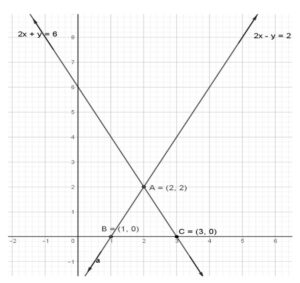
1. Solve the system of equations graphically and find the area of the triangle formed by the lines and the x-axis.
Step 1: Plot 2x + y = 6
Points: (0,6) and (3,0)
Step 2: Plot 2x − y − 2 = 0
Points: (0,−2) and (1,0)
Step 3: Find intersection
Adding the equations: 4x − 2 = 6 → 4x = 8 → x = 2
Substitute into first: 2(2) + y = 6 → y = 2
Intersection point: (2,2)
Step 4: Triangle vertices
A(1,0), B(3,0), C(2,2)
Step 5: Area
Base = 3 − 1 = 2
Height = 2
Area = ½ × 2 × 2 = 2
Answer:
Solution: x = 2, y = 2
Area = 2 square units
📥 View Answer for Visually Impaired
Proof:
Age Problem Solution
Let the present age of the Father age be x years and that of his son be y years.
Step 1: Equation from conditions after 5 years
After 5 years Father’s age = x + 5
After 5 years son’s age = y + 5
As per the question:
x + 5 = 3(y + 5)
⇒ x – 3y = 10 …(i)
Step 2: Equation from conditions 5 years ago
5 years ago Father’s age = x – 5
5 years ago son’s age = y – 5
As per the question:
x – 5 = 7(y – 5)
⇒ x – 7y = -30 …(ii)
Step 3: Solve the equations
Subtracting (ii) from (i):
(x – 3y) – (x – 7y) = 10 – (-30)
⇒ 4y = 40
⇒ y = 10
Step 4: Find x
Putting y = 10 in equation (i):
x – 3 × 10 = 10
⇒ x = 10 + 30 = 40
Answer:
Man’s present age = 40 years
Son’s present age = 10 years