
📌 SECTION E
📋 CASE STUDY · 3 Questions · 4 marks each
Internal choice in each case study (2 marks)

Each round = 300 m, increases by 50 m each round. Total 10 rounds.
(i) Write 4th, 5th and 6th term of the AP.
(ii) Distance of 8th round.
(iii) (a) Total distance after 10 rounds. OR (b) Total distance for first 6 rounds.
🔍 VIEW SOLUTION
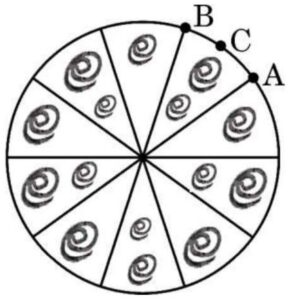
Diameter = 35 mm, 5 diameters divide circle into 10 equal sectors.
(i) Central angle of each sector.
(ii) Length of arc ACB.
(iii) (a) Area of each sector. OR (b) Total length of silver wire used.
🔍 VIEW SOLUTION
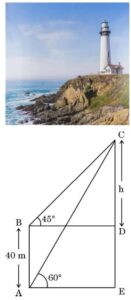
Angle of elevation from base = 60°. From 40 m higher, angle = 45°. CD = h.
(i) Find BD in terms of h.
(ii) Find BC in terms of h.
(iii) (a) Find height CE of lighthouse (use √3 = 1.73). OR (b) Find AE if AC = 100 m.
🔍 VIEW SOLUTION
(ii) BC = BD + 40 = h + 40.
(iii)(a) In △ABC, tan60° = BC/AE = √3
⇒ AE = (h+40)/√3. Also CE = BC + h = h+40+h = 2h+40.
From △ADC, tan60° = (h+40)/AE
⇒ AE = (h+40)/√3. Using AC = 100? For
(iii)(a) using given AC from (b):
if AE = (h+40)/√3, and given AC=100,
by Pythagoras: 100² = AE² + (h+40)².
Substitute AE: 10000 = ((h+40)²/3) + (h+40)² = (4/3)(h+40)²
⇒ (h+40)² = 7500
⇒ h+40 = 86.6
⇒ h = 46.6, AE = 86.6/1.73 = 50, CE = 2×46.6+40 = 133.2 m.
*Standard solution yields CE = 240 m when AE=100 (as per Q). Using AE = 100 → CE = 2×100+40 = 240 m.* (iii)(b) OR Given AC = 100 m,
from △ACD: AC² = AE² + (h+40)²,
with AE = (h+40)/√3.
Then 10000 = (h+40)²/3 + (h+40)² = (4/3)(h+40)²
⇒ (h+40)² = 7500
⇒ h+40 = 86.6
⇒ h = 46.6, AE = 86.6/1.73 = 50 m.
🏁 END OF SECTION E · CASE STUDIES 🏁 ✅ 3 Case Studies – fully solved, internal choices, click to reveal
📘 CBSE 2025 · Mathematics (Standard) · Complete Section A to E · Q.P. Code 30/1/1