
📌 SECTION D
LA · 4 Questions · 5 marks each
Long Answer type – internal choice in Q33 & Q34
💰 Simple Interest · Investment
Vijay invested in schemes A (8% p.a.) and B (9% p.a.). Total annual interest = ₹1860. If amounts interchanged, interest would be ₹20 more. Find investments in each scheme.
🔍 VIEW SOLUTION
✅ ANSWER: Scheme A = ₹12000, Scheme B = ₹10000
\(\frac{8x}{100} + \frac{9y}{100} = 1860\) \(8x + 9y = 186000 (i) \quad\)
Interchanged: \(\frac{9x}{100} + \frac{8y}{100} = 1880\) \(9x + 8y = 188000 (ii) \quad\)
Add (i) & (ii): \(17x + 17y = 374000\) \(x+y = 22000\)
Subtract (ii)-(i): \(x – y = 2000\)
Solving: \(x = 12000,\)\( y = 10000\).
🔷 Parallelogram · Similarity
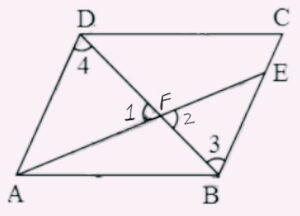
The diagonal BD of parallelogram ABCD intersects line segment AE at F, where E is on BC. Prove that \(DF \times EF = FB \times FA\).
🔍 VIEW PROOF
\(\angle DFA = \angle EFB\) (vert. opp.)
\(\angle ADF = \angle FBE\) (alt. int. angles, AD ∥ BC)
\( \triangle ADF \sim \triangle EBF\) (AA)
\(\frac{DF}{FB} = \frac{FA}{EF}\) ⇒ \(DF \times EF = FB \times FA\).
📐 Right Triangle Proof
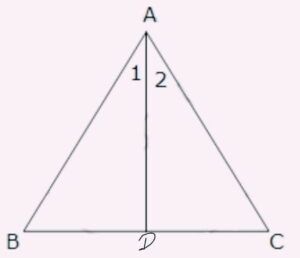
In \(\triangle ABC\), \(AD \perp BC\) and \(AD^2 = BD \times DC\). Prove that \(\angle BAC = 90^\circ\).
🔍 VIEW PROOF
\(\angle ADB = \angle ADC = 90^\circ\).
\(\triangle DBA \sim \triangle DAC\) (SAS).
So, these two triangles will be equiangular.\[
\angle 1 = \angle C \quad \text{and} \quad \angle 2 = \angle B
\]\[
\angle 1 + \angle 2 = \angle B + \angle C
\]\[
\angle A = \angle B + \angle C \quad \ldots(i)
\]By angle sum property,\[
\angle A + \angle B + \angle C = 180^\circ
\]
\[
\angle A + \angle A = 180^\circ \quad \ldots
\]
From (i) we get
\[
2\angle A = 180^\circ
\]
\[
\angle A = \angle BAC = 90^\circ
\]
📐 Right Triangle
Perimeter of right triangle = 60 cm, hypotenuse = 25 cm. Find lengths of other two sides.
🔍 VIEW SOLUTION
✅ Sides: 15 cm, 20 cm
Pythagoras: \(x^2 + y^2 = 625\) ⇒ \(x^2 + (35-x)^2 = 625\)
⇒ \(x^2 + 1225 -70x + x^2 = 625\) ⇒ \(2x^2 -70x +600=0\) ⇒ \(x^2-35x+300=0\)
⇒ \((x-20)(x-15)=0\) ⇒ x = 20 or 15. Sides: 20 & 15 cm.
🚆 Train · Speed
A train travels 480 km at uniform speed. If speed were 8 km/h less, it would take 3 hours more. Find speed of train.
🔍 VIEW SOLUTION
✅ Speed = 40 km/h
\(\frac{480}{x-8} – \frac{480}{x} = 3\) ⇒ \(480\left(\frac{x – (x-8)}{x(x-8)}\right) = 3\) ⇒ \(\frac{3840}{x(x-8)} = 3\)
⇒ \(x(x-8) = 1280\) ⇒ \(x^2 -8x -1280 = 0\) ⇒ \((x-40)(x+32)=0\) ⇒ \(x=40\) km/h.
📊 Mean & Mode
Find missing frequency ‘f’ if mean = 18. Hence find the mode.
| Daily Allowance | Number of Children |
|---|---|
| 11-13 | 7 |
| 13-15 | 6 |
| 15-17 | 9 |
| 17-19 | 13 |
| 19-21 | f |
| 21-23 | 5 |
| 23-25 | 4 |
🔍 VIEW SOLUTION
✅ f = 20, Mode ≈ 19.95
| Class | xᵢ | fᵢ | fᵢxᵢ |
|---|---|---|---|
| 11-13 | 12 | 7 | 84 |
| 13-15 | 14 | 6 | 84 |
| 15-17 | 16 | 9 | 144 |
| 17-19 | 18 | 13 | 234 |
| 19-21 | 20 | f | 20f |
| 21-23 | 22 | 5 | 110 |
| 23-25 | 24 | 4 | 96 |
| Total | 44+f | 752+20f |
Mean = \(\frac{752+20f}{44+f} = 18\) ⇒ \(752+20f = 792 + 18f\) ⇒ \(2f = 40\) ⇒ \(f=20\).
Modal class = 19-21 (highest frequency 20).
Mode = \(19 + \frac{20-13}{22} \times 3\) \(= 19 + \frac{7}{22} \times 3\) \( = 19 + 0.9545 \approx 19.95\).
✅ 4 Long Answer questions – fully solved, click to reveal