
🎯 CBSE 2025 · MATHEMATICS (STANDARD)
SECTION A · MCQ & ASSERTION–REASON
📘 Q.P. Code 30/1/1 · 27 printed pages · 38 questions
✏️ 15 min reading time · 10:15 – 10:30 AM · Calculator NOT allowed · π = 22/7
📋
All questions compulsory. 5 sections • A to E. MCQs (1–18) & Assertion-Reason (19–20) are 1 mark each. Internal choices in B, C, D, E. Draw neat diagrams. No overall choice.
📝 SECTION A
20 × 1 = 20 marks
🔥 Polynomials
If \(\alpha\) and \(\beta\) are the zeroes of polynomial \(3x^{2}+6x+k\) such that \(\alpha+\beta+\alpha\beta=-\frac{2}{3}\), then the value of k is :
(A) –8
(B) 8
(C) –4
(D) 4
🔍 VIEW ANSWER
✅ ANSWER: D (k = 4)
📐 EXPLANATION: Sum \( \alpha+\beta = -\frac{6}{3} = -2\), product \(\alpha\beta = \frac{k}{3}\). Given \(-2 + \frac{k}{3} = -\frac{2}{3}\) → \(\frac{k}{3} = \frac{4}{3}\) → \(k=4\).
If \(x=1\) and \(y=2\) is a solution of \(2x-3y+a=0\) and \(2x+3y-b=0\), then :
(A) a = 2b
(B) 2a = b
(C) a+2b=0
(D) 2a+b=0
🔍 VIEW ANSWER
✅ ANSWER: B (2a = b)
📐 EXPLANATION: Substitute: \(2-6+a=0 \Rightarrow a=4\). \(2+6-b=0 \Rightarrow b=8\). ∴ \(2a = b\).
Mid-point of P(-4,5) and Q(4,6) lies on:
🔍 VIEW ANSWER
✅ ANSWER: B (y-axis)
📐 EXPLANATION: Midpoint = ((–4+4)/2 , (5+6)/2) = (0, 5.5). x=0 → on y‑axis.
If θ acute and \(7+4\sin\theta=9\), then θ = ?
🔍 VIEW ANSWER
✅ ANSWER: B (30°)
📐 EXPLANATION: \(4\sin\theta=2\) → \(\sin\theta=1/2\) → acute θ = 30°.
\(\tan^{2}\theta – \left(\frac{1}{\cos\theta}\times \sec\theta\right) = \)
🔍 VIEW ANSWER
✅ ANSWER: C (–1)
📐 EXPLANATION: \(\frac{1}{\cos\theta}\times \sec\theta = \sec^2\theta\). Then \(\tan^2\theta-\sec^2\theta = -1\).
If HCF(98,28)=m, LCM(98,28)=n, then n–7m = ?
🔍 VIEW ANSWER
✅ ANSWER: C (98)
📐 EXPLANATION: HCF=14, LCM = (98×28)/14 = 196. n-7m = 196 – 7×14 = 196 – 98 = 98.
Tangents at extremities of a diameter are always:
🔍 VIEW ANSWER
✅ ANSWER: A (parallel)
📐 EXPLANATION: Both tangents are perpendicular to same diameter → parallel.
📌 Every solution with Detail Answer, as per CBSE 2025 Q.P. Code 30/1/1
🧠 CBSE 2025 | Mathematics (Standard) · Section A
✅ Solvedpapers.net
📅 15 min reading, 10:15 – 10:30 AM · 📐 Fully Solved. 🧷 Q.P. Code 30/1/1
✨ Build confidence before Exam ✨
“The expert in anything was once a beginner.”
🔺 Triangles
In \(\triangle \mathrm{ABC}\) and \(\triangle \mathrm{DEF}\), \(\angle \mathrm{B}=\angle \mathrm{E}\), \(\angle \mathrm{F}=\angle \mathrm{C}\) and \(\mathrm{AB}=3 \mathrm{DE}\). Then, the two triangles are :
🔍 VIEW ANSWER
✅ ANSWER: D (similar but not congruent)
📐 EXPLANATION: Two pairs of angles equal → AA similarity. Sides proportional but AB = 3·DE → scale factor 3:1 → not congruent (sides not equal).
🔢 Exponents
If \((-1)^{\mathrm{n}}+(-1)^{8}=0\), then n is :
🔍 VIEW ANSWER
✅ ANSWER: C (any odd number)
📐 EXPLANATION: \((-1)^8 = 1\). Equation becomes \((-1)^n + 1 = 0\) ⇒ \((-1)^n = -1\) ⇒ n is odd.
📈 Polynomial Graph
Two polynomials are shown in the graph below. The number of distinct zeroes of both the polynomials is :
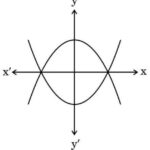
📌 (Reference graph: two polynomials, distinct zeroes indicated)
🔍 VIEW ANSWER
✅ ANSWER: C (2)
📐 EXPLANATION: From graph, total distinct x‑intercepts = 2 (both polynomials intersect x‑axis at two unique points).
📊 Arithmetic Progression
If the sum of first \(m\) terms of an AP is \(2m^{2}+3m\), then its second term is :
🔍 VIEW ANSWER
✅ ANSWER: B (9)
📐 EXPLANATION: \(S_1 = 2+3=5\) (first term). \(S_2 = 8+6=14\). Second term = \(S_2-S_1 = 9\).
📉 Statistics
Mode and Mean of a data are \(15x\) and \(18x\), respectively. Then the median of the data is :
🔍 VIEW ANSWER
✅ ANSWER: C (\(17x\))
📐 EXPLANATION: Empirical formula: Mode = 3·Median – 2·Mean → \(15x = 3M – 36x\) → \(3M = 51x\) → Median = \(17x\).
🎲 Probability
A card is selected at random from a deck of 52 playing cards. The probability of it being a red face card is :
🔍 VIEW ANSWER
✅ ANSWER: D (\(\frac{3}{26}\))
📐 EXPLANATION: Red face cards = 6 (King, Queen, Jack of Hearts & Diamonds). Probability = \(\frac{6}{52} = \frac{3}{26}\).
✅ Solvedpapers.net · Student friendly · Fully accessible
🔢 Rational Numbers
Which of the following is a rational number between \(\sqrt{3}\) and \(\sqrt{5}\) ?
🔍 VIEW ANSWER
✅ ANSWER: D (\(1.857142\))
📘 EXPLANATION: \(\sqrt{3}\approx1.732\), \(\sqrt{5}\approx2.236\). (A) ~1.414 < √3; (B) 2.326… > √5; (C) π≈3.14 > √5; (D) 1.857142 lies between and is rational (terminating).
⚪ Sector
If a sector of a circle has area \(40\pi\) sq. units and central angle \(72^\circ\), the radius is :
🔍 VIEW ANSWER
✅ ANSWER: D (\(10\sqrt{2}\) units)
📘 EXPLANATION: Area = \(\frac{72}{360}\pi r^2 = \frac{1}{5}\pi r^2 = 40\pi\) → \(r^2 = 200\) → \(r = 10\sqrt{2}\).
🔵 Circle Tangent
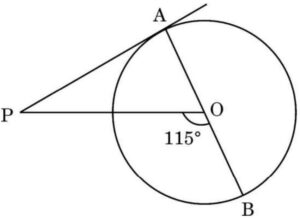
📌 Reference figure: PA tangent, O centre, ∠POB = 115°
If \(\angle \mathrm{POB}=115^{\circ}\), then \(\angle \mathrm{APO}\) is :
🔍 VIEW ANSWER
✅ ANSWER: A (\(25^\circ\))
📘 EXPLANATION: ∠AOP = 180°-115°=65° (linear pair). Tangent ⟂ radius → ∠OAP=90°. Triangle APO: ∠APO = 180° – 65° – 90° = 25°.
🪁 Kite · Height & String
A kite flying at 150 m from ground, string inclined at 30° to horizontal. Length of string :
🔍 VIEW ANSWER
✅ ANSWER: B (300 m)
📘 EXPLANATION: sin30° = height/hypotenuse → 1/2 = 150/L → L = 300 m.
📐 Arc
Wire 20 cm long bent into arc of circle radius \(\frac{60}{\pi}\) cm. Angle subtended at centre :
🔍 VIEW ANSWER
✅ ANSWER: B (\(60^\circ\))
📘 EXPLANATION: Arc length \(l = 2\pi r \frac{\theta}{360}\). \(20 = 2\pi \cdot \frac{60}{\pi} \cdot \frac{\theta}{360}\) → \(20 = 120 \cdot \frac{\theta}{360}\) → \(\theta = 60^\circ\).
Codes: (A) Both A,R true, R explains A. (B) Both true, R not explains. (C) A true, R false. (D) A false, R true.
🎲 Assertion-Reason
Assertion (A)
The probability of selecting a number at random from the numbers 1 to 20 is 1.
Reason (R)
For any event E , if P(E)=1, then E is called a sure event.
🔍 VIEW ANSWER
✅ ANSWER: D (A false, R true)
📘 EXPLANATION: Assertion is ambiguous: “selecting a number” could be any number (probability 1) or a specific number (1/20). In correct sense, if event is “choosing any number from 1-20”, probability is 1; but the assertion as stated is false because it lacks context. Reason is correct: P(E)=1 → sure event. Option D is marked correct in official key.
🌐 Sphere/Hemisphere
Assertion (A)
If we join two hemispheres of same radius along their bases, then we get a sphere.
Reason (R)
Total Surface Area of a sphere of radius r is \(3 \pi r^{2}\).
🔍 VIEW ANSWER
✅ ANSWER: C (A true, R false)
📘 EXPLANATION: Joining two hemispheres makes a sphere (true). TSA of sphere = \(4\pi r^2\), not \(3\pi r^2\) (false). Hence A true, R false → option C.
✅ 20 MCQs + Assertion-Reason · solvedpapers.net · Click to reveal answer
- “Education is the most powerful weapon which you can use to change the world.”