
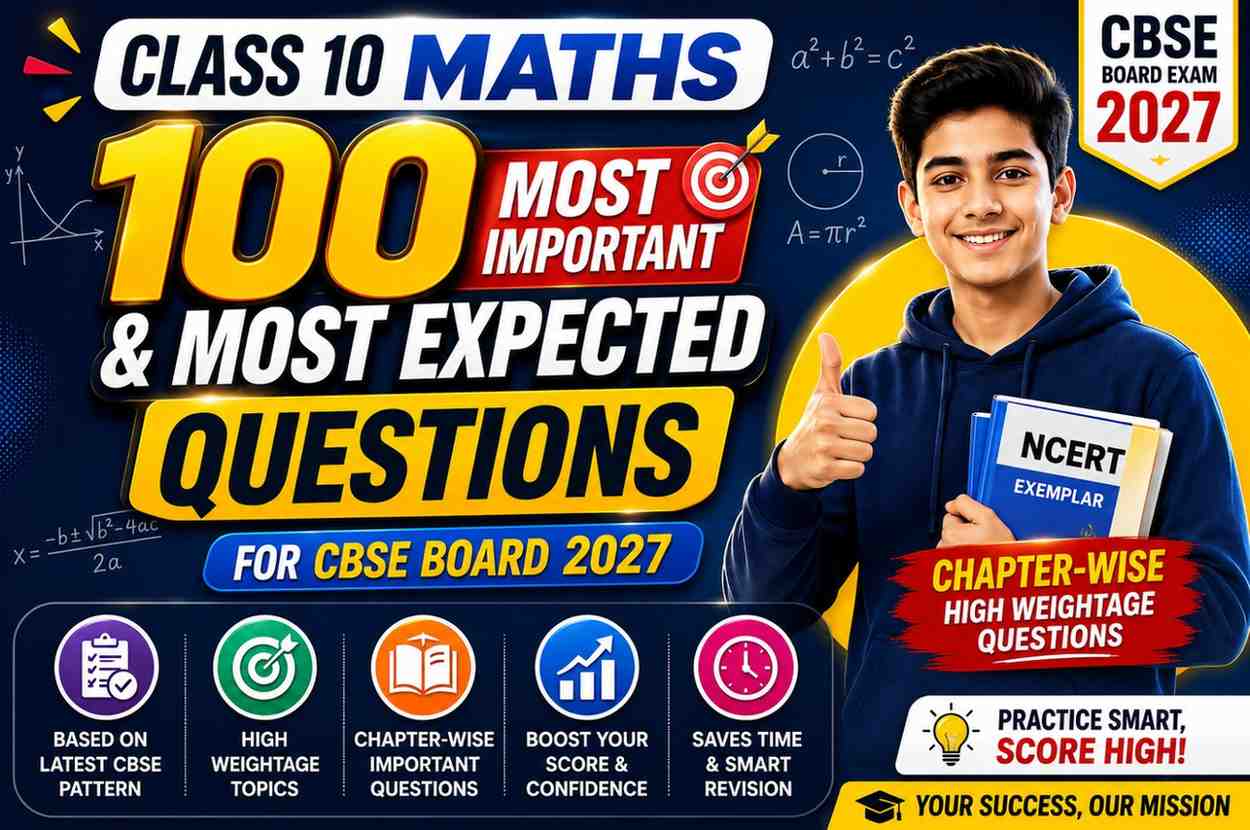
🔴CBSE Class 10 Maths Most Important and Expected Questions | 2027

CBSE 2027 · CLASS 10

📐 CBSE Class 10 Maths Most Important and Expected Questions | 2027

Chapter‑wise Preparation Guide for Board Exam 2027

✅ NCERT Based
✅ Competency Focus
✅ Previous Year Trends

✨ Why This Question Set Matters

The CBSE Class 10 Board Examination is a milestone. Mathematics is often the highest‑scoring subject when approached with the right strategy. The “100 Most Important & Most Expected Questions” are handpicked from past papers, sample papers, competency‑based items, and recurring NCERT concepts — giving you a smart revision roadmap for the 2027 exam.

📌 Note: The complete set of 100 questions is available separately. This guide explains their importance, selection process, and how to use them effectively.

🏛️ What is CBSE?

CBSE stands for the Central Board of Secondary Education. It is India’s premier national board, established in 1962, under the Union Government of India.

  • Objectives: To promote quality education, holistic development, and a continuous learning approach.
  • Affiliation: Over 27,000+ schools in India and abroad follow the CBSE curriculum.
  • Examination System: Transparent, standardised, and student‑centric with a focus on competency‑based education.
  • Recognised by universities across India and internationally (including the US, UK, and Canada).

📘 Syllabus 2025–26 (Chapter‑wise)
📊 Mark Distribution: Internal Assessment (20) + Board Exam (80) = Total 100

Unit I – Number Systems

Real Numbers – Euclid’s division lemma, HCF & LCM, irrational numbers, decimal expansions.

Unit II – Algebra

  • Polynomials: Zeros, relationship between zeros and coefficients, division algorithm.
  • Pair of Linear Equations: Graphical & algebraic methods (substitution, elimination, cross‑multiplication).
  • Quadratic Equations: Standard form, factorisation, quadratic formula, discriminant.
  • Arithmetic Progressions: nth term, sum of n terms, applications.

Unit III – Coordinate Geometry

Distance formula, section formula, area of a triangle (coordinate geometry).

Unit IV – Geometry

  • Triangles: Similarity criteria (AAA, SSS, SAS), Pythagoras theorem.
  • Circles: Tangents, theorems, properties.
  • Constructions: Division of line segment, tangents to a circle.

Unit V – Trigonometry

  • Introduction: Trigonometric ratios, identities, complementary angles.
  • Applications: Heights and distances (angles of elevation/depression).

Unit VI – Mensuration

  • Areas Related to Circles: Sector, segment, combination of figures.
  • Surface Areas & Volumes: Cube, cuboid, cylinder, cone, sphere, hemisphere (combined solids).

Unit VII – Statistics

Mean, median, mode of grouped data, cumulative frequency, ogives.

Unit VIII – Probability

Classical definition, simple problems on probability.

🔍 What are “Most Expected” Questions?

“Most Expected” questions are those that have a high probability of appearing in the board exam based on:

  • ✅ Analysis of previous 10 years’ papers
  • CBSE Sample Paper 2027 patterns
  • Competency‑based and case‑study questions
  • ✅ Frequently repeated NCERT exercises and exemplar problems
  • ✅ Expert teacher recommendations and high‑weightage topics
💡 These questions are not guesses — they are data‑driven predictions that help you focus your revision on the most impactful areas.

14 Benefits of Solving These Questions
🧠 Better understanding of concepts
💪 Improves confidence
📈 Helps score higher marks
📚 Covers complete syllabus efficiently
⚡ Enhances speed & accuracy
⏳ Improves time management
😌 Reduces exam stress
📋 Familiarises with question patterns
🔧 Strengthens problem‑solving skills
🎯 Identifies weak areas
🧩 Improves logical thinking
🔄 Increases revision efficiency
🚀 Boosts overall exam readiness

🧾 How Are These Questions Selected?

Our team of experienced educators follows a rigorous selection process:

  • 📅 Analysis of previous 10 years’ papers
  • 📖 NCERT textbook & exemplar problems
  • 📄 CBSE Sample Paper 2027
  • 🧠 Competency‑based questions
  • 📊 Case‑study questions
  • ⚖️ Assertion–Reason questions
  • 🌟 HOTS (Higher Order Thinking) questions
  • 🔄 Frequently repeated concepts
  • 👨‍🏫 Expert teacher recommendations
✅ This multi‑layer approach ensures the questions are relevant, balanced, and aligned with the latest CBSE exam pattern.

📌 Step‑by‑Step Preparation Strategy
  1. 1. Complete NCERT First – Every question in the board exam is rooted in NCERT. Read each chapter thoroughly.
  2. 2. Learn Formulas – Create a formula sheet and revise it daily.
  3. 3. Practice Chapter‑wise – Solve exercises and exemplar problems topic by topic.
  4. 4. Revise Daily – Dedicate 30–45 minutes to revision of previously studied topics.
  5. 5. Attempt Mock Tests – Simulate exam conditions with full‑length tests.
  6. 6. Analyse Mistakes – Maintain an “error log” to track and fix recurring errors.
  7. 7. Solve Previous Year Papers – Familiarise yourself with the pattern and difficulty level.
  8. 8. Focus on Weak Chapters – Allocate extra time to topics where you score less.
  9. 9. Manage Time Effectively – In the exam, attempt the easy questions first, then move to tougher ones.

🚫 Common Mistakes to Avoid
❌ Skipping NCERT
❌ Ignoring formulas
❌ Lack of revision
❌ Poor time management
❌ Not practising diagrams
❌ Leaving difficult chapters
❌ Guessing answers
❌ Not checking calculations

💡 Tip: Awareness of these pitfalls is the first step to overcoming them. Review your practice sessions to ensure you are not falling into these traps.

Frequently Asked Questions

1. Are these 100 questions enough for CBSE Board 2027?

They are a powerful revision tool but should be used alongside complete syllabus coverage. They cover the most important and high‑weightage topics.

2. Are they based on the latest syllabus?

Yes, they are strictly aligned with the CBSE Class 10 Maths syllabus 2025–26.

3. Do they include competency‑based questions?

Absolutely. The set includes case‑study, assertion‑reason, and HOTS questions as per the new CBSE pattern.

4. Should I study NCERT first?

Yes. NCERT is the foundation. Solve it completely before attempting the 100 questions.

5. Are previous year questions important?

Very. They help you understand the exam pattern, difficulty level, and frequently asked concepts.

6. How many marks can I expect after practising them?

With consistent practice and proper revision, you can aim for 95+ marks out of 100.

7. Are these useful for school exams too?

Yes. The questions are conceptual and cover the syllabus, making them helpful for school pre‑boards and unit tests.

8. Can average students score 95+ with these?

Absolutely. The set is designed to bridge the gap between average and excellent performance through focused practice.

9. How many times should I solve these questions?

At least 2–3 times – first for understanding, second for speed, and third for perfection.

10. Are the solutions provided?

Yes, the full question set comes with detailed step‑by‑step solutions to help you understand the approach.

11. Is this set enough for revision?

It is an excellent revision capsule. Combined with NCERT and sample papers, it covers all critical areas.

12. How should I time myself while solving?

Treat each question as a 2‑minute challenge. For long numericals, allow up to 5 minutes. Practise with a timer.

13. Where can I get the full 100‑question set?

The complete set is available separately as a downloadable PDF / online resource. Check the link provided in your study material.

🎯 Ready to Ace Your Maths Board Exam?

The 100 Most Important & Most Expected Questions are your shortcut to smart, focused revision. They are not a replacement for hard work — they are the catalyst that turns your effort into top scores.

📌 Complete your syllabus → Practise these questions → Score 95+

Consistent practice is the key. Start today, and walk into the exam hall with confidence.

📖 CBSE Class 10 Maths · 2027 Board Exam

Designed for students · Chapter‑wise · Competency‑focused


📄 CBSE Class 10 Maths – 100 Most Important & Expected Questions | 2027 fully Solved by Team Of Expert

Leave a Comment