
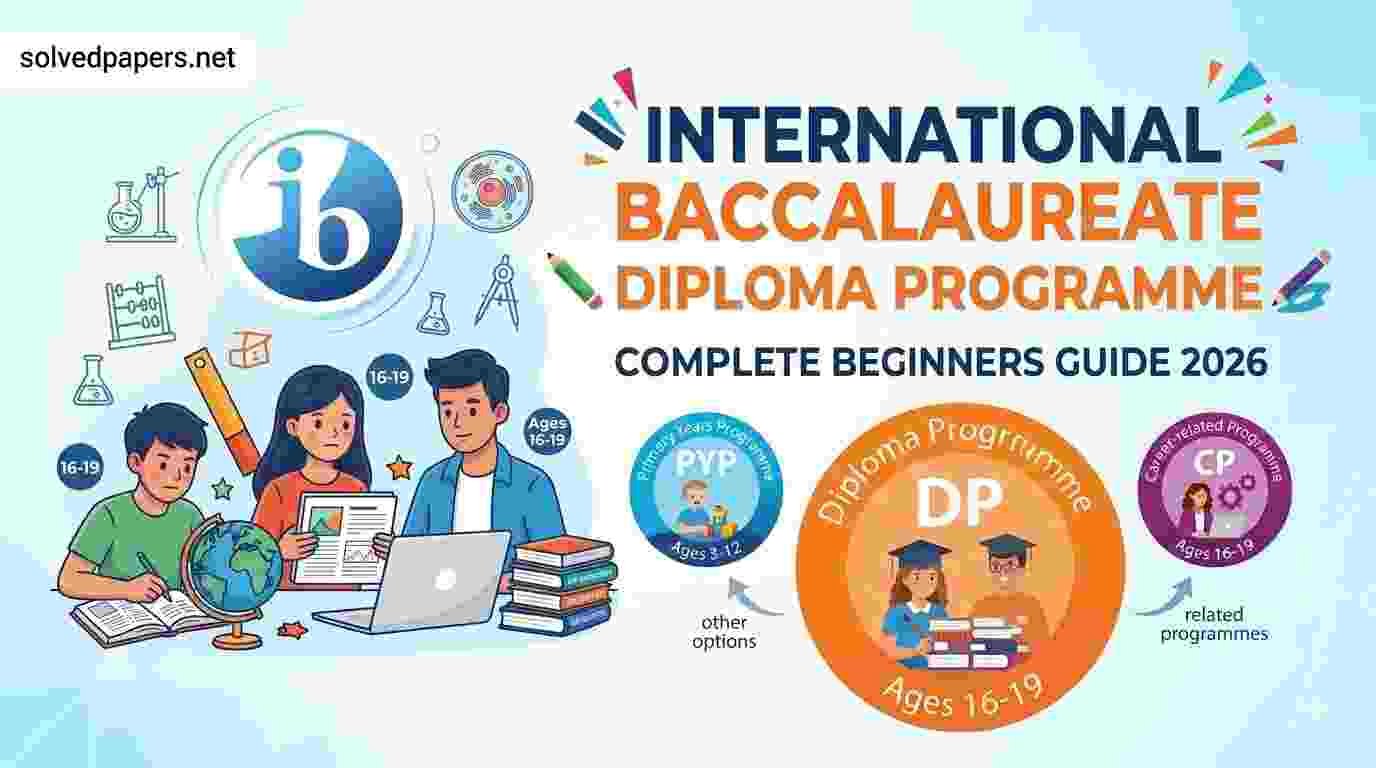
🎓 IB Diploma Programme (Dp)
The Complete Beginner’s Guide · 2026
📚 6 Subjects
⭐ TOK · EE · CAS
🌏 158 Countries
👋 Introduction
What is the IB Diploma Programme? It is a two-year
educational course for students aged 16 to 19. It is offered by
schools all over the world and is recognised by thousands of universities.
The IB Diploma Programme (often called IB DP or simply
IB) is not like other school courses. It does not just ask you to
remember facts. It teaches you how to think, question, research,
and understand the world from many different perspectives.
💡 Who should read this guide?
✅ Students hearing about IB for the first time
✅ Parents comparing school systems
✅ Teachers and school counsellors
✅ Anyone applying to international schools
✅ Students planning to study abroad
In this guide, you will learn: What the IB DP is, why it was created,
what subjects you can study, how you are assessed, how universities view it, and
much more – all in simple, easy-to-understand English.
📌 What is the IB Diploma Programme?
- Full form: International Baccalaureate Diploma Programme
- Definition: A challenging two-year pre-university course that
develops intellectual, personal, emotional and social skills. - Purpose: To prepare students for university and life in a
globalised world. - Age group: 16 to 19 years
- Duration: 2 years (usually Grades 11 and 12)
- Founded: 1968 in Geneva, Switzerland
- Mission: “To develop inquiring, knowledgeable and caring
young people who help to create a better and more peaceful world through
intercultural understanding and respect.” - Global recognition: Accepted by universities in over
100 countries.
| Aspect | Detail |
|---|---|
| Full Name | International Baccalaureate Diploma Programme |
| Founded | 1968, Geneva, Switzerland |
| Age Range | 16 – 19 years |
| Duration | 2 years |
| Subjects | 6 subject groups + Core (TOK, EE, CAS) |
| Max Score | 45 points (42 from subjects + 3 bonus) |
| Passing Score | Minimum 24 points + core requirements |
| Global Schools | 5,400+ IB World Schools |
| Headquarters | Geneva, Switzerland |
📌 Did You Know? The IB Diploma Programme was originally
designed for the children of diplomats and international organisation staff
who moved between countries frequently. Today, it is available in
over 5,400 schools worldwide.
🕰️ Why Was the IB Diploma Programme Created?
In the 1960s, international schools were growing quickly. But each school used a
different national system – British, American, French, and so on. Students who moved
from one country to another found it very difficult to continue their education.
A group of educators in Geneva asked: “Why not create one curriculum that works
everywhere?” So they designed the IB Diploma Programme in 1968.
Their goals were:
- To create a curriculum accepted by universities worldwide
- To teach critical thinking, not just memorisation
- To build international understanding and peace
- To prepare students for a changing, globalised world
💡 Quick Tip: The IB DP is now offered in 158 countries
and is one of the most respected pre-university qualifications in the world.
🌟 Why Students Choose the IB Diploma Programme
Every year, hundreds of thousands of students choose the IB DP.
Here is why:
The IB DP is recognised by universities in
over 100 countries. This gives students the freedom to
study anywhere.
Students learn to question, analyse,
and evaluate information – not just accept it. This is a skill that
universities and employers love.
The Extended Essay and other research tasks
teach students how to work independently – a key skill for
university.
The IB DP is rigorous and
prepares students well for the demands of higher education.
Through CAS (Creativity, Activity, Service),
students develop soft skills like empathy, teamwork, and
leadership – not just academic knowledge.
📌 Example: Maria, an IB DP student in Dubai, studied
Biology HL, Chemistry HL, and Maths AA HL. She also did her Extended Essay on
“The impact of climate change on coral reefs”. She received an offer from
University College London (UCL) to study Medicine – because
her IB grades and skills impressed the admissions team.
👤 Who Can Join the IB Diploma Programme?
Eligibility: Students aged 16 to 19 who have
completed their previous level of schooling (usually Grade 10 or equivalent).
Admission requirements: These vary by school, but typically include:
- Good grades in previous studies (usually 60%+ or equivalent)
- Strong performance in English and Mathematics
- An entrance test or interview (at some schools)
- Recommendation letters from teachers
Language requirements: The IB DP is taught in English,
French, or Spanish. Most schools use English. Students must be
proficient in the language of instruction.
School requirements: The school must be an IB World
School – authorised by the IB to offer the Diploma Programme.
💡 Quick Tip: If your school does not offer the IB DP,
you can sometimes join a school that does – even if you have to move or
travel. Some schools also offer online IB courses.
📚 Curriculum Structure
The IB DP curriculum has three core components and
six subject groups. Students must take one subject
from each of the six groups.
| Component | Description |
|---|---|
| Group 1 | Studies in Language and Literature |
| Group 2 | Language Acquisition |
| Group 3 | Individuals and Societies |
| Group 4 | Sciences |
| Group 5 | Mathematics |
| Group 6 | The Arts (or a second subject from Groups 1–4) |
| Core: TOK | Theory of Knowledge – explores “how do we know?” |
| Core: EE | Extended Essay – 4,000-word independent research |
| Core: CAS | Creativity, Activity, Service – experiential learning |
📌 Higher Level (HL) vs Standard Level (SL)
- Higher Level (HL): 240 teaching hours – deeper, more content,
more challenging. Students take 3 or 4 HL subjects. - Standard Level (SL): 150 teaching hours – broad but less depth.
Students take the remaining subjects at SL.
📌 Subject Selection Rules
- At least 3 subjects must be taken at Higher Level (HL).
- Students can take up to 4 HL subjects.
- The remaining subjects are taken at Standard Level (SL).
- All six subject groups must be represented.
📖 Complete Subject Groups
📖 Group 1: Studies in Language and Literature
What students study: Literature (poetry, novels, plays) and
language (writing, speaking, analysing texts). Students explore how language
creates meaning and shapes our understanding of the world.
- Subjects: English A: Literature, English A: Language and
Literature, and other languages (e.g., French A, Spanish A). - Skills developed: Critical reading, analytical writing,
oral communication, cultural awareness. - Difficulty: Medium to High – requires strong language skills.
- Suitable careers: Law, Journalism, Teaching, Publishing,
Public Relations, Politics.
🌐 Group 2: Language Acquisition
What students study: A second language (or a third language).
Students develop listening, speaking, reading, and writing skills.
- Subjects: French B, Spanish B, German B, Mandarin B,
Arabic B, and others. Also ab initio (beginner) courses
for students with no previous knowledge. - Skills developed: Communication, cultural understanding,
listening, speaking, reading, writing. - Difficulty: Varies – ab initio is easier; B courses
require prior knowledge. - Suitable careers: Diplomacy, International Business,
Translation, Tourism, Education.
🏛️ Group 3: Individuals and Societies
What students study: Human behaviour, societies, and how
people organise themselves. Subjects include History, Economics, Psychology,
Geography, Business Management, Philosophy, Global Politics, and more.
- Skills developed: Critical thinking, research, analysis,
evaluation, essay writing, understanding human behaviour. - Difficulty: Medium to High – requires strong analytical
and writing skills. - Suitable careers: Law, Economics, Business, Politics,
Social Work, Psychology, Journalism, International Relations.
macroeconomics, international trade, and development economics. They learn
how markets work and how governments influence them.
🔬 Group 4: Sciences
What students study: The natural world through observation,
experimentation, and analysis. Subjects include Biology, Chemistry, Physics,
Computer Science, Environmental Systems and Societies (ESS), and Sports,
Exercise and Health Science.
- Skills developed: Scientific inquiry, experimentation,
data analysis, problem-solving, research skills. - Difficulty: High – requires strong analytical and
mathematical skills. - Suitable careers: Medicine, Engineering, Research,
Environmental Science, IT, Pharmacy, Veterinary Science.
an interdisciplinary subject – it can be taken as a Group 3 OR Group 4
subject, making it a flexible choice.
📐 Group 5: Mathematics
What students study: There are four Maths
options, each with a different focus:
- AA HL (Analysis & Approaches HL): Pure maths,
calculus, algebra, theory. For students who love maths and plan to study
Engineering, Physics, Computer Science, or Maths. - AA SL: Similar to AA HL but less depth.
- AI HL (Applications & Interpretation HL): Statistics,
modelling, real-world applications. For students who enjoy applied maths
and plan to study Economics, Business, Biology, or Psychology. - AI SL: Similar to AI HL but less depth.
university, you should choose Mathematics AA HL. If you
want to study Business, Mathematics AI HL or
AI SL is usually sufficient.
🎨 Group 6: The Arts
What students study: Creative expression through visual arts,
music, theatre, dance, and film. Students can also choose a second
subject from Groups 1–4 instead of an Arts subject.
- Subjects: Visual Arts, Music, Theatre, Dance, Film.
- Skills developed: Creativity, self-expression, critical
analysis of art, performance skills, collaboration. - Difficulty: Varies – requires talent and practice.
- Suitable careers: Art, Design, Music, Theatre, Film,
Architecture, Media.
⚖️ Higher Level (HL) vs Standard Level (SL)
| Aspect | Higher Level (HL) | Standard Level (SL) |
|---|---|---|
| Teaching Hours | 240 hours | 150 hours |
| Depth of Study | More depth, more content | Broad but less depth |
| Difficulty | Higher – more challenging | More manageable |
| University Expectations | Often required for competitive courses | Acceptable for many courses |
| Internal Assessment | More demanding | Less demanding |
| Recommended For | Students aiming for top universities | Students with a balanced workload |
💡 Expert Advice: Choose HL subjects that are
relevant to your university course. For example, if you want
to study Medicine, take Biology HL and Chemistry HL. If you
are unsure, choose a balanced combination of HL and SL subjects
to keep your options open.
🧠 Theory of Knowledge (TOK)
What is TOK? TOK is a course that asks the question:
“How do we know what we know?” It is not about learning
facts – it is about thinking about thinking.
Students explore ways of knowing (emotion, reason, language,
sense perception, imagination, faith, intuition, and memory) and
areas of knowledge (mathematics, natural sciences, human sciences,
history, the arts, ethics, and religious knowledge).
📌 Assessment
- TOK Essay (1,600 words): Students write an essay on a prescribed
title. Example: “Can we trust our senses to give us truth?” - TOK Exhibition: Students create a display that explores how
TOK manifests in the real world. Example: choosing three objects and explaining
how they relate to a TOK prompt.
📌 Example: A TOK exhibition prompt: “What counts as
knowledge in the arts?” A student might choose a painting, a musical
score, and a film clip to explore how meaning is created in different art forms.
📝 Extended Essay (EE)
The Extended Essay is a 4,000-word research paper
on a topic of the student’s choice. It develops research, writing, and
critical thinking skills.
- Purpose: To prepare students for independent research at
university. - Topic selection: Choose a topic that interests you and that
relates to one of your IB subjects. - Assessment: Graded A–E (together with TOK, contributes up to
3 bonus points). - Tips: Start early, keep a research journal, and work closely
with your supervisor.
📌 Example: A student interested in Psychology might write:
“The impact of social media on self-esteem among teenagers in urban India.”
They would conduct research, review literature, and present their findings.
🏃 Creativity, Activity and Service (CAS)
CAS is about learning by doing. It is not graded with points,
but it is mandatory – you must complete CAS to earn your diploma.
Arts, music, drama, design, creative writing,
photography, film-making.
Sports, dance, hiking, fitness, outdoor
adventures, team games.
Volunteering, tutoring, community projects,
helping the elderly, environmental work.
📌 Example: A student might:
🎨 Creativity: Design and publish a school magazine.
⚽ Activity: Join the school football team and train regularly.
❤️ Service: Volunteer at a local animal shelter every weekend.
📊 Assessment System
The IB DP uses a balanced assessment approach:
- External Assessment: Written exams at the end of the course
(marked by IB examiners). - Internal Assessment (IA): Coursework, oral work, lab reports,
investigations (marked by teachers and moderated by IB). - Grading: Each subject is scored 1 to 7.
7 is the highest. - Bonus Points: Up to 3 points from TOK and EE
combined. - Maximum Total: 45 points (42 from subjects + 3 bonus).
- Passing: Minimum 24 points + all core
requirements met.
| Grade | Description | University View |
|---|---|---|
| 7 | Excellent – deep understanding | Top universities expect this |
| 6 | Very good – strong knowledge | Highly competitive |
| 5 | Good – solid understanding | Good for many universities |
| 4 | Satisfactory – acceptable | May be accepted for some courses |
| 3 | Basic – some understanding | Concern for universities |
| 2 | Limited – major gaps | Not acceptable |
| 1 | Minimal – very little understanding | Not acceptable |
💡 Quick Tip: Grade boundaries are set after
each exam session to ensure fairness across the world. A score of 7 in one
session may require a different raw score than in another session – it depends
on the difficulty of the paper.
🎯 Choosing Subjects – Career Recommendations
| Career | Recommended HL Subjects | Recommended SL Subjects |
|---|---|---|
| 🔧 Engineering | Maths AA HL, Physics HL | Chemistry, English, Language |
| 🩺 Medicine | Biology HL, Chemistry HL | Maths, English, Language |
| 📈 Business | Economics HL, Business HL | Maths AI, English, Language |
| ⚖️ Law | English A HL, History HL | Language, Economics, Maths |
| 💻 Computer Science | Maths AA HL, Physics HL | CS, English, Language |
| 🎨 Arts | Visual Arts HL, Theatre HL | English, History, Language |
| 🧠 Psychology | Psychology HL, Biology HL | Maths AI, English, Language |
| 📚 Humanities | History HL, English A HL | Language, Economics, Maths |
🏛️ University Recognition of the IB Diploma
The IB Diploma is recognised by thousands of universities in over
100 countries. Here is how different countries view the IB DP:
Accepted by all top universities – Harvard, MIT, Stanford, Yale, Princeton, UC Berkeley.
Many give college credit for HL subjects with scores of 5 or higher.
Oxford, Cambridge, Imperial, LSE, UCL all accept IB. Cambridge typically requires
40–42 points with HL scores of 7,7,6.
University of Toronto, UBC, McGill, McMaster all accept IB. U of T offers
scholarships for IB students.
ANU, Melbourne, Sydney, UNSW accept IB. Many Australian universities have
IB-specific entry pathways.
LMU Munich, Heidelberg, TU Berlin accept IB. Students must meet specific
subject requirements (e.g., German language).
Sciences Po, Sorbonne, HEC Paris accept IB. Good scores (35+) are competitive.
NUS, NTU, SMU accept IB. NUS typically requires 38+ points
for competitive courses.
Ashoka University, JGU, BITS Pilani, Azim Premji University accept IB.
Some universities require subject-specific scores.
NYU Abu Dhabi, UAE University, American University of Sharjah accept IB.
NYUAD offers generous scholarships for IB students.
💡 Quick Tip: Many universities have IB-specific
admissions pages – always check the requirements for your
target universities early in your IB journey.
⚖️ IB DP vs Other Curricula
🇮🇳 IB DP vs CBSE
| Aspect | IB DP | CBSE |
| Approach | Inquiry-based, research | Structured, exam-focused |
| Assessment | Coursework + final exams | Year-end board exams |
| Difficulty | Higher – requires critical thinking | Medium – focuses on content |
| Cost | Higher | Lower |
| Global Recognition | Worldwide | India + some global |
| Best For | Global universities, holistic development | Indian exams (JEE, NEET), affordability |
🇮🇳 IB DP vs ICSE
| Aspect | IB DP | ICSE |
| Teaching Style | Inquiry-driven | Language-rich, detailed |
| Global Recognition | Very high | Moderate |
| Focus | Holistic development | Academic rigour |
| Assessment | Continuous + final exams | Final exams + projects |
🇬🇧 IB DP vs Cambridge A Levels
| Aspect | IB DP | A Levels |
| Breadth | 6 subjects + core | 3–4 subjects |
| Depth | HL subjects are deep | Very deep focus |
| Core Components | TOK, EE, CAS (mandatory) | None |
| Assessment | Continuous + final exams | Final exams only |
| Best For | Holistic learners, global universities | Students who prefer depth over breadth |
🌍 IB DP vs IGCSE (Cambridge)
| Aspect | IB DP | IGCSE |
| Level | Pre-university (Grades 11–12) | Secondary (Grades 9–10) |
| Breadth | 6 subjects + core | 5–9 subjects |
| Assessment | Continuous + final exams | Final exams only |
| Best For | University preparation | Broad secondary education |
✅ Advantages of the IB Diploma Programme
⚠️ Challenges and How to Overcome Them
6 subjects + TOK + EE + CAS is a lot!
✅ Solution: Plan your time, use a calendar, break tasks into small steps.
Many students struggle to balance studies and CAS.
✅ Solution: Use the “Pomodoro” technique – 25 minutes work, 5 minutes break.
The EE and IAs require independent research.
✅ Solution: Choose a topic you love. Work closely with your supervisor.
High expectations can be stressful.
✅ Solution: Exercise, sleep 8 hours, talk to friends and family.
Tuition and exam fees can be high.
✅ Solution: Apply for scholarships, financial aid, or choose a school with lower fees.
💡 25 Practical Study Tips for IB DP Students
1. Start early – don’t leave things to the last minute.
2. Use a planner or digital calendar.
3. Break large tasks into smaller steps.
4. Practice past papers – they are your best friend.
5. Join a study group – learn with friends.
6. Ask your teachers for help – they are there for you.
7. Read the syllabus – know exactly what you need to learn.
8. Keep a “common mistakes” notebook.
9. Use flashcards for vocabulary and key concepts.
10. Teach someone else – it helps you understand better.
11. Take regular breaks – your brain needs rest.
12. Sleep 7–8 hours a night – it’s essential for memory.
13. Exercise – it reduces stress and improves focus.
14. Eat healthy – your brain needs good fuel.
15. Stay hydrated – drink plenty of water.
16. Use the Pomodoro technique (25/5).
17. Review your notes within 24 hours of class.
18. Make mind maps to connect ideas.
19. Record your study sessions (audio).
20. Use online resources – Khan Academy, IB YouTube channels.
21. Keep a CAS journal – reflect on your experiences.
22. Start your EE in the summer before DP2.
23. Practice TOK essay writing under timed conditions.
24. Stay positive – believe in yourself.
25. Celebrate small wins – reward yourself for progress.
❌ 20 Common Mistakes and How to Avoid Them
1. Procrastinating – start early.
2. Not reading the syllabus – know what you need to learn.
3. Choosing subjects without research – check university requirements.
4. Ignoring CAS – it’s mandatory, not optional.
5. Not practicing past papers – they are essential.
6. Overloading with HL subjects – 4 HL is tough.
7. Forgetting to sleep – sleep is vital for learning.
8. Skipping breakfast – your brain needs fuel.
9. Not asking for help – teachers are there to support you.
10. Leaving EE to the last minute – start in the summer.
11. Not using the TOK course effectively – it’s a great way to develop thinking.
12. Ignoring Internal Assessments – they contribute to your final grade.
13. Not checking grade boundaries – know what you need to achieve.
14. Studying alone all the time – study groups can help.
15. Not taking breaks – your brain needs rest.
16. Comparing yourself to others – focus on your own journey.
17. Not using the library or online resources – there is so much available.
18. Forgetting to reflect – reflection is key to growth.
19. Not planning for university applications – start early.
20. Giving up when it gets hard – persistence pays off.
💰 Fees of the IB Diploma Programme
The cost of the IB DP varies greatly by country and school. Below are
approximate annual tuition fees (in local currency) for
IB DP students.
💡 Quick Tip: In addition to tuition, schools usually charge
exam fees (approx. USD 450 per subject) and
registration fees. Always ask for a complete fee breakdown
before enrolling.
🏫 Best IB Schools (Examples)
🎓 Scholarships for IB Students
Many schools and universities offer scholarships for IB students.
Here are the main types:
- 🏅 Merit-based: For students with excellent academic performance
(e.g., high predicted grades). - 💰 Need-based: Financial aid for families who cannot afford
full tuition. - 🌍 University scholarships: Many universities offer
IB-specific scholarships – some cover up to 100% of tuition. - 🏫 School scholarships: Some IB schools offer scholarships for
exceptional students.
📌 Example: NYU Abu Dhabi offers generous scholarships
to IB students with strong scores. Many US universities (e.g., Vanderbilt, Duke)
also offer IB-specific merit scholarships.
💼 Career Opportunities with IB DP
The IB DP develops transferable skills that are valued in
every career. Here is how it helps in different fields:
❓ Frequently Asked Questions (100+)
Here are answers to 100+ common questions about the IB Diploma Programme.
Click each question to reveal the answer.
1. What does IB DP stand for?
International Baccalaureate Diploma Programme.
2. What age is the IB DP for?
Students aged 16 to 19.
3. How many subjects do you take in IB DP?
6 subjects + 3 core components (TOK, EE, CAS).
4. What are the 6 subject groups?
Language & Literature, Language Acquisition, Individuals & Societies, Sciences, Mathematics, The Arts.
5. What is Higher Level (HL)?
A subject taken at greater depth – 240 teaching hours. Students take 3 or 4 HL subjects.
6. What is Standard Level (SL)?
A subject taken with less depth – 150 teaching hours.
7. What is Theory of Knowledge (TOK)?
A course that explores “how do we know what we know?”
8. What is the Extended Essay (EE)?
A 4,000-word independent research paper on a topic of your choice.
9. What is CAS?
Creativity, Activity, Service – experiential learning outside the classroom.
10. How is IB DP graded?
Each subject is scored 1–7. Total = 42 + up to 3 bonus points = max 45.
11. What is a good IB score?
30+ is good, 38+ is excellent for top universities.
12. What is the passing score for IB DP?
Minimum 24 points + all core requirements met.
13. Which universities accept the IB DP?
Thousands of universities in over 100 countries – including Harvard, Oxford, Cambridge, NUS, and more.
14. Is IB DP harder than A Levels?
IB is broader (6 subjects + core); A Levels are deeper (3–4 subjects). Different types of challenge.
15. Is IB DP harder than CBSE?
IB requires more independent thinking and research; CBSE is more content-based. Both are challenging in different ways.
16. Can I take IB DP without a school?
You must be enrolled in an IB World School to earn the diploma. Some schools offer online IB courses.
17. How much does IB DP cost in India?
Approx. ₹8–20 lakh per year.
18. What is the difference between Maths AA and AI?
AA = Analysis & Approaches (pure/theoretical); AI = Applications & Interpretation (applied/statistics).
19. Which Maths should I choose for Engineering?
Mathematics AA HL.
20. Which Maths for Business?
Mathematics AI HL or AI SL.
21. What is Internal Assessment (IA)?
Coursework marked by teachers – e.g., lab reports, oral work, investigations.
22. What is External Assessment?
Final written exams marked by IB examiners.
23. What are bonus points?
Up to 3 bonus points awarded for TOK and EE performance combined.
24. What is a bilingual diploma?
Awarded when a student takes two Language A courses or completes a subject in a different language.
25. How many IB schools are there?
Over 5,400 IB World Schools in 158 countries.
26. Where is the IB headquarters?
Geneva, Switzerland.
27. When was the IB DP founded?
1968.
28. What is the IB mission?
“To develop inquiring, knowledgeable and caring young people who help to create a better and more peaceful world.”
29. What are the IB approaches to teaching?
Inquiry-based, concept-driven, collaborative, differentiated, and assessment-focused.
30. What are ATL skills?
Approaches to Learning – thinking, research, communication, social, and self-management skills.
31. What is the IB learner profile?
10 attributes that IB students develop: inquirers, thinkers, communicators, etc.
32. What is a predicted grade?
Teachers’ estimate of your final grade, used for university applications.
33. What is a re-mark?
An enquiry upon results – a senior examiner re-marks your paper.
34. What are grade boundaries?
The score ranges for each grade (1–7), set after each exam session.
35. What is the MYP?
Middle Years Programme – the IB programme for ages 11–16.
36. What is the PYP?
Primary Years Programme – the IB programme for ages 3–12.
37. What is the CP?
Career-related Programme – for students aged 16–19 who want a mix of academic and career learning.
38. Is the IB DP recognised in India?
Yes – Ashoka University, JGU, BITS Pilani, and many others accept IB.
39. Is the IB DP recognised in Germany?
Yes, German universities accept IB with specific conditions (e.g., certain subjects at HL).
40. Is the IB DP recognised in Singapore?
Yes – NUS, NTU, and SMU accept IB.
41. Can I take IB DP if I am not good at maths?
Yes – choose Maths AI SL or even the more accessible Maths options, but you must take some form of maths.
42. Can I take IB DP if I am not a native English speaker?
Yes – many IB schools offer language support. You must be proficient in English to follow the course.
43. How do I choose my IB subjects?
Start with your university course requirements. Then consider your strengths and interests.
44. How many hours should I study per day?
Aim for 2–3 hours of focused study per day, plus additional time for CAS and EE.
45. What is the pass rate for IB DP?
The global pass rate is approximately 80–85% (varies by year and region).
46. How many students take the IB DP each year?
Approximately 180,000 students take the IB DP globally each year.
47. What is the best IB school in the world?
There is no single “best” – but schools like UWC, Sevenoaks, and many others are highly regarded.
48. Can I get a scholarship for IB DP?
Yes – merit-based, need-based, and university-specific scholarships are available.
49. What is the IB DP exam schedule?
IB exams are held twice a year – in May (Northern Hemisphere) and November (Southern Hemisphere).
50. What are the CAS requirements?
Students must complete a CAS project and demonstrate achievement in Creativity, Activity, and Service over 18 months.
51. What is a CAS project?
A collaborative project that involves creativity, activity, or service – e.g., organising a charity fundraiser.
52. What is the TOK essay word count?
1,600 words.
53. What is the EE word count?
4,000 words.
54. What are the EE assessment criteria?
Focus and method, knowledge and understanding, critical thinking, presentation, and engagement.
55. What is a TOK exhibition?
A display of three objects that explore a TOK prompt – presented to the class.
56. What is the difference between IB and AP?
IB is a holistic diploma programme; AP is individual US-based exams.
57. Is IB better than AP?
It depends – IB is broader and more holistic; AP is more flexible and subject-focused.
58. Can I switch from CBSE to IB after Grade 10?
Yes, many students do this. You will need to adapt to the different style of learning.
59. Can I switch from IGCSE to IB after Grade 10?
Yes, IGCSE provides a good foundation for IB DP.
60. What is the IB DP syllabus?
Each subject has a detailed syllabus published by the IB – it covers content, skills, and assessment.
61. What are the IB DP assessment objectives?
They vary by subject but generally include knowledge, understanding, application, analysis, and evaluation.
62. What is the IB DP core?
The three mandatory components: Theory of Knowledge (TOK), Extended Essay (EE), and Creativity, Activity, Service (CAS).
63. What is the IB DP continuum?
The IB programmes (PYP, MYP, DP, CP) form a continuum – they flow from one to the next.
64. What is the IB DP subject brief?
A document that outlines the content, skills, and assessment for each subject.
65. What is the IB DP grade descriptors?
Descriptions of what is expected for each grade (1–7) in each subject.
66. What is the IB DP moderation?
The process by which the IB checks the quality of internal assessment marking to ensure fairness.
67. What is the IB DP results day?
Results are released in July (May session) and January (November session).
68. What is the IB DP diploma certificate?
The official certificate awarded to students who meet all requirements.
69. What is the IB DP transcript?
A document that shows your subject grades and final score – sent to universities.
70. What is the IB DP subject choice form?
A form that students fill in to choose their six subjects and HL/SL levels.
71. What is the IB DP course selection?
The process of choosing which subjects and levels you will study for the two-year programme.
72. What is the IB DP timetable?
The two-year schedule of teaching, assessments, and exams.
73. What is the IB DP subject guide?
A document for each subject that explains the content, skills, and assessment in detail.
74. What is the IB DP coordinator?
A teacher or administrator who manages the IB DP programme at the school.
75. What is the IB DP student?
A student enrolled in the IB Diploma Programme.
76. What is the IB DP alumni?
A graduate of the IB Diploma Programme.
77. What is the IB DP network?
The global community of IB World Schools, teachers, students, and alumni.
78. What is the IB DP website?
The official IB website at ibo.org – the best source for accurate information.
79. What is the IB DP past papers?
Previous exam papers – essential for practice and preparation.
80. What is the IB DP grade calculator?
A tool that estimates your final grade based on component scores – useful for practice.
81. What is the IB DP exam fee?
Approx. USD 450 per subject (estimate).
82. What is the IB DP registration fee?
A one-time fee paid by the school for each student – varies by school.
83. What is the IB DP candidate?
A student who is registered to take the IB DP exams.
84. What is the IB DP session?
The exam period – May session (Northern Hemisphere) or November session (Southern Hemisphere).
85. What is the IB DP subject report?
A document that shows how you performed in each subject, with feedback.
86. What is the IB DP university recognition?
The IB DP is recognised by thousands of universities worldwide.
87. What is the IB DP equivalence in India?
The IB DP is recognised by the Association of Indian Universities (AIU) as equivalent to Class 12.
88. What is the IB DP equivalence in the UK?
UK universities accept IB DP as equivalent to A Levels.
89. What is the IB DP equivalence in the USA?
US universities accept IB DP and often grant college credit for HL subjects with good scores.
90. What is the IB DP equivalence in Australia?
Australian universities accept IB DP and have IB-specific entry pathways.
91. What is the IB DP equivalence in Singapore?
NUS, NTU, and SMU accept IB DP – they have specific score requirements for each course.
92. What is the IB DP equivalence in Canada?
Canadian universities accept IB DP and often offer scholarships for IB students.
93. What is the IB DP equivalence in Germany?
German universities accept IB DP, but students may need to take certain subjects at HL.
94. What is the IB DP equivalence in France?
French universities accept IB DP – good scores (35+) are competitive.
95. What is the IB DP equivalence in the UAE?
UAE universities accept IB DP – NYU Abu Dhabi offers generous scholarships for IB students.
96. What is the IB DP equivalent in South Africa?
South African universities accept IB DP – it is recognised as an entrance qualification.
97. What is the IB DP equivalent in New Zealand?
New Zealand universities accept IB DP – it is recognised by all universities.
98. What is the IB DP equivalent in Japan?
Japanese universities are increasingly accepting IB DP – check individual university requirements.
99. What is the IB DP equivalent in South Korea?
South Korean universities accept IB DP – top universities like SNU have specific requirements.
100. What is the IB DP equivalent in Hong Kong?
Hong Kong universities (e.g., HKU, CUHK) accept IB DP – they have specific score requirements.
101. What is the best way to prepare for IB DP exams?
Start early, practice past papers, use the syllabus, and work with your teachers. Balance study with rest and CAS.
📖 Glossary of IB DP Terms
AA (Analysis & Approaches) – One of the two mathematics courses, focused on pure/theoretical maths.
AI (Applications & Interpretation) – The other mathematics course, focused on applied/statistical maths.
CAS – Creativity, Activity, Service – the experiential learning component.
CP – Career-related Programme – an IB programme for ages 16–19.
DP – Diploma Programme – the flagship two-year pre-university programme.
EE – Extended Essay – a 4,000-word independent research paper.
HL – Higher Level – subjects taken at greater depth (240 teaching hours).
IA – Internal Assessment – coursework marked by teachers.
IB – International Baccalaureate – the organisation that offers the DP.
MYP – Middle Years Programme – for ages 11–16.
PYP – Primary Years Programme – for ages 3–12.
SL – Standard Level – subjects taken with less depth (150 teaching hours).
TOK – Theory of Knowledge – a course exploring “how do we know what we know?”
ATL – Approaches to Learning – thinking, research, communication, social, self-management skills.
IB World School – A school authorised to offer IB programmes.
Transdisciplinary – Learning across subject boundaries.
Inquiry-based learning – Learning through questioning and investigation.
International-mindedness – Understanding and respecting other cultures and perspectives.
Grade boundaries – The score ranges for each grade (1–7).
Predicted grade – A teacher’s estimate of your final score.
Moderation – The process of verifying internal assessment marking.
Subject brief – A document outlining the content and assessment of a subject.
Learner profile – The 10 attributes that IB students develop.
Concept-based learning – Learning organised around “big ideas” (e.g., change, systems).
🎯 Final Summary
✅ Key Takeaways
- IB DP is a two-year pre-university programme for ages 16–19.
- 6 subjects + 3 core components (TOK, EE, CAS).
- Develops critical thinking, research, and global awareness.
- Accepted by top universities worldwide.
👤 Who Should Choose IB DP?
- Students who love asking questions.
- Those aiming for global universities.
- Students who enjoy research and projects.
- Families who value holistic education.
🚫 Who May Prefer Another Curriculum?
- Students who prefer memorisation over inquiry.
- Those focused only on Indian entrance exams (JEE, NEET).
- Families on a very tight budget.
- Students who struggle with independent work.
💡 Final advice: The IB DP is a transformational
journey. It will challenge you, but it will also prepare you for
university, career, and life in ways that few other
programmes can. If you are ready to work hard, think deeply, and
grow as a person – the IB DP is an excellent choice.
All information fact‑checked and updated for 2026.
“`