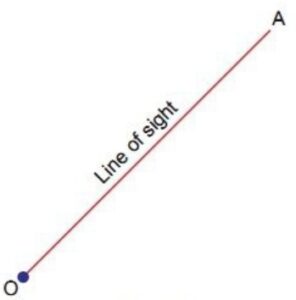
Line of Sight: If an observer eye is at $$O$$ and object under consideration is at point $$A$$ then the line $$O A$$ is called “line of sight”.
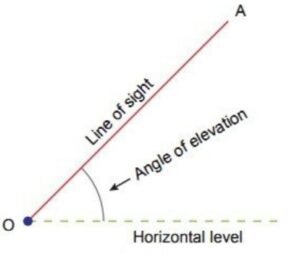
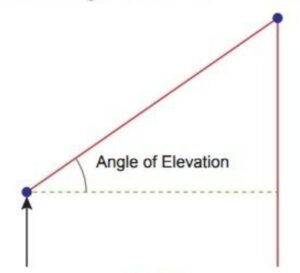
Angle of Elevation: If an observer $$O$$ is looking an object at $$A$$ above the horizontal level (horizontal line passing through observer eye), then the angle formed by the line of sight $$O A$$ with the horizontal is known as “Angle of elevation”.
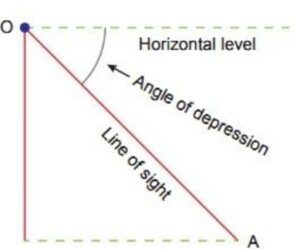
Angle of Depression: If an observer $$O$$ is looking an object at $$A$$ below the horizontal level, then the angle formed by the line of sight $$O A$$ with the horizontal is known as “Angle of depression.”
| IMPORTANT FACTS / TIPS | |
| (i) | Sometimes the angle of elevation or depression is not mentioned in the problem. (a) If the object is at a higher level than the observer, it is the (b) If the observer is at a higher level than the object, it is the |
| (ii) | Sometimes it is not clear which is at a higher level — the object or the observer. (a) If the angle of elevation is given, the object is at a higher level than the observer. (b) If the angle of depression is given, the observer is at a higher level than the object. |
| (iii) | The angles of elevation and depression are always acute angles. |
| (iv) | If the observer has some height, then the angle of elevation or depression is formed at the eye of the observer, as shown in figures. Otherwise, the observer is assumed to be a point. |
(v) If the angle of elevation of Sun decreases then length of shadow of an object increases and vice versa.
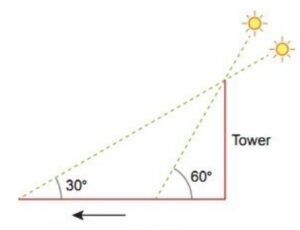
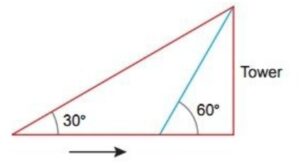
(vi) If the observer moves towards the object like tower, building, hill etc. from a point on the ground, the angle of elevation is increased and vice versa.