
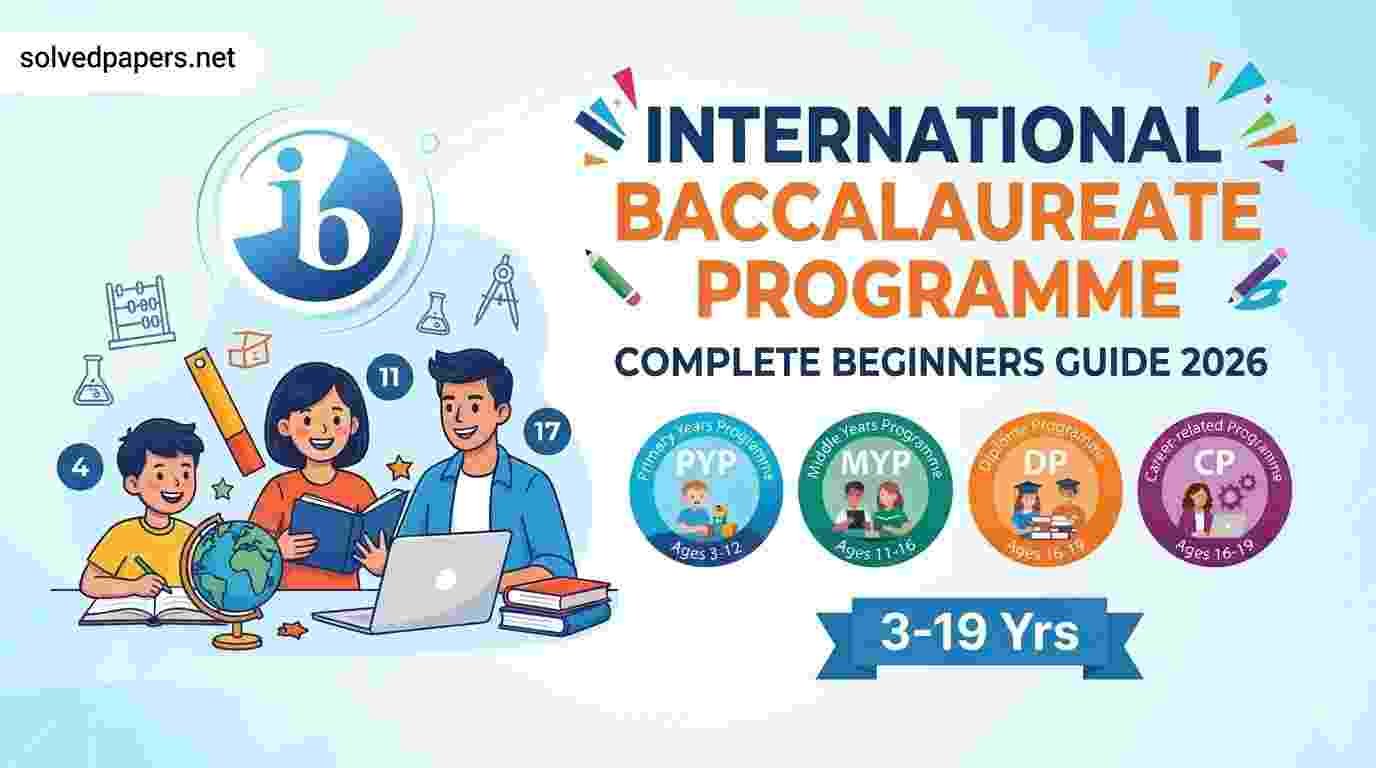
🌍 International Baccalaureate Programme
Complete Beginner’s Guide · 2026
🎓 3–19 yrs🌏 15
👋 What is International Baccalaureate Programme (IB)?
IB stands for International Baccalaureate. It is a
world-famous education programme used in over 5,400 schools across
158 countries. More than one million students
study IB worldwide.
Unlike traditional systems that focus on memorising facts, IB teaches students
how to think, ask questions, and
understand different cultures.
💡 Why millions of parents search for IB – Because IB graduates
get into the best universities (Harvard, Oxford, Cambridge, MIT,
NUS, etc.) and develop skills that top employers love: critical thinking,
communication, research, and global awareness.
📖 Who should read this guide?
✅ Students hearing about IB for the first time
✅ Parents comparing school boards
✅ Teachers & counsellors
✅ Anyone applying to international schools
📌 What is the International Baccalaureate?
- Full form: International Baccalaureate® (IB)
- Definition: A non‑profit educational foundation that offers
four challenging programmes for students aged 3 to 19.
It develops academic, personal, emotional and social skills. - Founded: 1968 in Geneva, Switzerland
- Founder: A group of international educators (led by
Alec Peterson, first Director General) - Mission: “To create a better and more peaceful world through
intercultural understanding and respect. - Headquarters: Geneva, Switzerland
- Global recognition: Accepted by thousands of universities
in over 100 countries - IB World Schools: 5,400+
- Students: 1+ million
- Countries: 158
| Aspect | Detail |
|---|---|
| Full Name | International Baccalaureate® |
| Founded | 1968, Geneva, Switzerland |
| Type | Non‑profit educational foundation |
| Age Range | 3 – 19 years |
| Programmes | PYP · MYP · DP · CP |
| IB World Schools | 5,400+ |
| Students | 1+ million |
| Countries | 158 |
| Headquarters | Geneva, Switzerland |
🕰️ Why Was IB Created?
In the 1960s, international schools were growing fast. But each school used a
different national system – British, American, French, etc. Students moving
between countries found it hard to continue their education.
A group of educators in Geneva asked: “Why not create one curriculum that
works everywhere?” So they designed the IB Diploma Programme
in 1968. Their goal was a curriculum that:
- Is accepted by universities worldwide
- Teaches critical thinking, not just memorisation
- Builds international understanding and peace
📌 Did You Know? The IB was originally created for the
children of diplomats and UN staff who moved countries often.
🧠 IB Philosophy
IB is not just about what you learn – it is about how
you learn.
Students ask questions and investigate, rather than just receiving facts.Example: Instead of reading about rainforests, students research why they are disappearing.
Learning around “big ideas” (like change, systems, perspective) that
connect different subjects.
Understanding and respecting cultures, perspectives, and global issues.Example: Studying a historical event from multiple countries’ viewpoints.
Analysing information, questioning sources, and forming your own reasoned
conclusions.
IB aims to create students who love learning – not just for
exams, but for life.
🌟 IB Learner Profile
The IB Learner Profile is a list of 10 attributes
that every IB school tries to develop in students in. These are not just
academic skills – they are life skills.
Curious – they ask “why?” and investigate.📌 Example: A student researching ocean pollution for a project.
They explore deep knowledge across subjects.📌 Example: Connecting geography, economics and history to understand global trade.
They analyse problems carefully.📌 Example: Evaluating different solutions to a maths problem before choosing one.
They express ideas clearly and listen well.📌 Example: Presenting a group project confidently and answering questions.
Honest, fair, and responsible.📌 Example: Admitting a mistake instead of blaming someone else.
They respect different cultures and views.📌 Example: Learning about a festival from another country and appreciating it.
They show empathy and kindness.📌 Example: Helping a new classmate feel welcome.
They try new things, even when scared.📌 Example: Performing on stage for the first time.
They manage academics, sports, and rest.📌 Example: Studying hard but also playing football and getting enough sleep.
They think about their own learning.📌 Example: After a test, thinking: “What could I have done better?”
they are a way of life that IB students develop over many years.
📚 Four IB Programmes
The IB offers four programmes for different age groups[reference:38].
They form a continuum – students can move from one to the next.
🧒 PYP – Primary Years Programme (Ages 3–12)
Curriculum: Transdisciplinary, inquiry-based. Students explore
“Units of Inquiry” that combine maths, science, language, and
social studies.
- Key features: Student‑centred, conceptual understanding,
action, and international‑mindedness. - Assessment: Teacher observations, portfolios, and the
PYP Exhibition – a final collaborative project. - Skills developed: Curiosity, communication, collaboration,
research. - Advantages: Builds a strong foundation for lifelong learning;
children learn to ask questions, not just memorise.
through inquiry; afternoon – science/social studies, arts, PE.
🧑 MYP – Middle Years Programme (Ages 11–16)
Curriculum: 8 subject groups:
Language & Literature, Language Acquisition, Individuals & Societies,
Sciences, Mathematics, Arts, Physical & Health Education, Design.
At least 50 hours per subject per year.
- Key features: Conceptual understanding, global contexts,
approaches to learning (ATL), service as action. - Assessment: Criterion‑based (four criteria per subject,
scored 0–8, converted to 1–7). Also a Personal Project
in the final year. - Skills developed: Critical thinking, research, self‑management,
communication. - Advantages: Bridges primary and diploma; students connect
learning to real‑world issues.
interdisciplinary unit per year; community service integrated.
🎓 DP – Diploma Programme (Ages 16–19)
The most famous IB programme. A rigorous two‑year
pre‑university course.
Curriculum: 6 subject groups + DP Core (TOK,
EE, CAS).
- Subjects: Group 1 (Language & Literature), Group 2
(Language Acquisition), Group 3 (Individuals & Societies), Group 4
(Sciences), Group 5 (Mathematics), Group 6 (Arts). - HL vs SL: Students take 3 or 4 subjects at Higher
Level (240 teaching hours) and the rest at Standard Level
(150 hours). - Assessment: External exams + Internal Assessment (IA)
– coursework, oral work, labs. Graded 1–7 per subject. - Core components: Theory of Knowledge (TOK), Extended
Essay (EE), Creativity‑Activity‑Service (CAS). - Maximum score: 45 (6 subjects × 7 = 42 + up to 3 bonus
points from TOK/EE).
classes; EE supervision; CAS activities after school.
💼 CP – Career‑related Programme (Ages 16–19)
For students who want a mix of academic study and career skills.
Launched in 2014.
Structure: At least 2 DP courses + a
career‑related study + the CP Core.
- CP Core: Personal & Professional Skills, Reflective
Project, Language & Cultural Studies, Service Learning. - Who is it for? Students interested in applied
learning – business, IT, engineering, healthcare, etc. - Advantages: Prepares for university, apprenticeships, or
direct employment.
📖 IB Diploma Programme (DP) – In Depth
The DP is the flagship of IB. It is a two‑year
course for students aged 16–19.
📌 Six Subject Groups
- Group 1: Studies in Language and Literature (e.g., English A)
- Group 2: Language Acquisition (e.g., French B, Spanish ab initio)
- Group 3: Individuals and Societies (e.g., History, Economics, Psychology, Business Management)
- Group 4: Sciences (e.g., Biology, Chemistry, Physics, Computer Science, ESS)
- Group 5: Mathematics (AA or AI, SL or HL)
- Group 6: The Arts (e.g., Visual Arts, Music, Theatre) – or a second subject from Groups 1–4
📌 Higher Level (HL) vs Standard Level (SL)
- HL: 240 teaching hours – deeper, more content
- SL: 150 teaching hours – broad but less dept
- Students take 3–4 HL and the rest SL
- Both are graded on the same 1–7 scale
📌 Example subject combination (Science student):
HL: Biology, Chemistry, Mathematics AA
SL: English A, Spanish B, Economics
📌 Mathematics Options
Focus: pure maths, calculus, algebra,
theory.
✅ Best for: Engineering, Physics,
Maths, Computer Science[reference:75]
Focus: statistics, modelling, real‑world
applications.
✅ Best for: Economics, Psychology,
Biology, Business[reference:77]
Choose based on your university course and strengths.
⭐ Core Components: TOK · EE · CAS
Every DP student must complete the DP Core – three special
components that make IB unique.
🧠 Theory of Knowledge (TOK)
TOK asks: “How do we know what we know?”
- Students explore ways of knowing (emotion, reason,
language, sense perception) and areas of knowledge
(science, history, arts, etc.) - Assessment: TOK essay (1600 words) + TOK exhibition
- Example question: “Can we trust our senses to give us
truth?”
📝 Extended Essay (EE)
A 4,000‑word independent research paper on a topic of the
student’s choice.
- Develops research, writing, and critical thinking skills
- Example: “The impact of social media on teenage mental
health in urban India”
🏃 Creativity · Activity · Service (CAS)
Students complete real‑world experiences outside the
classroom.
- Creativity: Arts, music, drama, design
- Activity: Sports, fitness, outdoor adventures
- Service: Volunteering, community projects
- Example: Teaching English to underprivileged children
(Service) + playing football (Activity) + creating a school magazine
(Creativity)
for the diploma.
📊 Assessment System
IB uses a balanced assessment approach: external
(exams) and internal (coursework).
- External Assessment: Written exams (essays, structured
problems, case studies) – marked by IB examiners - Internal Assessment (IA): Oral work, lab reports, fieldwork,
investigations – marked by teachers and moderated by IB - Grading: Each subject gets a score from 1 to 7,
with 7 being highest - Bonus points: Up to 3 points from TOK and EE
combined - Maximum total: 45 points (6 × 7 = 42 + 3 bonus)
- Passing: Minimum 24 points + all core
requirements met
| Grade | Description |
|---|---|
| 7 | Excellent – deep understanding and application |
| 6 | Very good – strong knowledge and skills |
| 5 | Good – solid understanding |
| 4 | Satisfactory – acceptable level |
| 3 | Basic – some understanding |
| 2 | Limited – major gaps |
| 1 | Minimal – very little understanding |
to ensure consistency worldwide.
🔬 IB Sciences & 🌐 Languages
Sciences (Group 4)
- Physics – laws of nature, mechanics, electricity
- Chemistry – atoms, reactions, organic chemistry
- Biology – cells, genetics, ecology, human body
- Computer Science – programming, algorithms, systems
- ESS – Environmental Systems & Societies (interdisciplinary)
All available at HL & SL.
Languages (Groups 1 & 2)
- Language A – mother tongue / native level (literature, language & literature)
- Language B – second language (French, Spanish, German, etc.)
- Language ab initio – for beginners (SL only)
Bilingual diploma available if you two Language A courses or a Language A in a different language.
🏛️ Universities Accepting IB
The IB diploma is recognised by thousands of universities in
more than 100 countries. Here is a snapshot:
Harvard, MIT, Stanford, Yale, Princeton, UC Berkeley
Oxford, Cambridge, Imperial, LSE, UCL
U of Toronto, UBC, McGill, McMaster
ANU, Melbourne, Sydney, UNSW
LMU Munich, Heidelberg, TU Berlin
Sciences Po, Sorbonne, HEC Paris
NUS, NTU, SMU
Ashoka, JGU, BITS Pilani, Azim Premji
NYU Abu Dhabi, UAEU, AUS
for IB HL subjects with scores of 5 or higher.
⚖️ IB vs CBSE vs IGCSE vs ICSE
🇮🇳 IB vs CBSE
| Aspect | IB | CBSE |
| Approach | Inquiry‑based, research | Structured, exam‑focused |
| Assessment | Coursework + exams | Year‑end board exams |
| Global recognition | Worldwide | India + some global |
| Cost | Higher | Lower |
🌍 IB vs Cambridge IGCSE
| Aspect | IB | IGCSE |
| Breadth | 6 subjects + core | Flexible, fewer subjects |
| Depth | HL subjects are deep | Focused subject knowledge |
| Assessment style | Continuous + final | Mostly final exams |
| Age range | 3–19 (continuum) | 14–16 (IGCSE) |
🇮🇳 IB vs ICSE
| Aspect | IB | ICSE |
| Teaching style | Inquiry‑driven | Language‑rich, detailed |
| Global acceptance | Very high | Moderate |
| Focus | Holistic development | Academic rigou |
✅ Advantages & ⚠️ Challenges
✅ Advantages (30+)
- 🌏 Globally recognised
- 🧠 Develops critical thinking
- 📚 Inquiry‑based learning
- 🤝 International mindedness
- 🎓 University credit (US)
- 📝 Research skills (EE)
- 💬 Communication skills
- 🌱 Holistic development
- 🧩 Interdisciplinary learning
- ❤️ Service & empathy (CAS)
- 📊 Balanced assessment
- 🌐 Language skills
- 🧘 Self‑management
- 🤔 Reflective thinking
- 🏅 Prepares for top universities
- 💼 Career readiness (CP)
- 🧪 Practical skills (labs, IAs)
- 📖 Love for learning
- 🧑🤝🧑 Collaboration
- ⚖️ Ethical understanding
- 🔍 Research skills
- 🎨 Creativity
- 🏃 Physical wellbeing
- 🧭 Global perspective
- 📈 University scholarships
- 🧬 STEM focus (MYP)
- 📚 Wide subject choice
- 🧩 Concept‑based learning
- 📝 Extended writing skills
- 🧠 Metacognition
- 🌱 Lifelong learning
⚠️ Challenges
- 💰 High cost (tuition + exams)
- 📚 Heavy workload
- 📝 Continuous assessment pressure
- 🧠 Requires self‑discipline
- 🏫 Limited schools in some areas
- 📖 Not aligned to Indian entrance exams (JEE, NEET)
- 🌏 May feel abstract for some students
- 🧑🏫 Requires trained teachers
- ⏳ Two‑year commitment (DP)
- 📊 Grade boundaries can be stressful
💰 Cost of IB
IB can be expensive, but costs vary greatly by country and school.
- Tuition fees: The biggest cost. Varies from school to school.
- Examination fees: Paid to the IB – approx. USD 450
per subject (estimate) - Books & materials: Approx. USD 200–500 per year
- Miscellaneous: Uniforms, trips, CAS activities
₹8–20 lakh/year (approx.)
AED 40,000–90,000/year
SGD 33,000–55,000/year
£15,000–35,000/year
USD 20,000–50,000/year
for IB students.
📝 Admission Process & 🎓 Scholarships
Admission Process (Step‑by‑Step)
- Research – Find IB schools near you.
- Check eligibility – Age, previous grades, language proficiency.
- Apply – Submit application form, transcripts, recommendation letters.
- Entrance test / interview – Many schools have assessments.
- Offer – Receive admission offer.
- Enrol – Pay fees and start!
Scholarships
- 🏅 Merit‑based – for outstanding academic performance
- 💰 Need‑based – financial aid for families
- 🌍 University scholarships – many universities offer scholarships specifically for IB diploma holders
- 🏫 School scholarships – check with individual IB schools
🏫 Best IB Schools (Examples)
💼 Career Opportunities
IB develops transferable skills that are valued in every career.
- 🔧 Engineering – AA Maths HL + Physics HL
- 🩺 Medicine – Biology HL + Chemistry HL
- 📈 Business – Economics HL + Business Management
- ⚖️ Law – English A HL + History HL
- 💻 Computer Science – AA Maths HL + Computer Science
- 🔬 Research – Sciences + EE + TOK
- 📚 Humanities – Language A + Individuals & Societies
🧨 Common Myths (Debunked)
❓ Frequently Asked Questions
1. What does IB stand for?
International Baccalaureate.
2. What age is IB for?
3 to 19 years, across four programmes.
3. How many subjects in IB DP?
6 subjects + 3 core components (TOK, EE, CAS).
4. What is a good IB score?
30+ is good, 38+ is excellent for top universities.
5. Is IB harder than A‑Levels?
IB is broader; A‑Levels are deeper. Different challenges.
6. Can I do IB online?
Some schools offer online IB courses, but the full diploma is usually in‑person.
7. How much does IB cost in India?
Approx. ₹8–20 lakh per year.
8. Does Harvard accept IB?
Yes, Harvard and all Ivy League universities accept IB.
9. What is the IB learner profile?
10 attributes that IB students develop: inquirers, thinkers, communicators, etc.
10. What is CAS in IB?
Creativity, Activity, Service – experiential learning outside the classroom.
11. What is the Extended Essay?
A 4,000‑word independent research paper.
12. What is Theory of Knowledge?
A course that explores “how do we know what we know?”
13. How is IB graded?
Each subject is scored 1–7. Total = 6 subjects + up to 3 bonus points = max 45.
14. What is the difference between HL and SL?
HL = 240 hours, more depth; SL = 150 hours.
15. Can I take 4 HL subjects?
Yes, maximum 4 HL.
16. What is IB PYP?
Primary Years Programme for ages 3–12.
17. What is IB MYP?
Middle Years Programme for ages 11–16.
18. What is IB CP?
Career‑related Programme for ages 16–19.
19. Is IB better than CBSE?
Depends on your goals. IB is better for global universities; CBSE for Indian exams.
20. Is IB better than IGCSE?
IB is broader and more holistic; IGCSE is more subject‑focused.
21. Does IB have a syllabus?
Yes, each subject has a detailed syllabus published by the IB.
22. How long is the IB DP?
Two years (Grades 11–12).
23. Can I switch from CBSE to IB?
Yes, many students do after Grade 10.
24. What are Internal Assessments?
Coursework marked by teachers – e.g., lab reports, oral work.
25. What are External Assessments?
Final written exams marked by IB examiners.
26. What is a bilingual diploma?
Awarded when a student takes two Language A courses or completes a subject in a different language.
27. How many IB schools are there?
Over 5,400 worldwide.
28. Where is IB headquarters?
Geneva, Switzerland.
29. When was IB founded?
1968.
30. What is the IB mission?
“To create a better and more peaceful world through intercultural understanding and respect.”
31. What are the 6 subject groups in DP?
Language & Literature, Language Acquisition, Individuals & Societies, Sciences, Mathematics, Arts.
32. What is the IB passing score?
Minimum 24 points + all core requirements met.
33. Can I take IB without doing the full diploma?
Yes, you can take individual IB courses (subject certificates).
34. What are predicted grades?
Teachers’ estimates of final grades, used for university applications.
35. What is a re‑mark?
An enquiry upon results – a senior examiner re‑marks the paper.
36. What are grade boundaries?
The score ranges for each grade (1–7), set after each exam session.
37. What is the MYP Personal Project?
A year‑long independent project in the final year of MYP.
38. What is the PYP Exhibition?
A collaborative inquiry project in the final year of PYP.
39. What are ATL skills?
Approaches to Learning – thinking, research, communication, social, self‑management skills.
40. What is service as action in MYP?
Community service integrated into the curriculum.
41. What is the CP Reflective Project?
A research project on a career‑related topic.
42. Does IB have digital exams?
Yes, starting 2026 with a small number of subjects.
43. What is the difference between AA and AI Maths?
AA = pure/theoretical; AI = applied/statistics.
44. Which IB Maths should I choose for engineering?
Mathematics AA HL.
45. Which IB Maths for economics?
Mathematics AI HL or SL.
46. What is Language ab initio?
A beginner’s language course (SL only).
47. What is the IB Diploma Programme?
A two‑year pre‑university programme for ages 16–19.
48. What is an IB World School?
A school authorised to offer one or more IB programmes.
49. Can I get a scholarship for IB?
Yes, merit‑based and need‑based scholarships are available.
50. What is the IB career‑related programme?
A programme combining DP courses with career‑related learning.
51. Is IB recognised in Germany?
Yes, German universities accept IB with specific conditions.
52. Is IB recognised in Singapore?
Yes, NUS and NTU accept IB.
53. What is the IB philosophy?
Inquiry‑based, concept‑based, international‑minded, critical thinking, lifelong learning.
54. What are the benefits of IB?
Global recognition, critical thinking, research skills, holistic development, etc.
55. What are the challenges of IB?
High cost, heavy workload, continuous assessment, limited schools.
56. Does IB have sports?
Yes, as part of CAS (Activity) and PE in MYP/PYP.
57. What is the IB curriculum framework?
A structure that emphasises inquiry, conceptual understanding, and international mindedness.
58. What is the IB continuum?
The four programmes (PYP, MYP, DP, CP) that flow from one to the next.
59. Is IB a British curriculum?
No, it is Swiss‑based and international.
60. Is IB an American curriculum?
No, it is international, not tied to any country.
61. How many students take IB?
Over 1 million.
62. What is the IB MYP age range?
11–16 years.
63. What is the IB PYP age range?
3–12 years.
64. What is the IB DP age range?
16–19 years.
65. What is the IB CP age range?
16–19 years.
66. Can I take IB if I am not a good student?
Yes, but you need to be willing to work hard and ask for help.
67. What is the IB code of conduct?
Academic integrity, honesty, and fairness are central.
68. What is the difference between IB and AP?
IB is a holistic diploma programme; AP is individual US‑based exams.
69. What is the difference between IB and A‑Levels?
IB is broader (6 subjects + core); A‑Levels are deeper (3‑4 subjects).
70. What is the IB mission statement?
“To develop inquiring, knowledgeable and caring young people who help to create a better and more peaceful world.”
71. What are the IB approaches to teaching?
Inquiry‑based, concept‑driven, collaborative, differentiated, and assessment‑focused.
72. Is IB good for ADHD students?
Many IB schools offer support and accommodations. It can be a good fit with the right support.
73. What is the IB school fee in Singapore?
SGD 33,000–55,000 per year.
74. What is the IB exam fee?
Approx. USD 450 per subject (estimate).
75. How to prepare for IB?
Start early, practice past papers, manage time, and balance studies with CAS.
76. What is the best IB school in the world?
There is no single “best” – UWC, Sevenoaks, and many others are highly regarded.
📖 Glossary of IB Terms
AA – Analysis & Approaches (Maths)
AI – Applications & Interpretation (Maths)
CAS – Creativity, Activity, Service
CP – Career‑related Programme
DP – Diploma Programme
EE – Extended Essay
HL – Higher Level
IA – Internal Assessment
IB – International Baccalaureate
MYP – Middle Years Programme
PYP – Primary Years Programme
SL – Standard Level
TOK – Theory of Knowledge
ATL – Approaches to Learning[reference:174]
UCC – University & Careers Counsellor
IB World School – Authorised IB school
Transdisciplinary – Learning across subjects
Inquiry‑based – Learning through questioning
International‑mindedness – Global perspective
Grade boundaries – Score ranges for each grade
🎯 Final Summary
✅ Key Takeaways
- IB is a global education for ages 3–19.
- Four programmes: PYP, MYP, DP, CP.
- Develops critical thinking, research, and global awareness.
- Accepted by top universities worldwide.
👤 Who should choose IB?
- Students who love asking questions
- Those aiming for global universities
- Students who enjoy research and projects
- Families who value holistic education
🚫 Who should not choose IB?
- Students who prefer memorisation over inquiry
- Those focused only on Indian entrance exams (JEE, NEET)
- Families on a very tight budget
- Students who struggle with independent work
💡 Final recommendation: If you want a world‑class,
future‑focused education that develops thinking, research,
and global citizenship – and you are ready for hard work
and growth – the IB is an excellent choice.
All information fact‑checked and updated for 2026.