CHAPTER 3
PAIR OF LINEAR EQUATIONS IN TWO VARIABLES
| |
|---|---|
| 1. | Each solution (x, y) of a linear equation ax + by + c = 0 represents a point on the line. |
| 2. | A pair of linear equations in two variables x, y is:
|
| 3. | a₁x + b₁y + c₁ = 0 ; a₂x + b₂y + c₂ = 0 |
| Graphical Representation of Two Lines | |
|---|---|
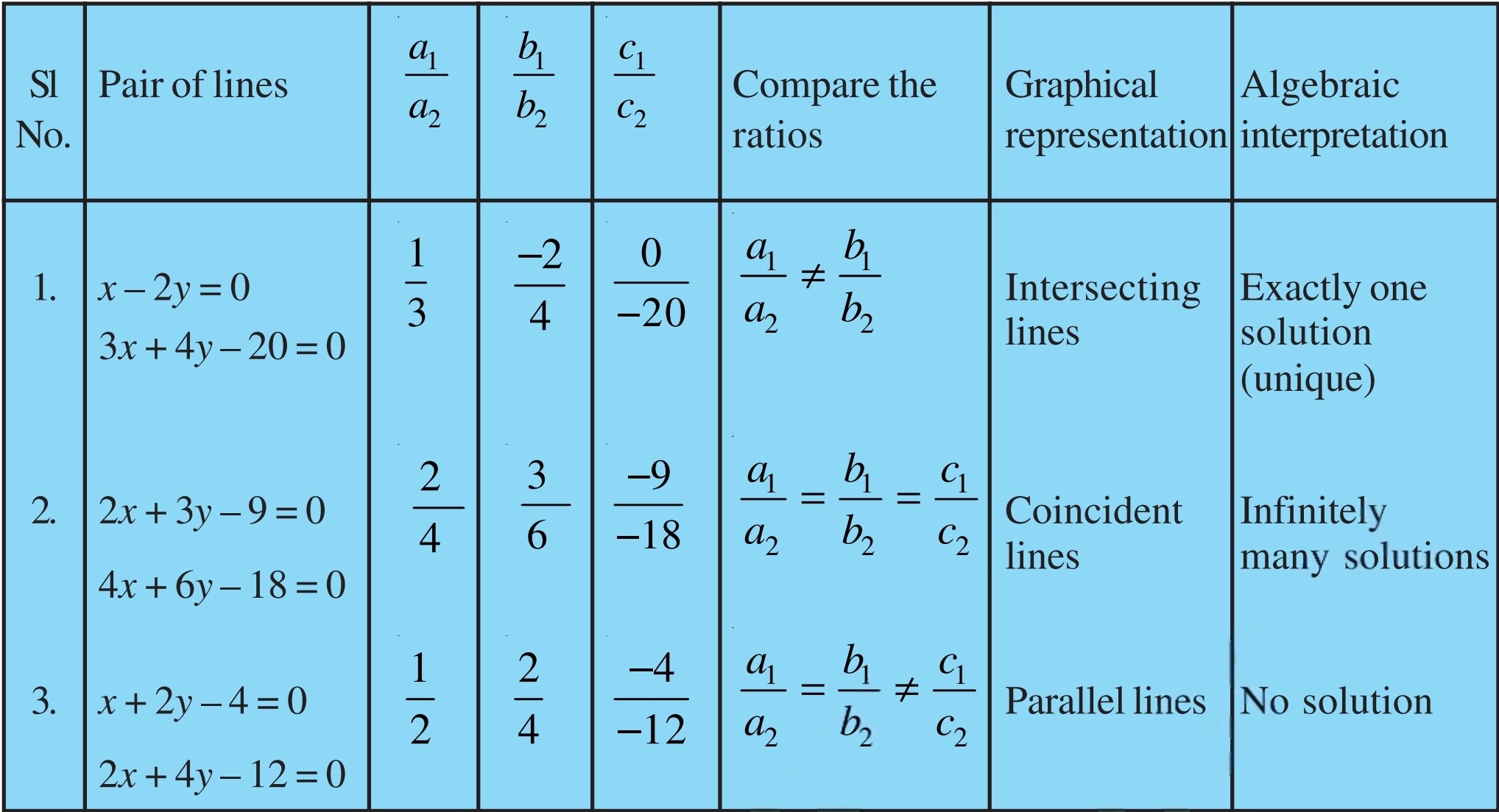 | |
| a) | Intersecting lines if a₁/a₂ ≠ b₁/b₂ |
| b) | Parallel lines if a₁/a₂ = b₁/b₂ ≠ c₁/c₂ |
| c) | Coincident lines if a₁/a₂ = b₁/b₂ = c₁/c₂ (Dependent linear equations) |
| Nature of Solutions | |
|---|---|
| 4(a) | Consistent and unique solution if a₁/a₂ ≠ b₁/b₂ |
| 4(b) | Consistent and infinite solutions if a₁/a₂ = b₁/b₂ = c₁/c₂ |
| 4(c) | Inconsistent and no solution if a₁/a₂ = b₁/b₂ ≠ c₁/c₂ |
| 5. Certain Basic Facts | |
|---|---|
(i) x = 0 is the equation of y-axis and y = 0 is the equation of x-axis (ii) x = a represents a line parallel to the y-axis (iii) y = b represents a line parallel to the x-axis (iv) Distance = Speed × Time (v) If unit digit = x and tens digit = y, then the number is 10y + x |
| 6. Special Case | |
|---|---|
Consider the equations:
The coefficients of x and y are interchanged. |