📌 SECTION C
Questions 27 to 34 · Internal choice in Q29 & Q33
📍 Section Formula
Find coordinates of points dividing the line segment joining A(-2,2) and B(2,8) into four equal parts.
🔍 VIEW ANSWER
✅ Points: (-1, 3.5), (0,5), (1, 6.5)
Points divide in ratios 1:3, 1:1, 3:1.
\(X = \left(\frac{1(2)+3(-2)}{4}, \frac{1(8)+3(2)}{4}\right)\)\( = \left(\frac{2-6}{4}, \frac{8+6}{4}\right)\)\( = (-1, 3.5)\)
\(Y = \left(\frac{2-2}{2}, \frac{2+8}{2}\right)\)\( = (0,5)\)
\(Z = \left(\frac{3(2)+1(-2)}{4}, \frac{3(8)+1(2)}{4}\right)\)\( = \left(\frac{6-2}{4}, \frac{24+2}{4}\right)\)\( = (1, 6.5)\).
⚪ Area of Quadrant
Find area of a quadrant of a circle whose circumference is 22 cm.
🔍 VIEW ANSWER
✅ Area = \(\frac{77}{8}\) cm²
\(2\pi r = 22\) \(⇒2\times\frac{22}{7}\times r = 22\) \(⇒r = \frac{7}{2} cm.\)
Area of quadrant = \(\frac{1}{4}\pi r^2\)\( = \frac{1}{4}\times\frac{22}{7}\times\frac{49}{4}\)\( = \frac{22\times49}{112} \)\(= \frac{1078}{112}\)\( = \frac{77}{8} cm².\)
🔵 Circle Geometry
Prove that opposite sides of a quadrilateral circumscribing a circle subtend supplementary angles at the centre.
OR Two tangents TP and TQ are drawn to a circle with centre O from external point T. Prove \(\angle PTQ = 2\angle OPQ\).
🔍 VIEW ANSWER
✅ Proof:
Main: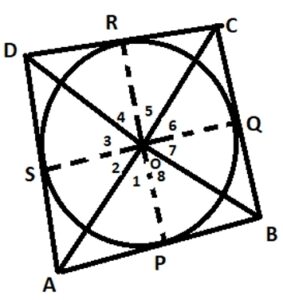
Using tangents from external point, we get congruent triangles \(⇒\angle1=\angle2, \angle3\)\(=\angle4, \angle5\)\(=\angle6, \angle7\)\(=\angle8\).
Sum around centre = 360° ⇒ \(2(\angle1+\angle4+\angle5+\angle8)=360°\) ⇒ \(\angle AOB+\angle COD=180°\). Similarly \(\angle BOC+\angle AOD=180°\).
OR: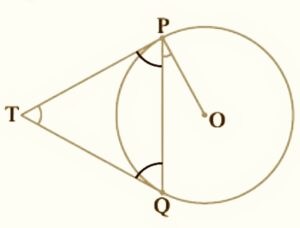
TP = TQ ⇒ \(\angle TQP = \angle TPQ\). In \(\triangle TPQ\), \(2\angle TPQ + \angle PTQ = 180°\). Also \(\angle OPT = 90°\) ⇒ \(\angle OPQ = 90° – \angle TPQ\) ⇒ \(2\angle OPQ = 180° – 2\angle TPQ\) ⇒ \(\angle PTQ = 2\angle OPQ\).
🔷 Similar Triangles
E is a point on side AD produced of parallelogram ABCD and BF intersects CD at F. Show that \(\triangle ABE \sim \triangle CFB\).
🔍 VIEW ANSWER
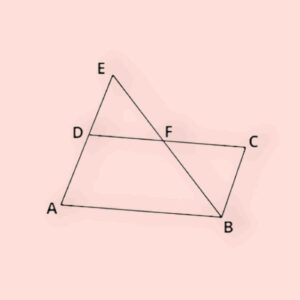
In parallelogram ABCD, AB ∥ CD ⇒ AB ∥ CF.
\(\angle BAE = \angle FCB\) (opposite angles equal).
\(\angle AEB = \angle FBC\) (AE ∥ BC, transversal EB).
∴ \(\triangle ABE \sim \triangle CFB\) (AA similarity).
📐 Trapezium Proof
Diagonals of quadrilateral ABCD intersect at O such that \(\frac{AO}{BO} = \frac{CO}{DO}\). Show ABCD is a trapezium.
🔍 VIEW ANSWER
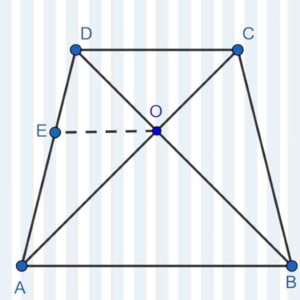
Draw EO ∥ DC meeting AD at E. In ΔDAB, EO ∥ AB ⇒ \(\frac{DE}{EA} = \frac{DO}{OB}\).
Given \(\frac{AO}{BO} = \frac{CO}{DO}\) ⇒ \(\frac{DO}{OB} = \frac{CO}{AO}\).
Hence \(\frac{DE}{EA} = \frac{CO}{AO}\) ⇒ EO ∥ DC (converse of BPT).
So AB ∥ EO ∥ DC ⇒ AB ∥ CD ⇒ ABCD is a trapezium.
🔢 Irrational Numbers
Prove that \(6+\sqrt{2}\) is irrational.
🔍 VIEW ANSWER
Assume \(6+\sqrt{2} = \frac{a}{b}\) (a,b coprime integers, b≠0).
⇒ \(\sqrt{2} = \frac{a}{b} – 6 = \frac{a-6b}{b}\).
RHS is rational, but \(\sqrt{2}\) is irrational ⇒ contradiction.
∴ \(6+\sqrt{2}\) is irrational.
📈 Arithmetic Progression
An AP of 50 terms: 3rd term = 12, last term = 106. Find 29th term.
OR Find sum of first 15 multiples of 8.
🔍 VIEW ANSWER
✅ 29th term = 64 or OR sum = 960
Main: \(a_3 = a+2d = 12\), \(a_{50} = a+49d = 106\). Subtract: \(47d = 94\) ⇒ \(d=2\), \(a=8\). Then \(a_{29}=8+28×2=64\).
OR: Multiples of 8: 8,16,…,120. \(Sum = \frac{15}{2}(8+120)\)\( = \frac{15}{2}×128\)\( = 15×64 = 960\).
🎲 Probability
One card drawn from a well-shuffled deck of 52 cards. Find probability of getting: (i) a face card (ii) a spade.
🔍 VIEW ANSWER
✅ (i) \(\frac{12}{52} = \frac{3}{13}\) (ii) \(\frac{13}{52} = \frac{1}{4}\)
Total cards = 52.
Face cards = 12 (4 Jacks, 4 Queens, 4 Kings).
Spades = 13.
✅ JKBOSE Class 10 2024 · Set X · Section C